
Author: Evan Shelley

  • The Ultimate Guide to Truck Parking Business Insurance

    The Ultimate Guide to Truck Parking Business Insurance

    truck parking lot owner

    As rewarding and profitable as running a truck parking business can be, it’s also surprisingly risky. Commercial truck parking lots are exposed to numerous liability hazards, such as cargo theft, truck damage, or on-premise accidents. 

    If anything happens at your parking lot, whether you believe it’s your fault or not, you can safely bet there will be a lawsuit shortly coming your way. The best way to protect yourself from the financial damage it can cause is to invest in proper truck parking business insurance. 

    But how much does such insurance cost? What types of policies are there, and what do they cover? And finally, how do you choose the right truck parking lot insurance? We’ll answer these and more in the following guide. 

    How Much Is Truck Parking Lot Insurance?

    As much as we’d like to provide you with a specific figure, there’s no one-size-fits-all answer to the cost of truck parking business insurance. 

    The truth is that the final cost of your premiums will depend on numerous factors, including: 

    • Size of your business: When it comes to truck parking insurance, size matters. Larger operations with more parking spaces and trucks will generally pay more, so be aware of that. 
    • Location: Where your parking lot is located will also greatly affect the price of your insurance. Urban areas, for instance, tend to have higher insurance rates than rural ones.
    • Crime rates in your area: The rule here is simple – higher crime areas lead to higher premiums. 
    • Types of coverage you choose: As we’ll cover in a moment, there are several types of insurance policies you can choose from. Those that are more comprehensive will naturally cost more. 

    All these can greatly impact your insurance premiums, making it difficult to calculate the overall specified cost of adding an insurance policy to your truck parking lot business plan

    Common Types of Truck Parking Business Insurance

    You have several types of truck parking lot insurance to choose from. These coverages can cover anything from damages to vehicles and on-premise injuries to cargo theft or even cyber crimes. When it comes to the most common types of commercial truck parking insurance policies, these include:

    • General Liability Insurance: This policy covers a wide range of incidents, including bodily injury, property damage, and personal injury, that occur on your parking lot, protecting you against claims made by truckers or trucking companies.
    • Commercial Property Insurance: This protects the physical assets of your parking lot, including the land, parking structures, office buildings, and any other property you own, covering damages from fires, storms, theft, and vandalism.
    • Garagekeepers Liability Insurance: Specifically important for businesses that store or service vehicles, garagekeepers liability insurance provides protection if a truck is damaged while it’s parked in your lot, under your care. This can cover damages due to events like theft, vandalism, and weather damage.
    • Workers’ Compensation Insurance: If you hire employees, it would be a good idea to include workers’ compensation insurance in your coverage as well. It will cover medical costs and a portion of lost wages for employees who get injured or become ill due to their jobs.
    • Crime Insurance: This is a standard policy that protects against losses related to criminal activities, such as theft by employees, forgery, or fraud.
    • Cyber Liability Insurance: If your truck parking lot business handles sensitive customer information, especially related to payment processing, cyber liability insurance can protect against data breaches and other cyber threats.
    • Business Interruption Insurance: Also known as business income insurance, this type of policy covers the loss of income that your business might suffer after a natural disaster, such as fire, flood, or tornado. It can help pay for ongoing expenses like rent or payroll while your parking lot is closed for repairs.

    Learning about these types of truck parking business insurance is one thing. Another is deciding which one to choose, which leads us to our next question…

    How to Find the Right Insurance for My Truck Parking Lot?

    Given the unique risks associated with parking large vehicles such as semi trucks, including theft, damage, and liability issues, it’s clear that the proper insurance policy is crucial for running a successful truck parking business.  

    Finding the right coverage, however, can get tricky. To make this process less daunting, follow these six simple steps:

    1. Assess Your Risks: Identify the types of risks your parking might be the most exposed to (e.g., theft, damage, natural disasters) and evaluate your assets to understand coverage needs.
    2. Know Insurance Types: Familiarize yourself with essential insurance policies, such as general liability insurance, garagekeeper’s liability insurance, or crime insurance. 
    3. Consult Professionals: Seek advice from insurance brokers or agents with experience in commercial and trucking-related insurance.
    4. Compare Quotes: Obtain multiple quotes for the same levels of coverage and carefully read policies for details on inclusions and exclusions. Compare your options and pick the one that best suits your needs. 
    5. Consider Bundling: Look into bundled packages for potentially lower costs, but ensure they provide adequate coverage.
    6. Review and Adjust Regularly: Conduct annual insurance reviews and adjust coverage as your truck parking business grows or changes.

    By taking a methodical approach to selecting insurance for your semi truck parking lot, you can ensure that you have the right coverage to protect your business against its unique risks. Still, the best idea is to seek professional advice. Working with an experienced insurance agent or broker is your safest bet to make the most informed decision. 

    Minimize Your Truck Parking Business Risks & Losses (and Maximize Your Revenue)

    Investing in insurance can protect your truck parking business against hefty fines and losses. But it won’t make all your liabilities go away. To achieve that, or at least minimize their number, you must invest in proper security measures. 

    This can involve hiring a security company, building a bulky fence, investing in a comprehensive surveillance system, and so on. 

    By keeping your truck parking lot secure, you will not only minimize the risk of something happening, but you will also pay less for your coverage, as you’ll be viewed as a more reliable business in the insurance company’s eyes. 

    It will also help you build trust in the industry and help convince truckers to park their rigs at your parking lot. 

    And to ensure your protected and insured business receives the recognition it deserves, be sure to list it on Truck Parking Club. Become a property member today and watch your investment in security pay off with interest. 

    BECOME A PROPERTY MEMBER

    The information published herein is for general informational purposes only. Truck Parking Club does not make any representations or warranties about the completeness, reliability, legality, and accuracy of this information. Any reliance placed on such material is strictly at the user’s own risk. Truck Parking Club shall not be responsible for any losses or damages incurred in connection with the information published herein.
  • How to Add Your Property to Truck Parking Club?

    How to Add Your Property to Truck Parking Club?

    truck parking lot owner standing in front of parked trucks

    Do you own an industrial yard, operate a truck tow company, manage a truck repair shop, warehouse, or CDL school? Well, have you considered turning your unused space into a bustling semi truck parking lot? 

    If you’re here, the answer is yes. And that’s not surprising, as running a truck parking business can be a goldmine waiting to be tapped. 

    But getting your commercial truck parking lot up and running is one thing. Another is convincing truckers that they should park at your location. Here’s where Truck Parking Club comes in, bridging the gap between truckers in need and spaces that wait to be filled. 

    Learn how to become a member, list your property, and maximize your truck parking business revenue. 

    Why Join Truck Parking Club?

    Becoming a property member at Truck Parking Club offers a multitude of advantages. First and foremost, it allows you to leverage a high-demand business model without the need for extensive marketing. 

    Additionally, it provides the flexibility to scale operations and increase property value, all within a low-maintenance, high-reward framework that supports the trucking community while offering passive income with little ongoing upkeep.

    But Truck Parking Club is not just a listing service; it’s a comprehensive ecosystem designed to monetize your unused space by connecting you with trucker members across the United States seeking reliable space to park their rigs. 

    By becoming a property member, you’re stepping into a role that goes beyond mere income generation – you’re becoming a vital part of a community that ensures the safety and well-being of truckers nationwide.

    How to Add Your Property to Truck Parking Club?

    1. Create Your Account

    To be able to list properties, you will first need to create your free membership account. To do that, simply head to our sign-up page for hosts and follow the instructions. The whole process is mighty straightforward and shouldn’t take you more than several minutes. Once done, you’ll be able to dive into managing your listings and bookings through a user-friendly personal dashboard.

    2. Add Your Listing

    With an account set up, it’s time to add your first listing. To do that, click on the ‘Become a Property Member’ button in the upper right corner of your dashboard. Add the name of your location and provide contact information. You’ll also be asked to provide a detailed address later on. 

    Highlight unique features, such as nearby amenities including Uber services, truck stops, repair shops, or recreational facilities. If your property has specific access information, like a gate code, make sure to include this in the “important information” section to ensure a smooth arrival for truckers after booking.

    Truck Parking Club also offers signage for property members to display, facilitating easy booking for trucker members. You can add a YouTube video to showcase your parking lot. 

    3. Enhancing Your Listing

    A successful listing is all about the details. Specify available amenities – whether it’s 24/7 access, security measures, food options, or nearby lodging. These details not only attract truckers but also assure them of the quality of your parking lot. 

    4. Price Your Listing

    Pricing your space competitively is also vital, as overly high rates may deter bookings. At this stage, you’ll be asked to decide whether to accept daily or monthly bookings and choose how much you want to charge for daily and monthly parking. Our Truck Parking Club property intake team is available to discuss pricing strategies to ensure your listing is both attractive and profitable.

    5. Add the Availability of Your Space

    Use the calendar to add the daily availability. Fill out how many parking spaces are available each day and pick the dates when you would like to not accept any bookings by choosing the day and placing the number of spaces available as 0. 

    6. Managing Your Bookings

    As bookings come in, you’ll be notified through email and text, allowing for real-time management of your space. The booking dashboard offers insights into reservations, payouts, and vehicle information, making it easy to keep track of your space’s utilization.

    7. Add Photos of Your Truck Parking Lot

    Although it’s not required, we highly recommend uploading at least two or three images of your truck parking lot. Be sure to include a high-quality photo of your entrance and most important amenities. Doing so will enhance your trustworthiness, helping attract more traffic to your parking lot. 

    8. Connect Your Stripe Account

    The final step is integrating your Stripe account with Truck Parking Club. This is a quick step, but it’s absolutely essential for smooth and secure financial transactions between property members and trucker members, safeguarding against fraud. 

    Truck Parking Club manages all payment processing and billing, ensuring payouts are swift and hassle-free. We operate on a transparent model, earning only a nominal fee per booking. There are no hidden fees, contracts, or commitments. We only earn money when you do. 

    Once you complete this step, the only thing left is to click on ‘Complete Your Listing.’ We will then immediately publish your location for truckers to see. 

    Become the Future of Truck Parking

    Joining Truck Parking Club as a property member is more than a business venture; it’s a partnership to create a safer, more efficient world for truckers. 

    Your underutilized space can become a haven for drivers, offering them a secure place to rest, and in return, you gain a steady stream of income and the satisfaction of contributing to a critical need in the trucking industry.

    So, why wait? Start your hosting journey with Truck Parking Club today and see how your spare space can make a significant impact.

    BECOME A PROPERTY MEMBER 

    The information published herein is for general informational purposes only. Truck Parking Club does not make any representations or warranties about the completeness, reliability, legality, and accuracy of this information. Any reliance placed on such material is strictly at the user’s own risk. Truck Parking Club shall not be responsible for any losses or damages incurred in connection with the information published herein.
  • How Truck Parking Club Revolutionizes the Truck Parking Industry

    How Truck Parking Club Revolutionizes the Truck Parking Industry

    We have an interesting track record in business here at Truck Parking Club. But not for the reasons you might expect. You might think that our background is in the transport and cargo industry. Having created one of the most popular apps in the area of trucking, you would be forgiven for assuming we are seasoned transport pros. The truth is a little different, however. 

    Before creating our revolutionary truck parking app, our co-founder, Evan Shelly, enjoyed a successful career in commercial restate. He probably wouldn’t agree with that statement, though. 

    If you were to ask him directly what his background in business has always been – his area of specialty, so to speak – he would almost certainly tell you he was a specialist in solving problems

    Evans’s entire career has been built around the notion of solving problems in whatever industry or sector that manifests. This skill is evident in the creation of Truck Parking Club, born from his observation of a major issue in the industry: the widespread shortage of truck parking spaces in America.

    Pre-Truck Parking Club

    Evan Shelley’s entry into the truck parking sector was an unexpected shift from his initial career in real estate, in which he enjoyed credible success. Starting soon after college, Evan ventured into the world of commercial real estate by house flipping, initially, before progressively moving on to larger projects. 

    His venture into land deals marked a huge turning point, however. It was here that Evan first identified a growing problem with truck parking spaces, leading to the idea for the Truck Parking Club, a concept that would soon evolve into the popular enterprise that it is today.

    Conceptualizing Truck Parking Club

    The transition from real estate to the truck parking industry was determined by an important initial insight, as Evan recognized the difficulty of scaling in traditional real estate compared to the potential scalability offered by technology. 

    This led to a big decision to shift focus towards a tech-driven solution to address the truck parking scarcity that has been plaguing the industry for decades. It was this move that laid the groundwork for the Truck Parking Club app, aiming to streamline and improve truck parking across the nation by leveraging technology and, in turn, addressing a growing need in the trucking industry.

    Addressing the Truck Parking Crisis

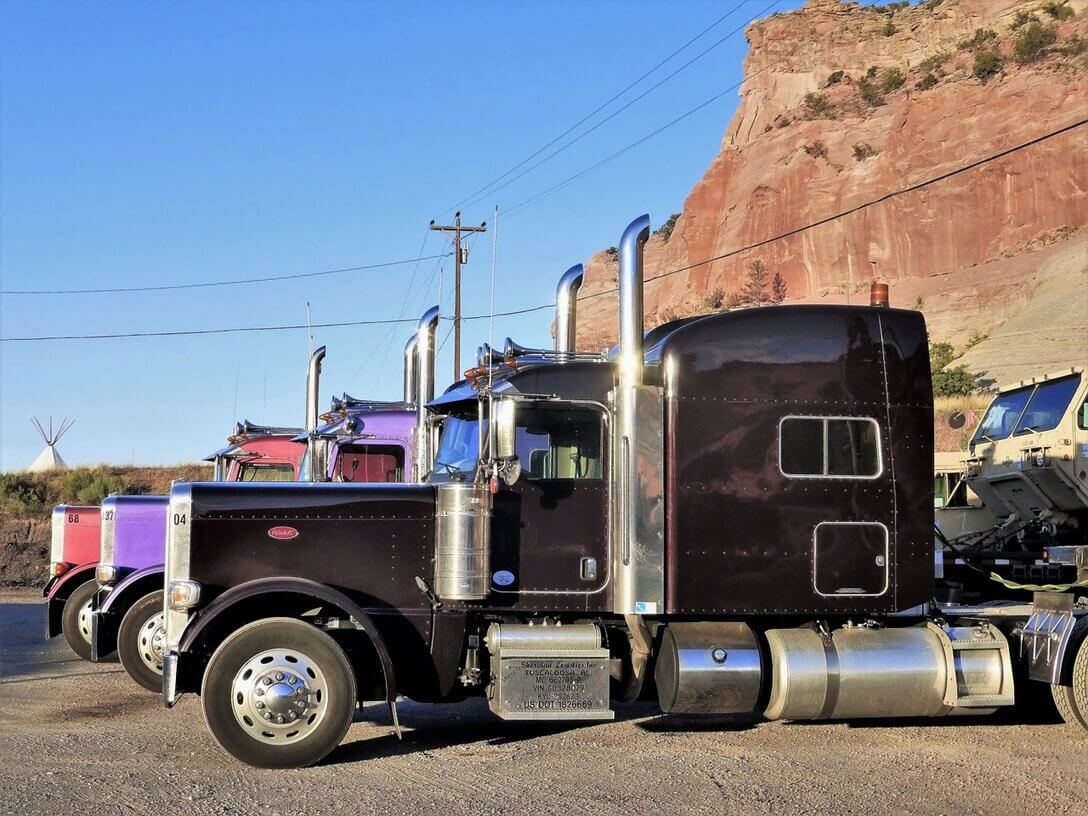
    trucks parked in a lot

    The transition into the truck parking sector involved a steep learning curve in transportation and logistics relating to identifying a market need but also gaining a deep understanding of the industry.

    Networking played a crucial role in this phase by actively engaging with various industry stakeholders and gaining knowledge and perspectives that were important in shaping the Truck Parking Club’s strategy. This process of continuous learning and interaction with professionals from different sectors of the industry played a huge part in comprehensively understanding the truck parking shortage.

    Boots on the Ground Approach

    Truck Parking Club’s approach to understanding the real challenges of truck parking was hands-on at first. By attending events and trade shows, firsthand insights were gained into the actual conditions and needs of truck parking. 

    Quickly, a clear picture of the complexities and varying requirements of truck parking across different regions began to develop. Building strong relationships through these interactions was key. 

    These connections not only informed the practical aspects of truck parking but also helped in understanding the diverse needs and preferences of truck drivers and property owners, thereby enabling Truck Parking Club to tailor its services more effectively.

    Building a Community Through Truck Parking Club

    One of the most intriguing aspects of Truck Parking Club’s growth has been its engagement with property owners. The TPC team introduced a unique concept,  transforming these owners into ‘property members‘ of the Truck Parking Club community. 

    The process involved educating property owners about the automated system, emphasizing how it could turn their unused spaces into productive assets without the hassle of day-to-day management. This innovative strategy broke new ground in how property owners viewed their involvement in the truck parking solution.

    Creating Value for Truckers and Property Owners

    The Truck Parking Club platform was designed to offer tangible benefits to both truckers and property owners. For truckers, it meant access to a broader range of great truck parking options. For property owners, it opened up a new revenue stream with minimal effort. 

    Overcoming initial skepticism was a challenge, but the platform demonstrated its effectiveness through its simplicity and reliability. By demonstrating real-life success stories and the ease of using the service, Truck Parking Club gradually gained trust among truckers and landowners in equal measure. 

    The result was a growing community where both truckers and property owners found mutual benefit, playing a huge part in the success of the Truck Parking Club.

    The Future of Truck Parking Club

    Truck Parking Club is setting its sights high for the future, aiming to dramatically increase its network to thousands of properties across the country, making parking availability widespread and accessible to every trucker who needs it. Alongside this growth, there’s a focus on refining the booking process and enhancing customer support

    The goal is to continue making every interaction with Truck Parking Club not just satisfactory but remarkably smooth and user-friendly. 

    The Bigger Picture in Trucking Logistics

    So, what does the future hold? The vision of Truck Parking Club is far more ambitious than just expanding parking spaces: reshaping the entire trucking logistics landscape through innovative parking solutions is the prime objective. 

    The ultimate aim is a future where booking a truck parking space is never an obstacle to the smooth flow of logistics – not just for reasons of convenience – but for the creation of a more efficient, reliable, and productive trucking industry. 

    Either way, with record numbers year after year and a brand that is becoming appreciated by truckers everywhere, Truck Parking Club’s journey ahead is almost certain to be an influential force in transforming how trucking logistics operates at its core.

    Reach Out

    Interested in becoming a property member? If you have commercial land available that is suitable for truck parking, you can join an industry that is booming at the moment by launching your own truck parking lot business. With minimal effort or capital required, you can have a legitimate, lucrative, high-demand business up and running in no time, with Truck Parking Club driving your customers to you.

    The information published herein is for general informational purposes only. Truck Parking Club does not make any representations or warranties about the completeness, reliability, legality, and accuracy of this information. Any reliance placed on such material is strictly at the user’s own risk. Truck Parking Club shall not be responsible for any losses or damages incurred in connection with the information published herein.
  • What Makes a Great Truck Parking Lot? Tips on Finding the Best Spot to Park Your Semi-Truck

    What Makes a Great Truck Parking Lot? Tips on Finding the Best Spot to Park Your Semi-Truck

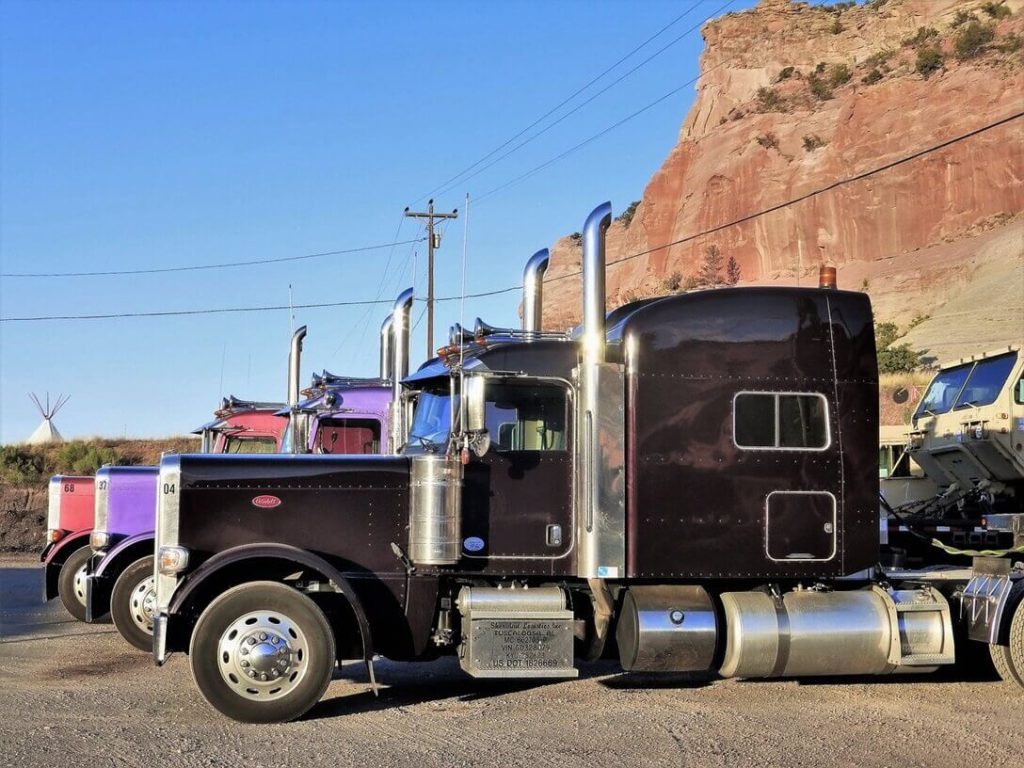
    When you’re trying to choose the right truck parking lot, there are many different things to consider. In this article,  we’ll take a look at some of the many things you should look at when trying to choose the right semi-truck parking lot for your vehicle.

    1- Consider the Lot’s Safety and Security

    Naturally, one of the first things most truckers look at is safety and security. No one wants to park their truck in a lot that may be unsafe. For this reason, it should be one of the priority points. 

    Some of the things you may wish to look into include the following:

    • Is the parking lot well-lit? It’s easier to commit a crime under the cover of darkness.
    • Are there any other security measures in place? I.E. a security service, armed response, or CCTV coverage.

    2- Consider the Available Amenities

    Amenities are one of the next things truckers are likely to look for when considering semi-truck parking lots. It’s always convenient when you can rest for the night and have access to amenities in the same location. 

    While many truck parking lot services offer little more than parking, you may encounter some of these amenities at certain lots:

    • Clean restrooms and showers
    • Laundry facilities
    • Truck washes
    • Restaurants
    • Fuel points  

    3- Consider the Location

    Location is the next thing you want to consider when looking at a truck parking lot. A large part of the convenience of a semi-truck parking lot lies in the location. 

    Here are a few questions you can ask yourself:

    • Is it conveniently located in relation to your route? 
    • Can you easily get to stores or amenities from the location? 
    • Would you consider the parking lot to be located in a safe area?

    Of course, there are many other questions you can ask yourself, but you mainly want the truck parking lot to be located in an area that isn’t too out of the way and where you’ll feel secure.

    4- Ask Yourself if You’re Getting Value for Money

    Another obvious selection criteria is centered around pricing. There are cheap semi-truck parking lots, and there are more expensive ones. However, neither of these ratings necessarily says much about the quality of the lot. 

    What you’re looking for isn’t necessarily a specific price range, but rather value for money. If you book in at a cheap parking lot in a seedy location with no amenities or real lighting, that isn’t really value for money. If you book in at a slightly more expensive truck parking lot, but if it’s in a secure location, well-lit, and near a fuel station with amenities, you’re getting better value for money.

    5- Consider the Parking Availability

    Naturally, you want to use a truck parking lot with enough space. Some of the best lots barely ever have space because they’re so popular. If you can’t get into a semi-truck parking lot, then it isn’t the right fit for you. 

    While this isn’t exactly what one would consider a convenient criterion, it certainly is an important factor. 

    6- Read the Ratings and Reviews

    The last thing you likely want to review before choosing a semi-truck parking lot is what other people have to say about it. If you have the option, it’s a good idea to read through reviews and ratings left by other truck drivers. 

    Always bear in mind that it’s easy for someone to leave a scalding review when they’ve had a bad day or a single bad experience and that their experience isn’t always the rule. If there are multiple reviews, try to see what the average opinion is about the truck parking lot. 

    Conclusion

    If you’re looking for the right semi-truck parking lot for your vehicle, there are a few main things to consider. Start by considering the location since it may not work out well if the lot is too far out of your way. 

    Next, find out if the lot has space. There’s no point in driving to a lot that doesn’t have space for your truck.

    Then, find out how much the lot charges and what facilities it has to offer. Once you’ve determined whether or not the lot is conveniently located, has space, and offers value for money, you can look at other aspects like safety and reputation.

    Of course, phoning hundreds of different semi-truck parking lots can be taxing and take a significant amount of time and effort. It’s much easier to use the Truck Parking Club website or mobile app. 

    It gives you access to instant information, including details like availability, pricing, and which amenities are on offer (if any). Make your life easier; find your next parking space through Truck Parking Club online or on mobile.

    The information published herein is for general informational purposes only. Truck Parking Club does not make any representations or warranties about the completeness, reliability, legality, and accuracy of this information. Any reliance placed on such material is strictly at the user’s own risk. Truck Parking Club shall not be responsible for any losses or damages incurred in connection with the information published herein.
  • How Much Does It Cost to Build a Semi Truck Parking Lot?

    How Much Does It Cost to Build a Semi Truck Parking Lot?

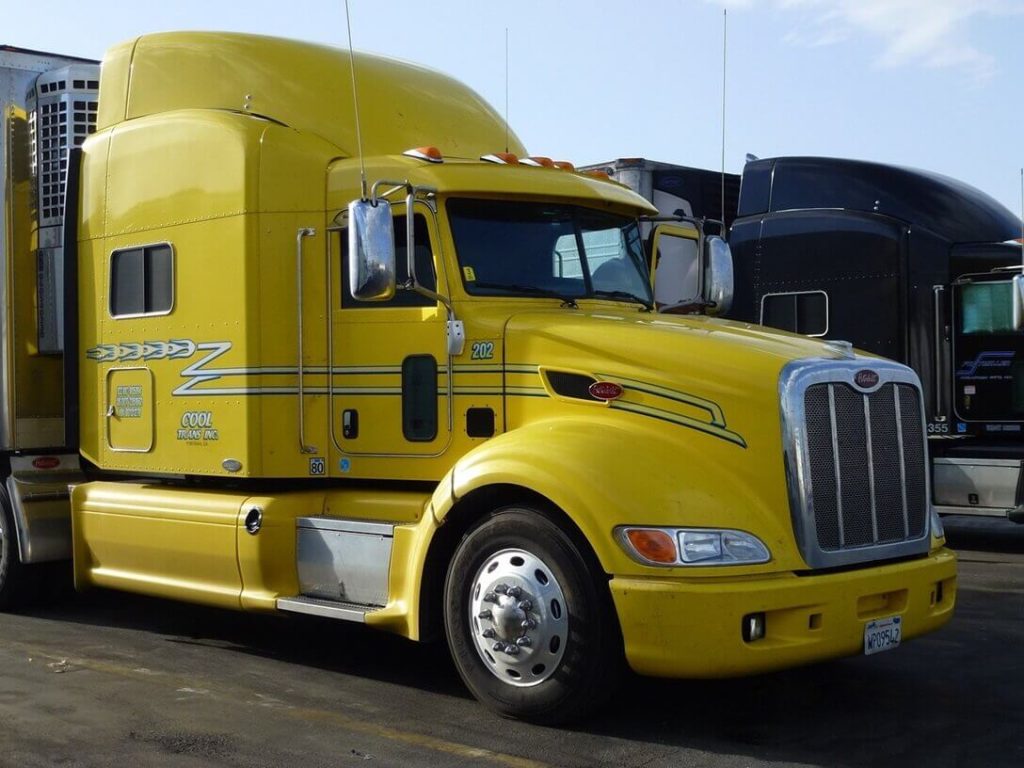
    Transforming your vacant property into a functional semi truck parking lot can be a brilliant business idea. Truck parking lots are in incredibly high demand, and a well-run lot can prove highly profitable. 

    However, before you welcome your first weary trucker into your parking lot, you must first build one. That means investing in the necessary permits, appropriate paving, amenities, security measures, and labor. 

    We won’t pull the wool over your eyes – starting a semi truck parking can get costly. How costly? That depends on several factors…

    Truck Parking Lot Cost Factors

    It’s practically impossible to estimate how much building a truck parking lot would cost. That’s because the costs involved depend on numerous factors, starting with acquiring the necessary permits and ending with building the chosen amenities.

    Local Permits and Approvals

    To start your truck parking lot business, you must first obtain the necessary permits and approvals. Without them, your construction will most likely be shut down, even leading to possible fines. 

    Their number and costs will vary from state to state, so be sure to look into the zoning laws, land use regulations, transportation codes, and local licenses for development, construction, and operation. 

    Truck Parking Size

    The bigger the lot, the more it will cost to build it. On average, you should expect to pay between $3 to $7 per square foot to pave the parking area, depending on the type of paving material you choose. 

    How large should a truck parking lot be? A standard dimension for one semi-trailer parking space is 55 ft x 14 ft (length/width). For a semi-trailer with a truck, these dimensions increase to 75 ft x 14 ft. 

    Use our guide to help calculate the dimensions of your lot. Based on that, it will be much easier to estimate the cost of paving the area along with the expenses of preparing the surface, such as leveling, fencing, space marking, etc. 

    Security Features

    Investing in proper security measures is a must-do. Without ensuring safety, you won’t be able to attract truckers to stay at your parking lot overnight. It will also increase the risk of cargo getting stolen or damaged, exposing you to potential lawsuits and fines. 

    Long story short, we wouldn’t recommend looking for ways to save money here. To keep your truck parking lot secure, be sure to invest in proper fencing, a 24/7 surveillance system, and appropriate lighting. You might also want to hire a security company. Oh, and let’s not forget about investing in proper insurance. 

    All this might seem like a lot. Trust us, though, securing your truck parking lot should be the number one priority. Sure, it will cost you much more, but it will prove invaluable in the long run, helping you attract more truckers and protect you from potential lawsuits and hefty fines. 

    Amenities

    There are many amenities you can include in your semi truck yard. If we were to choose the most important truck parking amenities, these would be a restroom, showers, and a bar or restaurant. Many truck parking lots also have on-site mechanic/service stations, convenience stores, or weigh stations. 

    Naturally, the more amenities you want, the higher the cost of building them. Choose the amenities that you’d like to build carefully. For instance, if your parking lot is located near a larger store or a restaurant, having your own bar or convenience store doesn’t make much sense. 

    The absolute must-haves are restrooms, showers, and security amenities. These are the first-need amenities that every trucker wants from a parking lot. Investing in those practically guarantees truck drivers will park at your lot. 

    You can then gradually expand the variety of amenities offered as your parking lot starts generating a steady income. Don’t rush, especially if you’re on a tight starting budget. 

    Labor 

    We assume you won’t be building your truck parking lot with your own hands. In that case, you will also need to add labor costs to your estimate. These can add a significant amount to your already large pile of required construction costs. 

    How much should you expect to pay? It’s hard to tell as labor rates depend on numerous factors, such as your location or chosen contractor. Our suggestion is to do your research. Look at various contractors in your area and contact them for estimates. Then, create a list and pick the contractor that best fits your needs. 

    Is Building a Truck Parking Lot Worth It?

    Considering all the costs mentioned above, building a truck parking lot can cost well over $500,000. That’s for the basic lot, without fancy amenities. Once we add those in, it’s not uncommon for a semi-truck parking lot to cost over $1 million. 

    So yes, it’s not surprising that you might have second thoughts. However, while it might seem like a lot, building a well-functioning truck parking lot can provide an excellent revenue stream with relatively low maintenance costs. 

    First of all, the ongoing truck parking shortage means reliable truck parking lots are in mighty high demand. This means that even without major investments, you should still be able to attract many truckers and generate a satisfactory income. 

    Secondly, once built, your lot won’t require that much attention. Maintenance fees usually include security, cleaning, and fee collection, whereas marketing costs are minimal compared to many other businesses. 

    Finally, in 2023, the US government introduced the Truck Parking Safety Improvement Act, which aims to tackle the ongoing truck parking shortage crisis by giving out grants to new and existing truck parking businesses. If you play your cards right, you can use this program to minimize the amount you spend on building the parking lot from your pocket. 

    Wrapping Up

    Although starting a semi-truck parking lot business isn’t cheap, running it can be incredibly profitable and rewarding. And to maximize your potential returns, be sure to list your available parking at Truck Parking Club

    Our app connects property owners with truck drivers who can use it to quickly and effortlessly find available parking spots across the US. By listing your parking yard at Truck Parking Club, you will be able to reach more potential truckers, increasing the chances of more drivers opting for parking at your location. 

    Become a Property Member today. Create your free account and maximize the return on your truck parking investment!

    The information published herein is for general informational purposes only. Truck Parking Club does not make any representations or warranties about the completeness, reliability, legality, and accuracy of this information. Any reliance placed on such material is strictly at the user’s own risk. Truck Parking Club shall not be responsible for any losses or damages incurred in connection with the information published herein.

  • Can a Truck Parking Business be Profitable? Discover the Pros and Cons of Opening a Truck Parking Lot

    Can a Truck Parking Business be Profitable? Discover the Pros and Cons of Opening a Truck Parking Lot

    The rapidly expanding prospect of running a truck parking business comes with unique opportunities for entrepreneurs with commercial or nonresidential land available. 

    The benefits of opening a truck parking business are broad and lucrative, but like any business venture, its success depends on several factors.

    The concept of running a semi-truck parking lot is refreshingly simple, with the single requirement of providing a secure and accessible space for truck drivers to park their vehicles. However, the simplicity of the concept doesn’t always correlate with easy success, and while the overwhelming majority of new truck parking businesses are doing very well, profitability involves careful planning and strategic decision-making.

    In this article, we shall look at the various considerations for starting and operating a truck parking lot business, including the various aspects that may influence its success, before looking at the main pros and cons.

    Before we cover those pros and cons, let’s first consider the required elements for success for a newly launched semi-truck parking lot.

    Main Elements of Truck Parking Lot Business Success 

    At one time, advertising and marketing would have been the most decisive factor in launching a successful truck parking lot business. Even the most spacious, well-lit, easily accessible lots would struggle to survive if truck drivers were unaware of its existence. 

    At Truck Parking Club, we have removed your advertising and marketing concerns from the equation. Truckers everywhere are now aware of our popular, established truck parking app, and by listing your property with us, customers will find you. Aside from a few well-placed signs, there is no pressing need to commit too heavily, if at all, to advertising.

    That aside, your truck parking business plan should consist mainly of the following crucial elements: 

    Location 

    At the risk of stating the obvious, a truck parking lot located near major highways, logistics centers, or busy urban areas has a higher chance of attracting consistent traffic due to the increased demand for truck parking spaces. The ideal location should balance accessibility for drivers and proximity to their key destinations. Within fifteen minutes of a highway or major road would be ideal. 

    Pricing

    A well-thought-out pricing model needs to balance affordability for the truckers with profitability for the business. This may involve varying rates based on demand, length of stay, and additional services offered. For a general idea of parking rates currently, you can browse our truck parking listings to gauge what other property members in your area are charging.

    Operational Factors

    Encompassing everything from the layout of the parking lot to the use of technology for managing bookings and payments, your operational factors are another important consideration. Streamlining your operations will reduce overhead costs and improve customer experience. 

    While not essential, investments in technology for easy access and security can make a difference in attracting customers. That said, price and location are going to be your biggest draw. 

    Other factors should be considered of course, but these three main elements – location, pricing, and operational factors – are going to form the main foundation of a successful truck parking lot business. 

    What Are the Advantages of a Truck Parking Lot Business?

    With those brief caveats considered, what exactly are the most obvious benefits of owning a truck parking lot business? 

    1. Steady Revenue Source

    Given the current truck parking crisis in which just one truck parking space exists for every ten trucks on American roads, success is almost guaranteed at the moment.

    Well-located truck parking lots, especially near logistic hubs or major transit routes, are almost guaranteed to experience a high and consistent demand for spaces. This high demand equates to a regular and reliable income stream for a semi-truck parking business.

    1. Low Ongoing Operational Costs

    Once established, truck parking lots generally have lower operational expenses compared to many other businesses, primarily because they require minimal staffing and maintenance, especially if automated systems are in place. 

    As mentioned earlier, advertising is one of the biggest overheads faced by many truck parking lot businesses. With Truck Parking Club, truckers find you, and not the other way around. Removing these expensive advertising costs will greatly reduce your overhead.

    1. Opportunities for Expansion 

    The truck parking lot business provides immense room for growth through expanding the existing physical space or adding services such as vehicle maintenance, washing stations, or overnight facilities, all of which can create additional revenue streams.

    1. Flexibility

    Running a truck parking lot business is not as time-consuming as you might imagine. As a result, you can dedicate as much time as you can afford. All driver communication and payments are managed through the Truck Parking Club app, and there is no need to be on-site during arrival times unless you want to be there. 

    1. Hassle-Free Customers

    Truck drivers are notorious for being pretty easygoing with very few expectations. All they require is a convenient truck parking space for a reasonable rate. Provide that, and you will have very little in the way of interaction or customer service issues.

    What Are the Challenges of a Truck Parking Lot Business?

    1. Initial Capital Investment

    Setting up a truck parking lot can require a large initial investment, particularly in purchasing land in a strategic location and developing the necessary infrastructure. Of course, this is not an issue if you happen to own existing commercial land.

    1. Market Fluctuations

    The demand for truck parking is influenced by economic conditions and industry trends, making the market somewhat unpredictable in previous years. However, with the current drastic shortage of truck parking spaces nationwide, the market seems quite stable for the next decade or so, at the very least.

    1. Competition

    In areas with high demand, competition can be quite fierce, with several parking lots vying for the same clientele. That said, there are a lot of truck drivers looking for spaces at the moment – unless you are located in a heavily populated truck parking area, competition should be too much of a concern.

    1. Regulatory Hurdles

    Complying with zoning laws, environmental regulations, and other local ordinances can be something of a headache at times –  and can sometimes prove a little costly.

    1. Maintenance and Security

    Keeping the parking lot in good condition and ensuring good security are ongoing responsibilities that can require attention and resources. Assuming you already have a fenced property, this can be a moot point. In any event, security is not a prerequisite and isn’t necessarily a factor outside of urban areas. 

    Join the Truck Parking Revolution Today

    With careful initial planning and a good eye for location selection, the advantages greatly outweigh the few existing challenges of a truck parking lot business. 

    It is with good reason why truck parking lot businesses are so lucrative at the moment: with such a critical shortage of truck parking spaces, this is a business that can very easily succeed, assuming you get the location right and list for affordable prices.

    Do you own underutilized property? You can easily transform it into a profitable venture by partnering with Truck Parking Club right now. Join as a property member today, and you can potentially earn healthy revenues from day one!

    The information published herein is for general informational purposes only. Truck Parking Club does not make any representations or warranties about the completeness, reliability, legality, and accuracy of this information. Any reliance placed on such material is strictly at the user’s own risk. Truck Parking Club shall not be responsible for any losses or damages incurred in connection with the information published herein.

  • Truck Parking Club Benefits for Fleet Owners

    Truck Parking Club Benefits for Fleet Owners

    The shortage of accessible parking for commercial trucks has reached critical levels, leaving many drivers stranded on the shoulder of highways each night. 

    Truck Parking Club offers an innovative solution by partnering with Property Members across the United States to convert underused or vacant lots into secure, accessible truck parking stops.

    Truck members can reserve parking through the Truck Parking Club app and website, and these property members can generate revenue by providing essential parking capacity. A win-win situation.

     For fleet owners and managers, Truck Parking Club gives your drivers access to guaranteed, affordable parking across the country. Not only does this improve driver satisfaction, performance, and retention, but it can directly strengthen fleet planning and efficiency. 

    This article will explore the advantages Truck Parking Club can provide for commercial fleet operations. To begin, let’s briefly discuss how Truck Parking Club works.

    How to Book a Parking Spot for Fleet Owners

    Step 1

    Sign Up as a Trucker Member: Fleet owners/drivers should create an account with Truck Parking Club, registering themselves as Trucker Members. This step ensures access to the platform’s booking system.

    Step 2

    Book a Space: Once registered, use the platform to search for and book a parking space at the desired location. The booking process allows fleet owners or their designated Trucker Members to specify the type of parking needed—be it daily, weekly, or monthly—according to their specific route plans and schedules.

    Step 3

    Receive Confirmation and Parking Instructions: After booking, the fleet owner or the Trucker Member will receive a confirmation of the reservation.

    Once you’re booking is confirmed, if you have any additional questions regarding your chosen location you can reach out directly to the property member for assistance.

    It’s also essential for fleet owners to ensure their drivers have all the necessary information needed to access the parking facilities if you are making the booking.

    Benefits for Fleet Owners

    Happier Drivers, Higher Retention

    One of the most valuable advantages of Truck Parking Club is how it directly translates into improved driver satisfaction and engagement. 

    Between lack of spaces and amenities in disrepair, it’s no wonder retention can be a perpetual struggle for fleets.

    Truck Parking Club flips the parking paradigm through guaranteed access to designated spots at secure partner properties complete with maintained facilities. Whether it’s hot showers or cooked meals from on-site restaurants – Truck Parking Club ensures drivers’ basic needs are met at every stop. 

    With the daily stress of parking off their plates, drivers are free to focus fully on getting from Point A to Point B. This gives them the energy and positivity needed to excel. And when you have motivated, fulfilled drivers who feel valued by their company, retention naturally follows suit.

    Cost Savings

    As well as driver benefits, Truck Parking Club also delivers compelling financial savings for fleet operations. First, the service reduces costs associated with inadequate parking. Between fees for citations from roadside parking, fines from highway violations, and pricey towing when shoulders must be suddenly cleared – lack of parking capacity takes a toll. We alleviate these expenses through guaranteed access to approved private lots.

    Additionally, the company’s offerings enhance preventative savings tied to better-rested drivers. Fewer accidents mean lower insurance premiums and medical costs.

    Real-Time Visibility and Control Over Parking Reservations

    Truck Parking Club gives fleet owners and dispatch personnel enhanced visibility and control when managing parking reservations for their fleet drivers. The online platform clearly displays available parking spots across all property member locations, making it easy to identify openings to match routing needs.

    Additionally, long-term parking reservations can be booked at monthly rates in advance. Fleet owners can reliably access consistent parking capacity for regular routes. Being able to directly manage all reservations also means fleet dispatch can strategically coordinate their fleet parking as operational needs shift.

    With real-time updates on upcoming driver reservations, Truck Parking Club gives fleet decision-makers greater oversight and flexibility in managing day-to-day parking operations. Gaining the insights and controls necessary to optimize parking budgets and logistics planning.

    Driver Autonomy

    Allowing drivers to directly manage their own TCP reservations and parking gives me a great sense of freedom. Fleet managers assign a parking budget, and then drivers choose their preferred stops. This sense of control over their own route planning results in higher engagement, as drivers feel their needs are prioritized. 

    At the same time, fleet visibility into upcoming reservations remains transparent. Truck Parking Club enables a mutually beneficial dynamic between drivers and fleet managers by giving drivers more autonomy over day-to-day parking decisions.

    Expanding National Footprint and Reach

    Truck Parking Club continues expanding its partnerships with Property Members across all 50 states, from Washington state in the Pacific Northwest to sunny southern states like Florida. This gives fleets access to an ever-growing national network of truck parking spots. 

    Regardless of where shipments take your fleet, Truck Parking Club likely has truck parking spaces nearby. And with new properties joining weekly, capacity stretches farther by the day.

    Making the Most of Truck Parking Club

    As a fleet owner, take full advantage of everything Truck Parking Club has to offer with these pro tips:

    Book Early and Often

    Parking tends to fill up quicker around holidays and other peak drive times. Book reservations well in advance whenever possible to lock in spots. Setting recurring bookings is wise for frequently traveled routes.

    Take Advantage of Amenities

    Make sure drivers know what amenities are available at each property, like showers, laundry, meals, and more. 

    Provide Parking Feedback

    Make sure to rate locations and share feedback on your experiences. This helps us at Truck Parking Club to continually improve our parking network.

    Give Your Fleet a Parking Upgrade

    Truck Parking Club makes it simple to guarantee drivers have access to comfortable and affordable parking nationwide. Join our rapidly growing community of Trucker Members.

    Getting started takes just minutes – create your profile and start reserving parking today.

    Don’t waste any more time struggling with parking headaches. Let Truck Parking Club become your fleet’s parking partner so you can focus on the shipments while we handle the spots.

    Sign Up to Truck Parking Club Today

    The information published herein is for general informational purposes only. Truck Parking Club does not make any representations or warranties about the completeness, reliability, legality, and accuracy of this information. Any reliance placed on such material is strictly at the user’s own risk. Truck Parking Club shall not be responsible for any losses or damages incurred in connection with the information published herein.

  • Big-rig parking shortage across the US spells juggernaut problems

    Big-rig parking shortage across the US spells juggernaut problems

    FIND DAILY TRUCK PARKING IN NEARLY EVERY STATE

    On the road and looking for a daily truck parking space? Find the closest daily parking spot in a matter of seconds.

    Big-rig parking shortage across the US spells juggernaut problems

    You may have seen them precariously parked alongside highway ramps or clustered in big-box store parking lots. There are millions of big-rig trucks on United States roadways daily, and often, there is nowhere to park them overnight or during mandated driver breaks.

    In a Federal Highway Administration survey of more than 11,000 drivers, almost every (98%) driver responded that they have problems finding safe parking, with nearly 3 in 4 drivers reporting it is a regular problem that happens once or more a week. Truck Parking Club used data from the Department of Transportation to explore the severity of the truck parking shortage in the U.S.

    Safe, designated semitruck parking facilities often fill up past capacity during overnight hours, leaving drivers to find a makeshift solution—often risking their own safety and that of fellow motorists.

    In July 2023, Mario Gonzalez died when his pickup truck crashed into a semitruck parked overnight on the side of a rest stop service road off an interstate near San Antonio. News reports said Gonzalez was speeding and hit the brakes right before impact, and the big-rig did not have its lights on. In another high-profile case that year, a Greyhound bus crashed into three tractor-trailers parked along a ramp’s shoulder, killing three passengers in Illinois.

    There have also been instances where drivers are pressured to find a spot quickly due to mandatory breaks and time limits, and many say they waste about 56 minutes of available driving time a day looking for parking, according to the American Trucking Association.

    The tragic beginnings of Jason’s Law

    In March 2009, a truck driver named Jason Rivenburg needed to drop off his delivery, but the distribution center wasn’t open yet, so he had to look for somewhere nearby to park. He chose an abandoned gas station that other truckers had told him was safe. He was attacked and murdered in his sleep, with the murderer taking the $7 that was in his wallet.

    Rivenburg’s death spurred new legislation called Jason’s Law that created a national truck parking survey administered by the DOT. The survey evaluates and measures the capability of each state to provide adequate parking and rest facilities.

    An analysis of the survey data by the FHWA found that truck vehicle miles traveled increased by 15% between 2012 and 2017—and parking capacity isn’t keeping up. Parking spaces at private facilities increased by 11%, while public spots increased by 6%, according to the FHWA analysis of 2020 data.

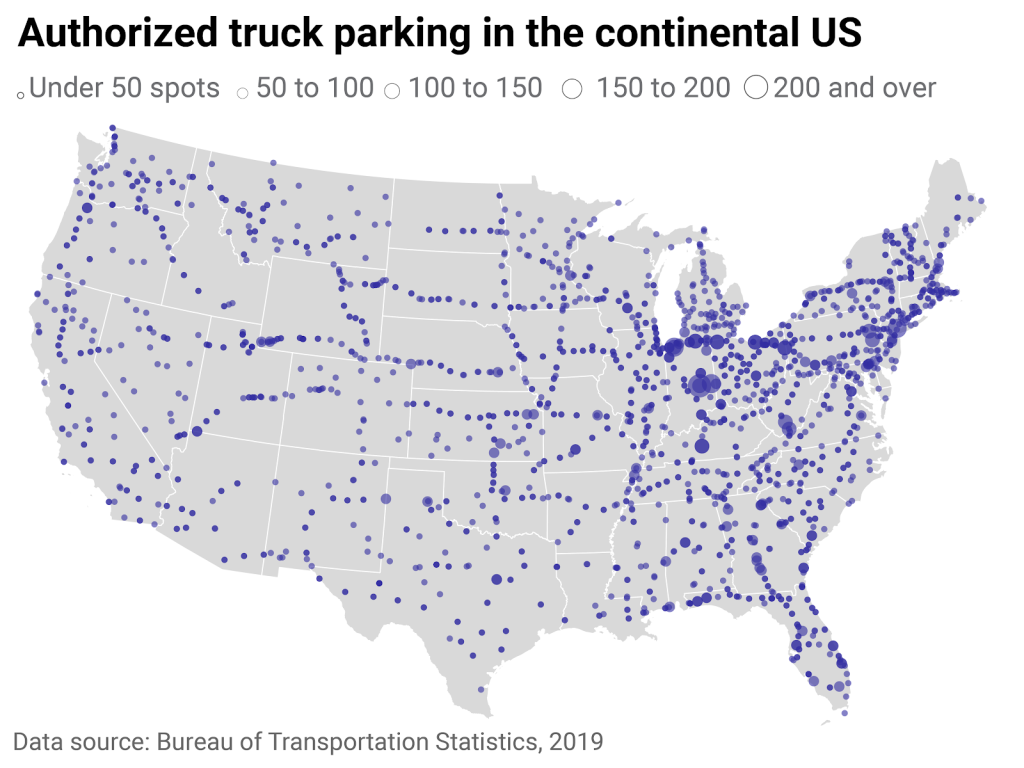
    While not all trucks are long-haul, and some return to their depots at the end of the day, many truck drivers are forced into the precarious position of searching for parking that isn’t there. This data highlights where parking spots are located across the country relative to road coverage, but it doesn’t necessarily show where truck drivers most frequently look for parking.

    FIND DAILY, WEEKLY, AND MONTHLY TRUCK PARKING

    On the road and looking for a daily truck parking space? Operated by truckers, we source the best parking spots across the nation to ease your trip planning.

    Lack of parking costs time and money

    According to the latest Jason’s Law national truck parking survey, there are 40,000 parking spots at public rest areas and 273,000 at private truck stops—but that is nowhere near enough.

    Nearly 3 in 5 truck drivers admit to parking in unauthorized spots at least three times a week. These can include highway shoulders, ramps, or empty lots.

    The ATA estimates that drivers waste precious minutes worth about $5,500 annually in pay as they spend time looking for parking. It’s especially hard to find spots near roads connecting major cities in the Southeast, Midwest, and East Coast, as well as along the West Coast and major east-west interstate highways, where truck volume is high, per the DOT.

    “I’ve heard from countless truckers across the country about how the shortage of truck parking costs them time and money—not to mention making our roads less safe and weakening our supply chains,” Transportation Secretary Pete Buttigieg told a DOT statement. “We’re using funds from President Biden’s Bipartisan Infrastructure Law to help address truck parking shortages, and we’re working with state and industry leaders to develop more parking that will improve safety and quality of life for our nation’s truck drivers.”

    Additionally, the DOT invested $22.6 million to add about 125 spaces along I-40 near Nashville and $15 million to add about 120 new truck parking spaces along an important roadway between Orlando and Tampa.

    PARK YOUR TRAILER WITH NO HASSLE

    Store your trailer in a safe place with a state-of-the-art platform that locates trailer parking near me.

    States with the worst shortages

    The data collected over the years through the Jason’s Law survey reveals disparities in parking availability among states.

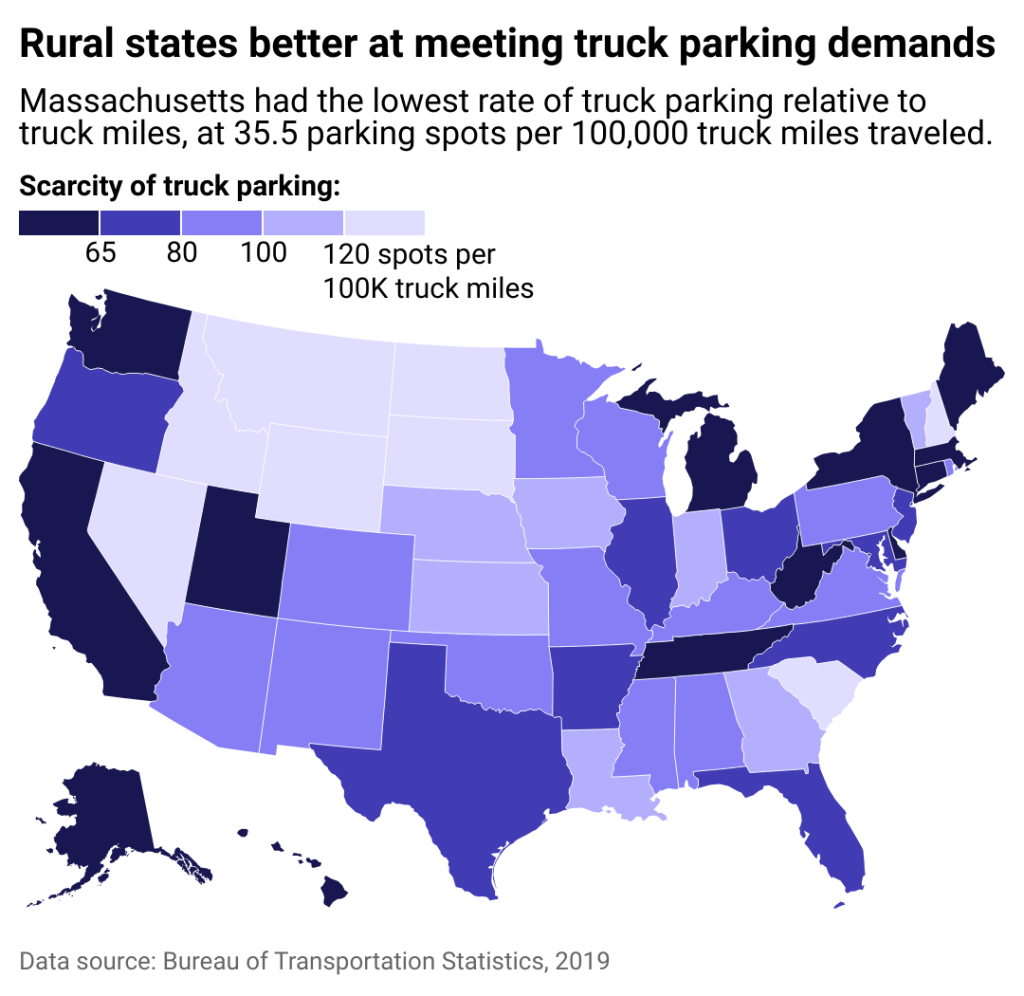
    On the East Coast, Massachusetts and Maine had the lowest available parking with 35.5 spots and 45.3 spots per 100,000 truck miles traveled, respectively, while neighboring New Hampshire and Vermont offered 230 and 109.2 spots. Parking up and down the West Coast is also sparse, with California at 58 spots per 100,000 truck miles traveled, Oregon at 74.2 spots, and Washington at 62.3 spots. Drivers would find more luck in Nevada, with 176.5 spots per 100,000 truck miles traveled, or Idaho, with 147.1 spots. Wyoming was the state with the most spots, with 832.1 spots per 100,000 truck miles traveled.

    In some cases, states have applied for and received federal money to help alleviate the problem.

    According to the DOT, Caldwell County, Texas, received $22.9 million to construct a trucking park plaza that will include 24-hour monitored security. A Louisiana town is constructing a truck parking facility that will host 50 commercial trucks and include EV charging stations that will ultimately power the trucks’ cab heating and cooling, helping curb emissions. Both projects are funded through the Rebuilding American Infrastructure with Sustainability and Equity program and are hailed as examples of President Joe Biden’s ongoing commitment to invest in truck parking and roadway safety.

    Written by Cassidy Grom. Story editing by Carren Jao. Copy editing by Paris Close.

  • The most congested freight corridors

    The most congested freight corridors

    PARK YOUR TRAILER WITH NO HASSLE

    Store your trailer in a safe place with a state-of-the-art platform that locates trailer parking near me.

    The most congested freight corridors

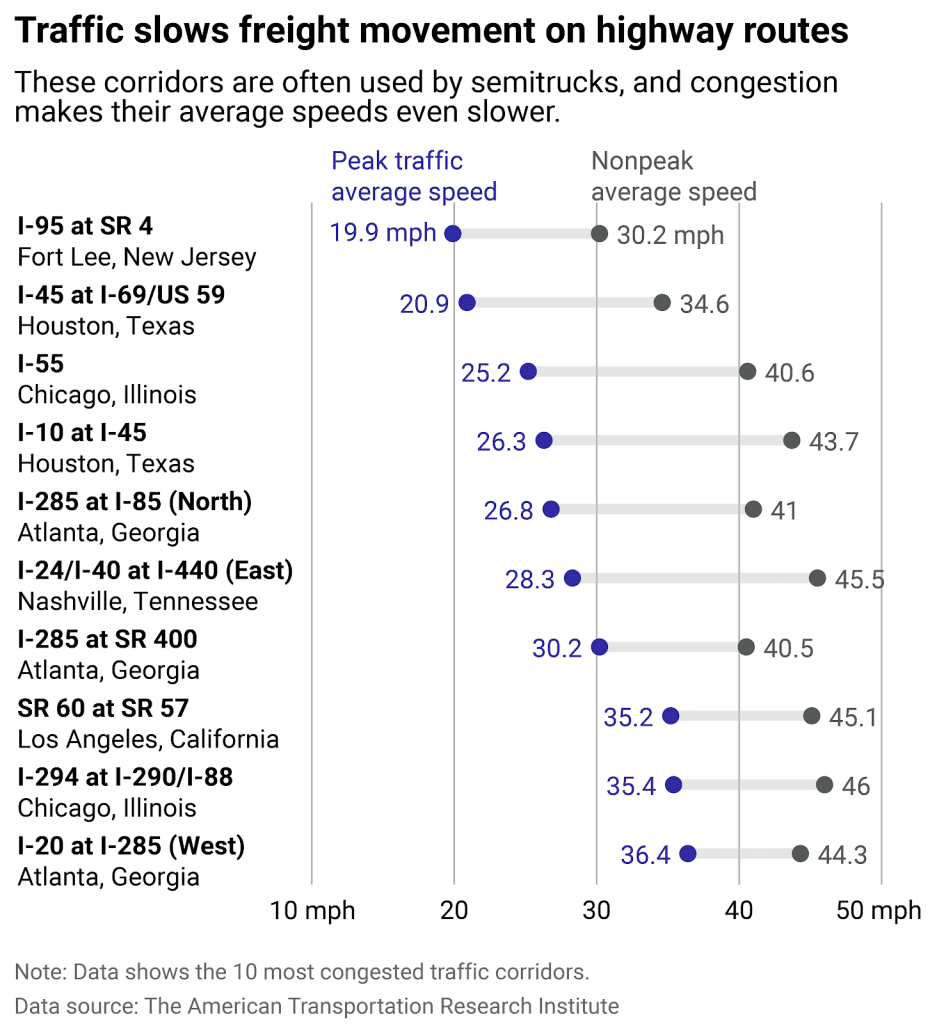
    Wondering why your packages are delayed, or perhaps why store inventory is low? The simple answer is these goods might be stuck in traffic. For example, the speed limit on Interstate 71 through Kentucky and Ohio is 70 mph, but the average speed for semitrucks is under 40 mph. Congestion around major metro areas can also create traffic backups that don’t just affect commuters but also the supply chain.

    Companies rely heavily on the trucking industry to move goods around the country. In 2022, trucks carried nearly three-quarters of all freight in the U.S.—or 11.46 billion tons—according to the American Trucking Associations.

    Unfortunately, ongoing highway congestion creates bottlenecks, which keep truck drivers from getting to where they need to go. Recurring bottlenecks happen for many reasons, including heavy traffic, construction, accidents, congestion at interchanges, and poorly timed traffic lights.

    In their 2024 report, the American Transportation Research Institute found that trucks traveling along the country’s top 100 bottlenecks during peak hours hit an average speed of 34.4 mph, and if they had to drive through a top 10 bottleneck, speeds dropped to 28.5 mph. The problem’s not improving—83 of the top 100 bottlenecks reported peak traffic average speeds slower in 2023 than in 2022, making congestion worse.

    Some traffic corridors are worse than others for freight drivers. Truck Parking Club used data from the ATRI to break down speeds on the 10 most congested freight corridors in the U.S. ATRI’s congestion value also considers the number of trucks that pass through each route on an hourly basis.

    The struggle to get through traffic affects how much it costs to ship goods. In 2021, gridlock added $94.6 billion in labor, fuel, repair, and maintenance costs to the trucking industry, according to the ATRI. This included 1.27 billion hours lost to crawling down the highways—the equivalent of one work year for 460,000 truck drivers—and an extra 6.7 billion gallons of diesel fuel costing $22.3 billion.

    Extra fuel usage also negatively impacts air quality. In 2016, ATRI researched the effect of congestion-related fuel usage on the environment. That year, the trucking industry used just 2% more fuel than it would in 2021—6.87 billion gallons—adding 67.3 million metric tons of carbon dioxide emissions to the atmosphere.Even short delays result in big costs. In 2019, UPS estimated that if every one of their trucks experienced a five-minute delay every day, it would cost the company $114 million each year. These costs generally get passed on to consumers.

    FIND DAILY TRUCK PARKING IN NEARLY EVERY STATE

    On the road and looking for a daily truck parking space? Find the closest daily parking spot in a matter of seconds.

    Most congested corridors are concentrated around large cities

    The bottleneck near the George Washington Bridge connecting New York City and New Jersey has had the country’s worst congestion for six consecutive years, thanks to high population numbers and demand for goods.

    Houston also suffers from major congestion along I-10 and I-45. The I-10 corridor alone carries over $130 billion of goods a year, per Daily Commercial News. In 2024, the Texas Department of Transportation plans to break ground on a $9.7 billion improvement project to widen I-45 and reroute it around the Central Business District. This massive construction project should provide much-needed traffic improvements, but it won’t be completely finished until 2042.

    Atlanta has several congestion hot spots, including fifth-place “Spaghetti Junction,” an interchange that connects four of the city’s biggest highways. Along with commuter traffic, truckers’ problems come from nearby trucking companies, a UPS distribution center, and the air cargo hub at Hartsfield-Jackson Atlanta International Airport.

    The federal government is another major contributor to bottlenecks around the country, as the Infrastructure Investment and Jobs Act has created many construction sites on highways. For now, truck drivers can hold on to the hope that the short-term pain they currently feel while navigating around these work zones should turn into long-term gain as the completion of new roads and bridges improves traffic flow.

    PREVIOUSLY INACCESSIBLE TRUCK PARKING

    Take care of your truck and trailer parking needs with new locations added daily.

    Written by Jill Jaracz. Story editing by Shannon Luders-Manuel. Copy editing by Tim Bruns.

  • Why You Shouldn’t Park a Semi Truck on Highway Ramps

    Why You Shouldn’t Park a Semi Truck on Highway Ramps

    highway

    Highway ramp parking is one of the ways that truck drivers get a night’s rest. Unfortunately, it’s a dangerous practice that’s generally frowned upon. Let’s take a closer look at why parking on highway ramps is a bad idea.

    Safety Hazards

    One of the main reasons not to park on highway ramps is that the process comes with a significant number of safety hazards. Some of these may include the following:

    Increased Risk of Accidents

    Let’s be honest: highway ramps weren’t made with the intention of having truckers park there for a nap. In fact, these structures were actually built for acceleration, not stopping. As a result, a semi-truck parked on a highway ramp provides an unexpected obstacle, reducing visibility and reaction time for other drivers. This significantly increases the risk of collisions. 

    Traffic Disruptions

    Whether you’re parked on the on-road or off-road highway ramp, you face the risk of disrupting traffic. Naturally, it’s less of a risk in urban areas or outside of peak hours. However, it is a very real hazard when you park on highway ramps.

    Vehicle Damage

    Perhaps one of the most compelling reasons not to park on highway ramps is that you expose your vehicle to potential damage. Not all cars and drives approach highway ramps with equal caution, and being parked on a ramp exposes you to potential swiping and fender benders. There have also been cases where drunk or fatigued drivers caused much more significant damage.

    Legal Issues

    The next major set of reasons not to use highway ramps as parking is that legality forbids it in many places. Let’s take a closer look. 

    Illegal in Most Jurisdictions

    In many states in the United States, it is now illegal to park on highway ramps. Not all states enforce it with equal fervor, but it is generally frowned upon. In some areas, you may get a ticket, while in others, authorities may wake you up and send you on your way to other places.  

    Civil Liability

    In addition to the basic illegality of parking on highway ramps, you may want to consider civil liability as well. For instance, if you’ve parked on the highway ramps and your truck causes an accident, it’s possible that you may be held responsible for the costs and damages. 

    Alternatives to Parking a Semi-Truck on Highway Ramps

    Now that we’ve established that you shouldn’t be parking on highway ramps, what are the alternatives? Let’s take a look at a few of the best options.

    Designated Truck Parking Stops

    Many towns and cities have designated truck parking stops where truckers can spend the night. Much of the time, these facilities also provide access to certain amenities. The downside to this option is that spaces are usually limited.

    Rest Areas

    Many areas, districts, and jurisdictions ensure that there are rest areas available where truckers and other drivers can stop for a rest. The upside to this arrangement is that it’s 100% legal. The downside is that there are generally few amenities and that the spaces may be limited. 

    Truck Parking Apps

    Another of the more modern options for finding truck parking is to use a truck parking app or website. There are several advantages to this approach, including the fact that these apps generally have access to a far broader range of parking spots. You can also book space in advance. Between affordability, ease of use, and the option to book spaces in advance, truck parking apps are easily one of the most convenient modern options.

    Find a Parking Spot with Truck Parking Club

    It’s time to bring your days of highway ramp parking to an end, and what could be better than getting simple, affordable parking through a truck parking app? If you’re interested in using a truck parking app, one of the best options to consider is Truck Parking Club. Not only does it offer an app, but it offers a website as well. This means that you can easily book your parking space before or during a trip from any device with an internet connection.

    One significant advantage that the Truck Parking Club system offers is that it allows owner members to register their properties anywhere in the country. As a result, the service has access to a whole host of properties that aren’t generally available to truckers.

    Another excellent feature or benefit is that you can subscribe to a parking spot with a monthly subscription. This means that if you visit a town or city regularly, you can rest assured that there will be a space available where you can park your truck.

    So, if you want to ensure that you always have access to a place where you can take a load off and get some rest, register with Truck Parking Club today.

    The information published herein is for general informational purposes only. Truck Parking Club does not make any representations or warranties about the completeness, reliability, legality, and accuracy of this information. Any reliance placed on such material is strictly at the user’s own risk. Truck Parking Club shall not be responsible for any losses or damages incurred in connection with the information published herein.