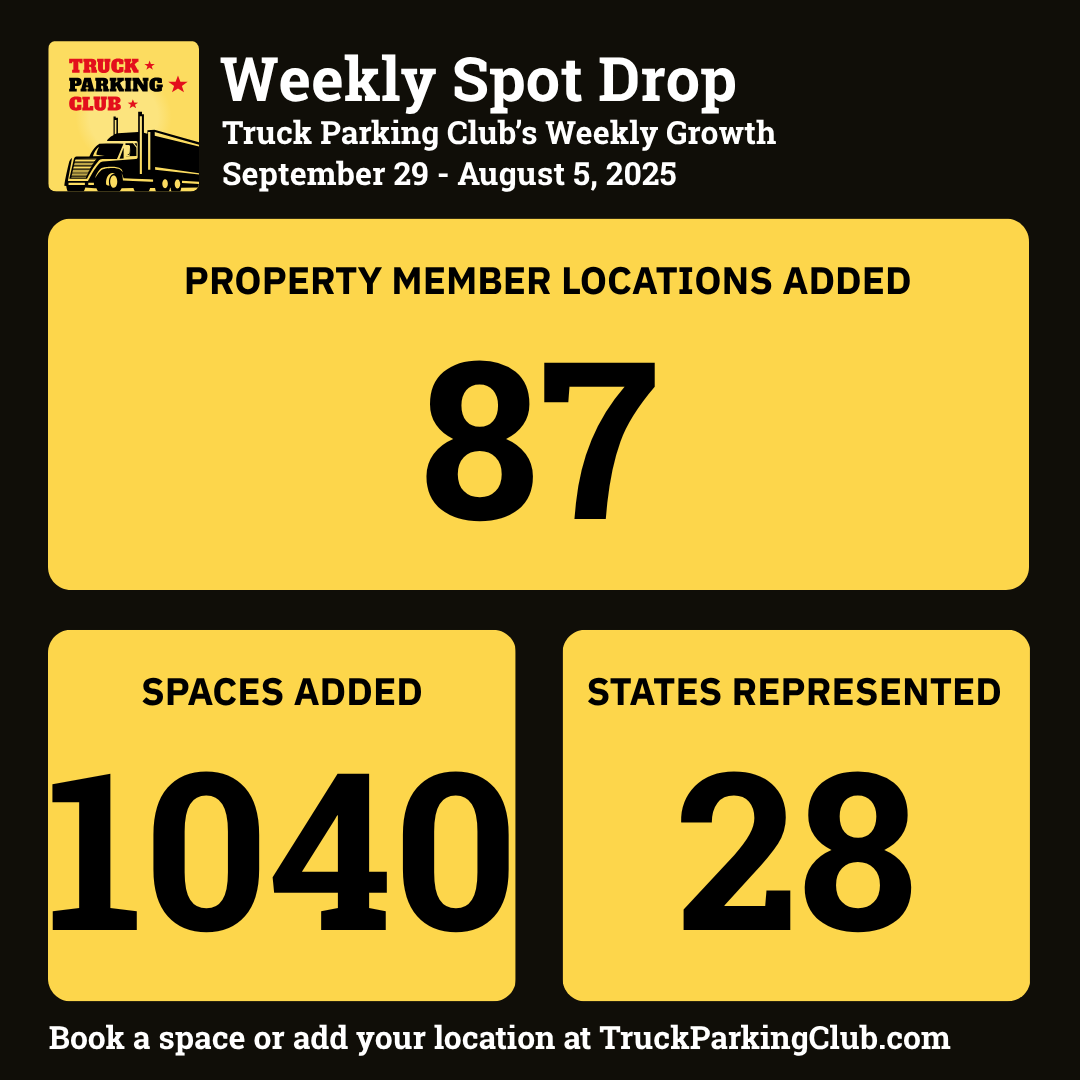
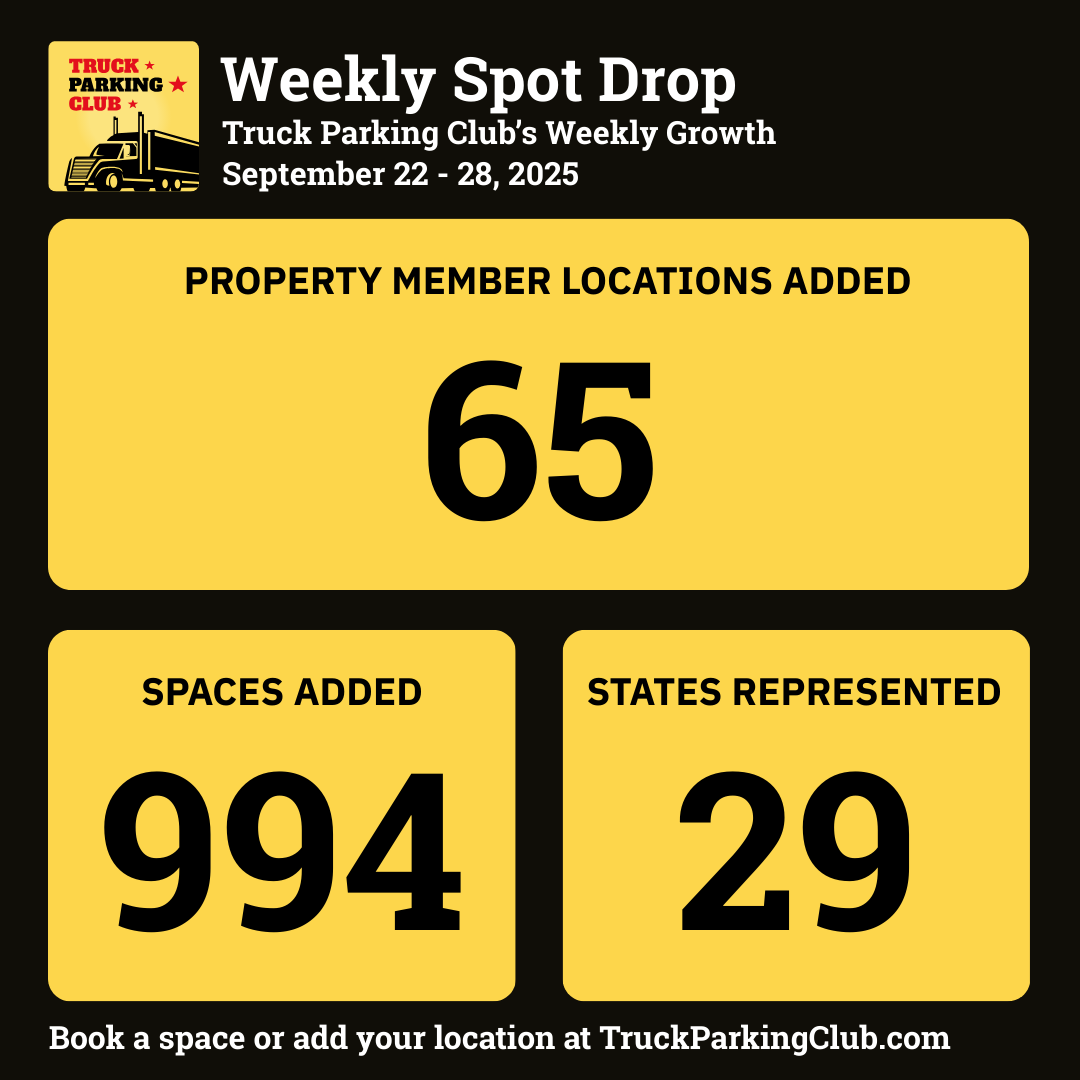
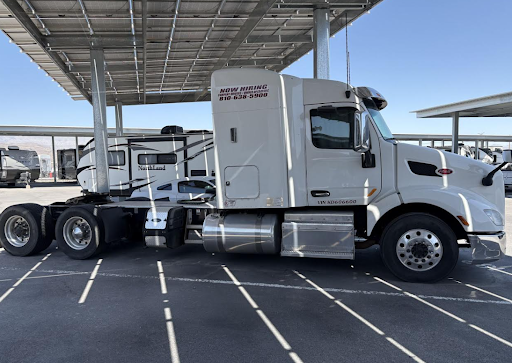
We added 87 new truck parking locations with 1,040 spaces across 28 states this week bringing our total truck parking location count to 2966. Another strong expansion giving drivers more reliable parking options across key trucking routes nationwide.
With drivers spending 56 minutes every day just looking for a place to park, these new locations continue to reduce search time and stress for drivers across the country.
Where We Added the Most Spaces
Texas: 18 locations, 362 spaces Massive week with 100 spaces in Burleson, 70 spaces in Dallas, and 60 spaces in Laredo. Major relief for Dallas, Houston, and border corridor drivers.
Michigan: 5 locations, 189 spaces Outstanding expansion with 125 spaces in Dearborn Heights, plus 50 additional spaces also in Dearborn Heights. Huge help for Detroit area and I-75 drivers.
New Jersey: 3 locations, 59 spaces Strong addition with 40 spaces in Secaucus, 13 spaces in Newark, and 6 spaces in Egg Harbor Township. Great for Northeast corridor traffic.
Georgia: 2 locations, 54 spaces Solid growth with 50 spaces in Rossville and 4 spaces in Tallapoosa. Big help for I-75 drivers.
Ohio: 2 locations, 52 spaces Good week with 50 spaces in Grove City and 2 spaces in Tiffin. Helpful for I-70 and I-71 corridors.
The South and Midwest dominated this week’s expansion. Texas continues leading with 362 spaces across 18 locations, including those massive additions in Burleson (100 spaces), Dallas (70 spaces), and Laredo (60 spaces) that will be game-changers for drivers in major metropolitan areas and border crossings.
Michigan had an exceptional week with 189 spaces, including that huge 175-space expansion in Dearborn Heights that will provide much-needed relief for Detroit area traffic and I-75 routes.
The New Jersey expansion, particularly that 40-space Secaucus location, provides critical relief for Northeast corridor drivers dealing with some of the toughest parking challenges in the country.
Perfect for Every Parking Need
Whether you’re a driver or carrier, these new locations support all your parking requirements:
Overnight Parking: Secure, well-lit locations for safe rest stops. No more worrying about theft or safety issues when you need to shut down for the night.
34-Hour Reset: Dedicated spaces for your mandatory reset periods. Book in advance to guarantee your spot and avoid scrambling to find parking when your clock runs out.
On-Demand Drop Trailer Yards: Quick trailer drops and pickups for efficient freight operations. Perfect for carriers managing multiple loads and drivers.
Relay Yards: Strategic locations for driver changes and equipment swaps. Keep your freight moving while ensuring driver compliance and safety.
Long-Term Storage: Extended parking for trailers and equipment when not in active use. Cost-effective storage solutions that keep your assets secure and accessible.
How to Book
Download the Truck Parking Club app or go to truckparkingclub.com to reserve your location. You can book hourly, daily, weekly, or monthly. Our customer service team is available 24/7, and they’re all former truckers who get it.
We’re now at over 2,500 locations with more than 45,000 parking spaces nationwide. All locations are safe, legal, and reservable.
Got Land? Make Money
If you own property that could work for truck parking, you can list it with us for free. No upfront costs, no long-term contracts. Property owners make passive income while helping solve the parking shortage.
We’ll help you set competitive rates and provide up to $25,000 damage coverage.
More Locations Coming
We add new truck parking locations every week. This week we covered 28 states with strong growth across the South and Midwest. Check back here or follow us for updates on where we’re expanding next.
Texas: 7 locations, 272 spaces Strong week with 100 spaces each in Fort Worth and Houston, plus 50 spaces in Needville. Major relief for Dallas and Houston area drivers.
Illinois: 4 locations, 176 spaces Excellent expansion with 100 spaces in Kewanee, 70 spaces across Blue Island locations, and 10 spaces in Chicago. Great for I-55 and I-80 drivers.
Missouri: 5 locations, 126 spaces Solid growth including 69 spaces in Kennett, 50 spaces in Lebanon, and smaller locations in Carrollton and Adrian. Big help for I-70 and I-44 corridors.
Ohio: 2 locations, 79 spaces Major addition with 75 spaces in Middletown and 4 spaces in Huber Heights. Helpful for I-75 drivers.
Florida: 2 locations, 102 spaces Great week with 100 spaces in Royal Palm Beach and 2 spaces in Punta Gorda. Excellent for I-95 corridor.
The Midwest and South dominated this week’s expansion. Texas continues leading with 272 spaces across 7 locations, including those massive 100-space additions in Fort Worth and Houston that will be game-changers for drivers in the Dallas and Houston metro areas.
Illinois had an outstanding week with 176 spaces, including that huge 100-space Kewanee location and solid additions in the Chicago area. Missouri drivers got excellent coverage with 126 new spaces spread across 5 strategic locations.
The Ohio expansion, particularly that 75-space Middletown location, provides much-needed relief for I-75 traffic between Cincinnati and Dayton.
Perfect for Every Parking Need
Whether you’re a driver or carrier, these new locations support all your parking requirements:
Overnight Parking: Secure, well-lit locations for safe rest stops. No more worrying about theft or safety issues when you need to shut down for the night.
34-Hour Reset: Dedicated spaces for your mandatory reset periods. Book in advance to guarantee your spot and avoid scrambling to find parking when your clock runs out.
On-Demand Drop Trailer Yards: Quick trailer drops and pickups for efficient freight operations. Perfect for carriers managing multiple loads and drivers.
Relay Yards: Strategic locations for driver changes and equipment swaps. Keep your freight moving while ensuring driver compliance and safety.
Long-Term Storage: Extended parking for trailers and equipment when not in active use. Cost-effective storage solutions that keep your assets secure and accessible.
How to Book
Download the Truck Parking Club app or go to truckparkingclub.com to reserve your location. You can book hourly, daily, weekly, or monthly. Our customer service team is available 24/7, and they’re all former truckers who get it.
We’re now at over 2,500 locations with more than 44,000 parking spaces nationwide. All locations are safe, legal, and reservable.
Got Land? Make Money
If you own property that could work for truck parking, you can list it with us for free. No upfront costs, no long-term contracts. Property owners make passive income while helping solve the parking shortage.
We’ll help you set competitive rates and provide up to $25,000 damage coverage.
More Locations Coming
We add new truck parking locations every week. This week we covered 29 states with solid growth across the Midwest and South. Check back here or follow us for updates on where we’re expanding next.
We now now offers 49,000+ parking spaces across 49 states, cutting driver search time and costs
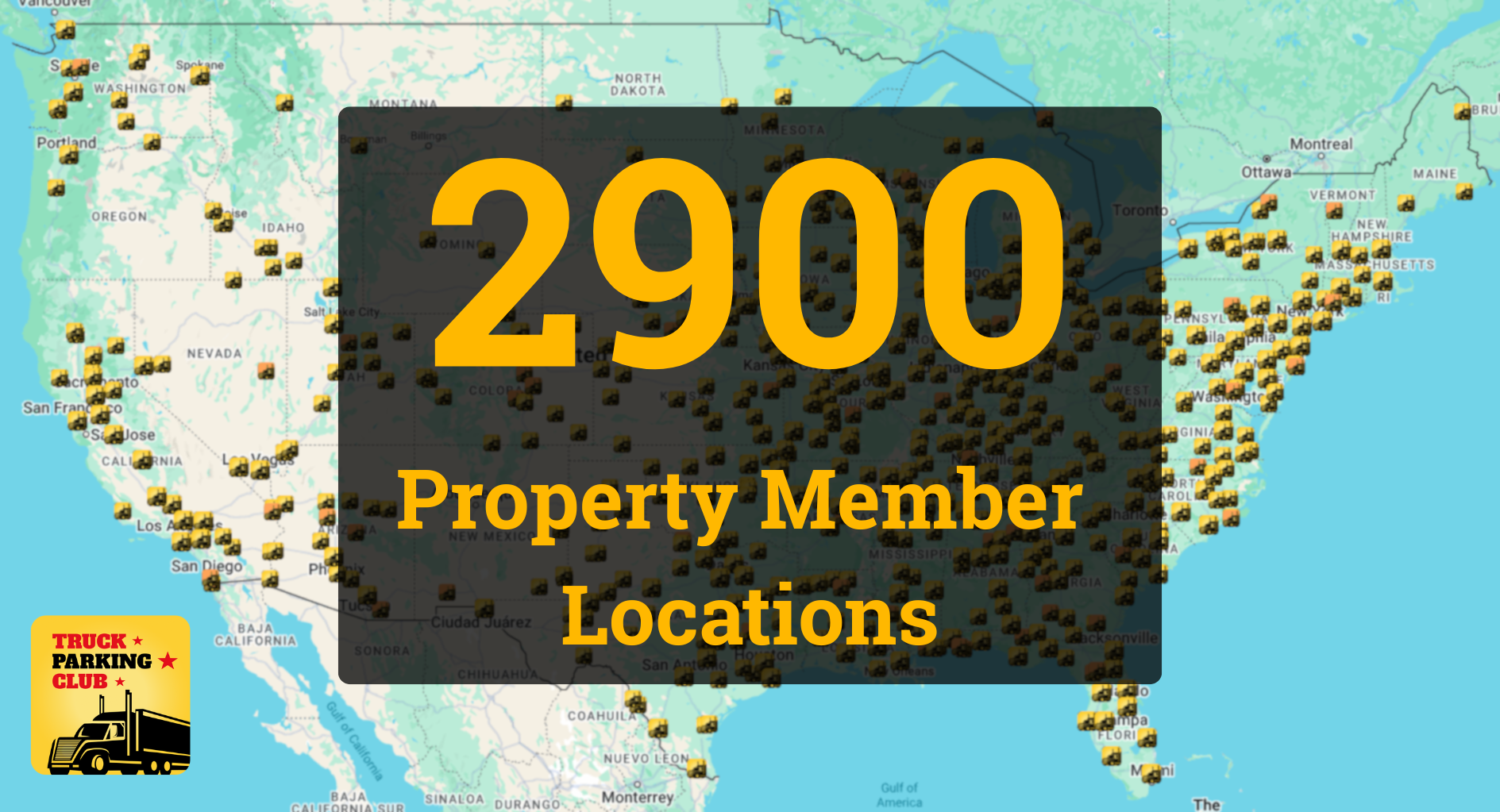
Truck Parking Club has reached a major milestone: 2,900 Property Member locations providing over 49,000 truck parking spaces across 49 states (excluding Hawaii). This isn’t just about hitting a number – it’s about solving the critical shortage that forces drivers to spend 56 minutes daily searching for safe parking.
From 2,000 to 2,900: Rapid Growth Driven by Real Need
Since hitting 2,000 locations in May 2025, we’ve added 900 more locations in just 4 months. This growth is driven by urgent demand from truck drivers seeking reliable parking and property owners looking to monetize unused space.
Diverse Network, Maximum Coverage
Our Property Members include trucking companies, repair shops, storage facilities, real estate investors, truck stops, and independent parking operators. This diverse network creates a scalable solution to a problem traditionally addressed through expensive infrastructure projects.
New truck parking construction typically costs $100,000-$200,000 per space and takes years to complete. Truck Parking Club can activate existing spaces within a day, transforming unused property into income-generating locations while giving drivers the certainty they need.
The Real Impact
With locations in 49 states, drivers can find safe, reliable parking whether they’re hauling freight from California to New York or making deliveries in rural Montana. Every new Property Member location means:
Less time searching for parking
More time earning on the road
Reduced stress about overnight parking
Better route planning with verified locations
Looking Ahead: 10,000 Locations and Beyond
As we celebrate this milestone, we’re setting our sights on 10,000 locations. Our goal remains clear: reduce parking search time to under 10 minutes per day.
The platform offers hourly, daily, weekly, and monthly reservations through truckparkingclub.com and mobile apps, backed by 24/7 customer service staffed by former truck drivers.
Ready to find your next parking spot? Visit truckparkingclub.com to access our network of 49,000+ truck parking spaces.
Property owners:Join our network and start monetizing your unused space today.
The City of Converse, Texas has taken decisive action to address growing concerns about commercial and oversized vehicles parking in residential areas. A new ordinance, announced by the Converse Police Department on September 18, 2025, establishes strict parking restrictions with penalties up to $500 for violations, marking a significant shift in how the city handles commercial vehicle parking.
The New Ordinance: Comprehensive Restrictions
The ordinance targets two specific categories of vehicles that have been causing problems in residential neighborhoods:
Commercial Vehicles
Semi-trailers
Buses
Tractors
Delivery trucks
Oversized Vehicles
Vehicles 24 feet or longer in length
Vehicles 8 feet or wider
Vehicles with trailers extending more than 7 feet
Key Restrictions and Penalties
The new ordinance establishes several critical restrictions:
Private Property Restrictions
No parking in private driveways unless providing service to the resident (limited to 2 hours)
No parking in front yards or side yards except for service purposes
Service vehicles must not block sidewalks or extend into the street
Public Street Restrictions
No parking on public streets unless actively loading/unloading or dealing with emergency repairs
No parking on residential streets at any time, even without posted signs
City can post “No Truck Park” signs on other roads if complaints arise
Penalty Structure
Violations can result in:
Fines up to $500
Towing and impoundment
Citations
Immediate enforcement at the owner’s expense
Weight Limit Restrictions on Specific Streets
The ordinance also establishes weight limits on certain roadways:
80,000-Pound Weight Limit
Upper Seguin Road
Lower Seguin Road
Toepperwein Road
Kitty Hawk Road
Gibbs Sprawl Road
Legion Street
20,000-Pound Weight Limit
Schaefer Road
Rocket Lane
Kneupper Road
Only light trucks (pick-up trucks, panel delivery trucks, and carryall trucks under 2,000 pounds) are permitted on these restricted streets.
Community Response: Mixed Reactions
The ordinance has generated significant community discussion, with residents expressing both support and opposition:
Supportive Voices
“Finally, that U-Haul trailer will stop blocking the turn on our road!”
“So glad to see this is finally done. No more listening to that loud idle for hours at a time, no more obstructed views causing safety issues. Residential streets just aren’t designed to handle the weight or size.”
Concerned Property Owners
“Wait. How does the City get to dictate what I can park in my driveway, on my property that I not only pay a mortgage on, but also pay property taxes on?”
“When is the next town meeting? I would love the opportunity to have a vote against this policy.”
What’s Not Affected
The city has clarified that the ordinance does not impact:
Everyday vehicles such as SUVs, cars, or pickup trucks
Recreational vehicles (RVs) are specifically excluded from the ordinance
The Broader Context: Texas Truck Parking Challenges
Converse’s new ordinance reflects a growing trend across Texas communities to address truck parking issues through stricter enforcement. The state faces unique challenges due to its extensive highway network and significant commercial trucking activity.
According to the Texas Department of Transportation, Texas has over 80,000 miles of public roads and serves as a critical corridor for interstate commerce, making truck parking management a priority for many communities.
Implementation and Enforcement
The Converse Police Department will be responsible for enforcing the new ordinance. The department has emphasized that violations can result in immediate enforcement, including towing and impoundment at the owner’s expense.
How Truck Parking Club Provides Solutions
While enforcement addresses the immediate problem, private solutions like Truck Parking Club can help provide legal parking alternatives for commercial vehicle operators:
For Property Owners in Converse and Surrounding Areas
Converse’s approach demonstrates how smaller Texas communities can address truck parking issues through comprehensive ordinances. The combination of:
Clear vehicle classifications
Specific weight restrictions
Substantial penalties for violations
Immediate enforcement capabilities
Shows how local governments can take decisive action to protect residential communities while maintaining the flow of commercial traffic.
The Path Forward
The success of Converse’s new ordinance will depend on several factors:
Consistent enforcement by the Converse Police Department
Awareness among trucking companies about the new restrictions
Availability of alternative parking options for drivers
Ongoing community feedback to ensure the solution addresses all concerns
Balanced approach that protects neighborhoods while supporting commerce
Looking Ahead
As the ordinance takes effect, Converse residents should begin to see improvements in their neighborhoods. The key to long-term success will be:
Effective enforcement of the new restrictions
Partnerships between law enforcement, trucking companies, and local communities
Continued development of legitimate parking options for commercial vehicles
Regular review of the ordinance’s effectiveness and community impact
This initiative represents more than just parking restrictions—it’s a commitment to maintaining the quality of life in Converse neighborhoods while ensuring that commercial trucking operations can continue safely and legally.
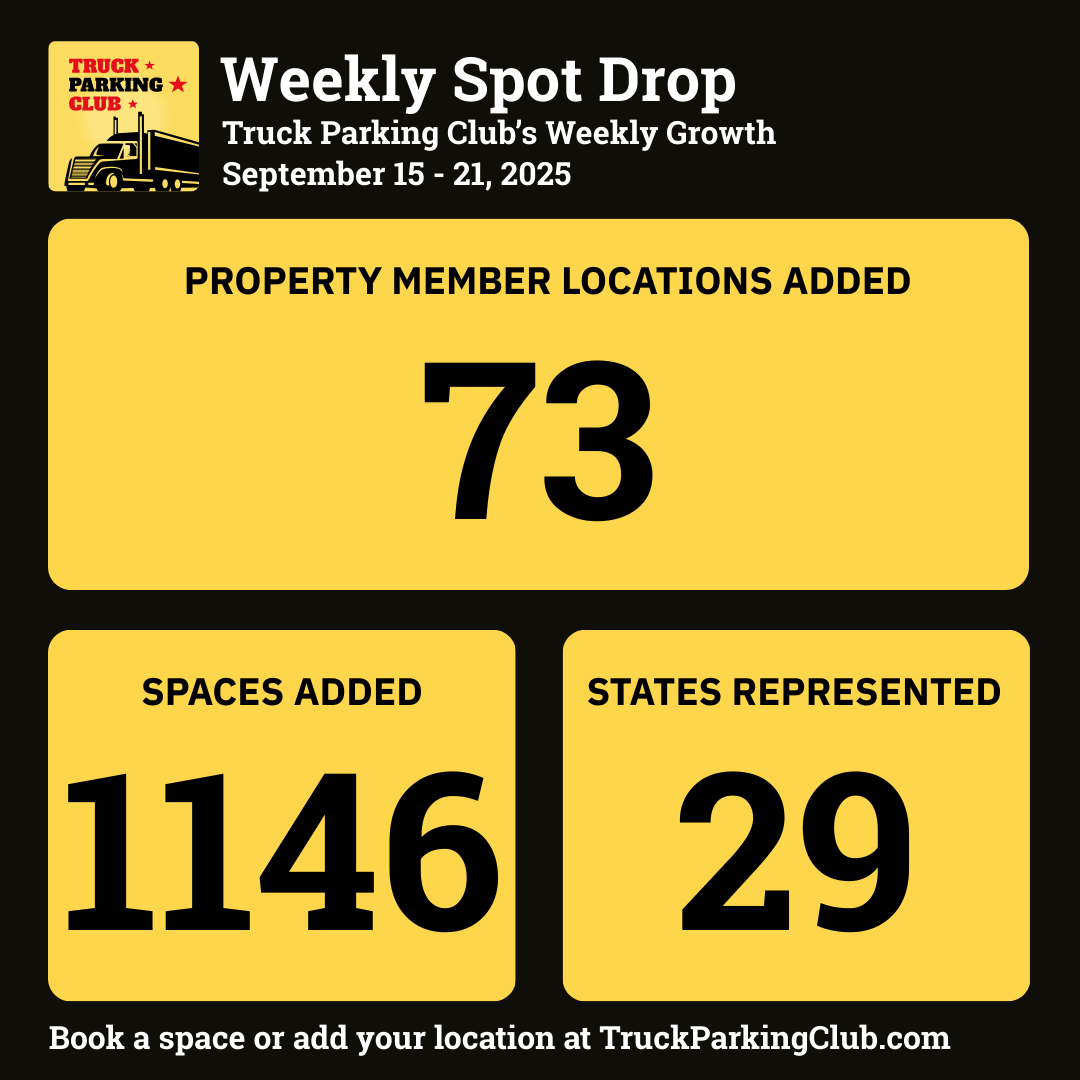
We added 76 new truck parking locations with 1,146 spaces across 29 states this week. That’s our biggest expansion yet, giving drivers significantly more options across major trucking corridors nationwide.
With drivers spending 56 minutes every day just looking for a place to park, these new locations are going to dramatically reduce search time and stress for drivers across the country.
Where We Added the Most Spaces
Texas: 8 new locations, 245 spaces Massive addition including 85 spaces in Fort Worth and 75 spaces in Wilmer. Major relief for Dallas and Houston area drivers.
Georgia: 2 new locations, 209 spaces Huge expansion with 197 spaces in Dublin and 12 spaces in Macon. Big help for I-75 and I-95 drivers.
Michigan: 4 new locations, 105 spaces Strong week including 100 spaces in Woodhaven and 2 spaces in Roscommon. Great for drivers on I-75 and I-94.
Florida: 5 new locations, 101 spaces Solid growth with 50 spaces in Lakeland and 25 spaces in Ocala. Helpful for I-95 and I-75 corridors.
California: 4 new locations, 60 spaces Good addition with 30 spaces in San Bernardino and 15 spaces in Rialto. Big help for Southern California routes.
The South got a massive boost with Texas leading the way at 245 spaces. That Fort Worth location alone will save drivers hours of searching around Dallas. The Southeast saw strong growth with Georgia adding 209 spaces across 2 locations, including that huge 197-space Dublin location.
Michigan drivers got much-needed relief with 105 new spaces, including that massive 100-space Woodhaven location that will be a game-changer for I-75 and I-94 routes.
Perfect for Every Parking Need
Whether you’re a driver or carrier, these new locations support all your parking requirements:
Overnight Parking: Secure, well-lit locations for safe rest stops. No more worrying about theft or safety issues when you need to shut down for the night.
34-Hour Reset: Dedicated spaces for your mandatory reset periods. Book in advance to guarantee your spot and avoid scrambling to find parking when your clock runs out.
On-Demand Drop Trailer Yards: Quick trailer drops and pickups for efficient freight operations. Perfect for carriers managing multiple loads and drivers.
Relay Yards: Strategic locations for driver changes and equipment swaps. Keep your freight moving while ensuring driver compliance and safety.
Long-Term Storage: Extended parking for trailers and equipment when not in active use. Cost-effective storage solutions that keep your assets secure and accessible.
How to Book
Download the Truck Parking Club app or go to truckparkingclub.com to reserve your location. You can book hourly, daily, weekly, or monthly. Our customer service team is available 24/7, and they’re all former truckers who get it.
We’re now at over 2,500 locations with more than 43,000 parking spaces nationwide. All locations are safe, legal, and reservable.
Got Land? Make Money
If you own property that could work for truck parking, you can list it with us for free. No upfront costs, no long-term contracts. Property owners make passive income while helping solve the parking shortage.
We’ll help you set competitive rates and provide up to $25,000 damage coverage.
More Locations Coming
We add new truck parking locations every week. This week we covered 29 states – our widest coverage yet. Check back here or follow us for updates on where we’re expanding next.
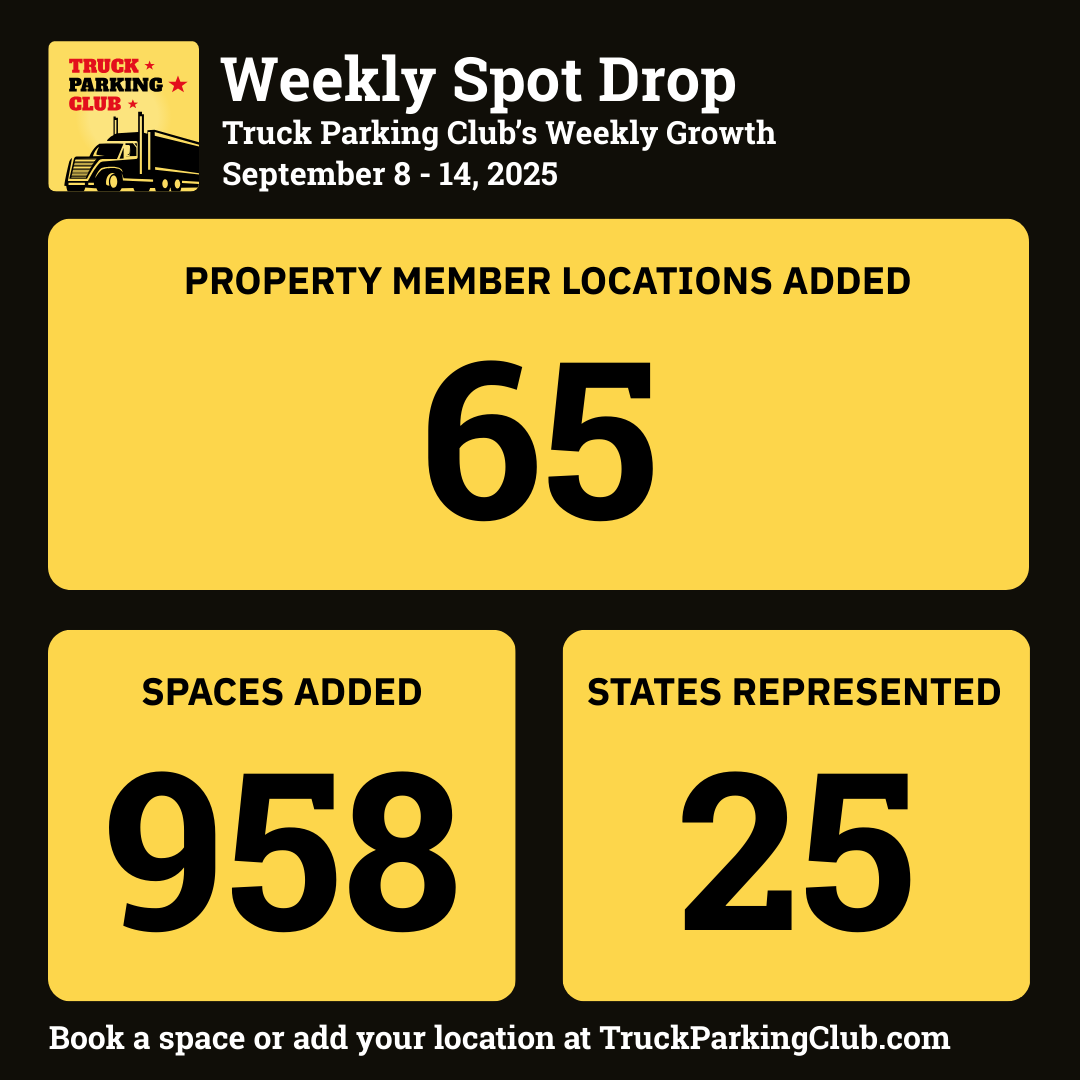
We added 64 new truck parking locations with 958 spaces across 25 states this week. That’s our biggest expansion yet, giving drivers significantly more options across major trucking corridors nationwide.
With drivers spending 58 minutes every day just looking for a place to park, these new locations are going to dramatically reduce search time and stress for drivers across the country.
Where We Added the Most Spaces
Georgia: 3 new locations, 120 spaces Massive addition including 60 spaces in Macon and 30 spaces in Valdosta. Major relief for I-75 and I-95 drivers.
Texas: 7 new locations, 108 spaces Strong week including 40 spaces in Mt. Juliet and 20 spaces in San Antonio. Big help for Houston and Dallas area routes.
New York: 4 new locations, 101 spaces Solid expansion with 100 spaces in Syracuse and 1 space in Port Jefferson Station. Great for drivers on I-90 and I-95.
Florida: 4 new locations, 95 spaces Good growth with 50 spaces in Fruitland Park and 20 spaces in Jacksonville. Helpful for I-95 and I-75 corridors.
Tennessee: 2 new locations, 50 spaces Strong addition with 40 spaces in Mt. Juliet and 10 spaces in Lascassas. Big help for Nashville area routes.
The Southeast got a massive boost with Georgia leading the way at 120 spaces. That Macon location alone will save drivers hours of searching around Atlanta. The South saw strong growth with Texas adding 108 spaces across 7 locations, including major spots in Mt. Juliet and San Antonio.
New York drivers got much-needed relief with 101 new spaces, including that huge 100-space Syracuse location that will be a game-changer for I-90 and I-95 routes.
Perfect for Every Parking Need
Whether you’re a driver or carrier, these new locations support all your parking requirements:
Overnight Parking: Secure, well-lit locations for safe rest stops. No more worrying about theft or safety issues when you need to shut down for the night.
34-Hour Reset: Dedicated spaces for your mandatory reset periods. Book in advance to guarantee your spot and avoid scrambling to find parking when your clock runs out.
On-Demand Drop Trailer Yards: Quick trailer drops and pickups for efficient freight operations. Perfect for carriers managing multiple loads and drivers.
Relay Yards: Strategic locations for driver changes and equipment swaps. Keep your freight moving while ensuring driver compliance and safety.
Long-Term Storage: Extended parking for trailers and equipment when not in active use. Cost-effective storage solutions that keep your assets secure and accessible.
How to Book
Download the Truck Parking Club app or go to truckparkingclub.com to reserve your location. You can book hourly, daily, weekly, or monthly. Our customer service team is available 24/7, and they’re all former truckers who get it.
We’re now at over 2,500 locations with more than 43,000 parking spaces nationwide. All locations are safe, legal, and reservable.
Got Land? Make Money
If you own property that could work for truck parking, you can list it with us for free. No upfront costs, no long-term contracts. Property owners make passive income while helping solve the parking shortage.
We’ll help you set competitive rates and provide up to $25,000 damage coverage.
More Locations Coming
We add new truck parking locations every week. This week we covered 25 states. Check back here or follow us for updates on where we’re expanding next.
It’s National Truck Driver Appreciation Week (September 14-20), and we’re putting our money where our mouth is.
Use code thanks2025 (all lowercase) for $50 off truck parking at any of our 47,000+ spaces nationwide.
What We’re Doing
We’re working hard to add more locations every day to support drivers. With 2,800+ Property Member locations already live across the US, you can book instantly—no membership fees, no BS.
Truck Parking Club: 47,000+ reservable spaces at 2,800+ locations. No membership fees. Real support from real truckers. Find parking at truckparkingclub.com/truck-parking
Fleet managers face a persistent challenge that drains budgets and complicates operations: trailer parking.
Industry data shows fleets waste an average of $47,000 annually on underutilized parking contracts. Dispatchers spend 3-5 hours per week coordinating drop lot access across multiple vendors. And when routes change or seasonal volumes shift, fleets remain locked into contracts for spaces they no longer need.
The traditional approach—long-term contracts, fragmented vendors, limited visibility—is increasingly incompatible with modern logistics demands.
This guide explores how flexible, on-demand trailer parking and drop lot solutions are reshaping fleet operations, along with practical frameworks for evaluating providers and calculating potential savings.
What Is Trailer Parking and Drop Lot Access?
On-demand trailer parking provides fleets with instant access to secure drop lots and trailer storage facilities without contracts or long-term commitments.
Instead of locking into monthly agreements with multiple vendors, dispatchers book trailer parking spaces or drop yards near key freight corridors as needed—paying only for actual usage.
This flexible approach addresses several critical operational challenges:
Seasonal capacity fluctuations without paying for year-round overhead
Route optimization and new lane expansion without infrastructure investments
Real-time trailer and equipment tracking from centralized platforms
Budget control with usage-based pricing instead of fixed contracts
Emergency parking solutions when regular yards reach capacity
Whether called a drop lot, drop yard, trailer storage facility, or equipment parking, the fundamental value proposition remains consistent: safe, flexible, and scalable space that adapts to actual fleet requirements.
The True Cost of Traditional Drop Yard Contracts
Most fleets significantly overpay for trailer parking—often without visibility into the actual waste.
A typical mid-sized fleet maintains 3-5 monthly parking contracts across different locations, each averaging $800-$2,000 per month. During off-peak periods or after route adjustments, utilization rates frequently drop to 40-60%. Those empty spaces represent pure waste.
Hidden Costs Beyond the Monthly Invoice
Unused capacity: During slow seasons, fleets often pay $6,000-$15,000 monthly for spaces that sit empty. Unlike on-demand solutions, contracted space can’t be scaled down without penalties or lengthy negotiations.
Vendor management overhead: Coordinating with multiple drop yard operators—each with different billing cycles, policies, and communication preferences—consumes significant administrative resources.
Accounting complexity: Finance teams process separate invoices, reconcile driver reimbursements, and track parking expenses across disparate systems. This administrative burden often goes unquantified in total cost analyses.
Equipment visibility gaps: Traditional drop yards rarely provide digital tracking or integration with fleet management systems, leaving dispatchers without real-time visibility into trailer locations.
Route inflexibility: When customer needs shift or new lanes open, existing contracts create friction. Fleets either maintain unused capacity at old locations while paying for new spaces, or navigate complex early termination negotiations.
Driver productivity loss: Without centralized booking systems, drivers call facilities individually to check availability, especially during peak periods or in unfamiliar territories.
Industry research indicates fleets typically waste 30-40% of their contract parking budget on unused capacity and administrative overhead. For a mid-sized operation, this translates to $18,000-$28,000 in annual waste.
Key Benefits of Flexible Drop Lot and Trailer Parking Solutions
Immediate Cost Reduction
Usage-based pricing eliminates payment for empty spaces during slow periods or after route changes. Fleets only pay for the trailer parking and drop lot capacity they actually use.
Data from fleets that have transitioned to flexible parking models shows average cost reductions of 35-50%, or $1,200-$3,500 monthly for typical operations. Savings vary based on current utilization rates and seasonal fluctuations.
Operational Efficiency
Modern platforms enable dispatchers to book trailer parking or drop lot space in under 30 seconds—no phone calls, no waiting for callbacks, no coordinating with multiple vendors.
This efficiency translates to meaningful time savings. Dispatchers report recovering 10-15 hours per week previously spent on parking coordination, allowing them to focus on route optimization and customer service.
Complete Fleet Visibility
Centralized platforms provide real-time visibility into every trailer’s location, which drivers booked which spaces, and total parking expenditure across all locations.
This visibility proves valuable for:
Asset management and equipment utilization analysis
Theft prevention and security
Financial reporting and budget forecasting
Compliance documentation and audit trails
Scalability Without Commitment
Flexible models enable fleets to expand into new markets, test shipping lanes, or add seasonal capacity without long-term infrastructure commitments.
This de-risks expansion significantly. Need 20 extra trailer storage spots for Q4 peak season? Book them October-December only. Testing a new customer route? Reserve drop lot access for 30-60 days to validate economics before scaling.
How Modern Trailer Parking Platforms Work
While specific features vary by provider, most flexible trailer parking platforms share common operational elements:
Network-Based Approach
Modern solutions aggregate thousands of parking locations—from dedicated truck parking operators to property owners with excess space—into searchable networks accessible through mobile apps and web platforms.
Leading platforms now offer 2,000-5,000+ vetted locations across major freight corridors, industrial hubs, and metro markets nationwide.
Digital Booking and Access
Drivers search available spaces by location, filter by needed amenities (gating, cameras, reefer plugs), and complete bookings in seconds. Access codes or gate credentials arrive instantly via text and email.
This digital-first approach eliminates phone tag and provides documentation of every transaction.
Centralized Fleet Management
Fleet accounts aggregate all drivers under unified billing. Dispatchers gain dashboard visibility into bookings, spending, and trailer locations. Finance teams receive consolidated invoicing instead of reconciling dozens of separate vendors.
Flexible Pricing Models
Most platforms offer multiple pricing tiers:
Hourly rates for short-term drops
Daily rates for overnight parking
Weekly rates for relay points or temporary storage
Monthly rates for consistent needs (but without traditional contracts)
This flexibility allows fleets to optimize costs based on actual usage patterns rather than over-provisioning for peak capacity.
Types of Trailer Parking and Drop Lots Available
Flexible parking networks typically include diverse facility types to meet varying operational requirements:
Drop and Hook Yards: Dedicated facilities designed for relay operations and trailer swaps between drivers. Often located near interstate junctions for efficient team operations.
Overnight Trailer Parking: Short-term secure parking for trailers between loads or during driver rest periods.
Long-Term Trailer Storage: Monthly options for overflow equipment, seasonal trailers, or extra capacity—but without traditional long-term lease commitments.
Bobtail Parking: Separate spaces for tractors after dropping trailers, enabling drivers to return home or access rest areas independently.
Distribution Center Overflow: Expanded capacity near customer facilities, warehouses, and shipping hubs during peak seasons.
Secure Equipment Storage: Enhanced-security facilities for high-value loads, temperature-controlled trailers, or specialized equipment requiring additional protection.
Evaluating Drop Lot Providers: Key Considerations
When assessing trailer parking solutions—whether traditional or flexible—consider these critical factors:
Network Coverage and Density
Evaluate whether available locations align with your actual routes and freight lanes. A provider with 5,000 locations is less valuable if most fall outside your operating territory than one with 500 locations precisely where your fleet operates.
Security Standards and Vetting
Understand how providers vet and monitor facilities. Key security elements include:
Gated access with controlled entry
Surveillance camera systems
Adequate lighting
Secure fencing and perimeters
Regular facility inspections
Insurance and Liability Coverage
Review what damage protection or liability coverage comes standard with bookings. This proves especially important for high-value loads or expensive equipment.
Traditional drop yards often provide minimal or no coverage, leaving fleets exposed. Some modern platforms include up to $25,000 damage coverage per booking.
Customer Support Structure
Consider when and how support is available. Fleet operations don’t stop at 5 PM, so parking support shouldn’t either.
Evaluate:
Support hours (24/7 vs. business hours only)
Response time commitments
Communication channels (phone, text, app, email)
Industry experience of support staff
Technology and Integration
Assess how well the platform integrates with existing fleet management systems, accounting software, and driver workflows. Look for:
Mobile app quality and reliability
Real-time availability accuracy
Booking modification flexibility
Reporting and data export capabilities
Pricing Transparency
Understand the complete fee structure beyond headline rates. Some providers add:
Booking fees or transaction charges
Monthly platform fees
Payment processing fees
Cancellation penalties
Calculate total cost including all fees for accurate comparisons.
Common Fleet Use Cases for Flexible Drop Lot Solutions
Relay Operations and Driver Handoffs
Regional and long-haul fleets utilize drop lots near major interstates as efficient relay points where drivers swap trailers without route deviations.
Example: A national LTL carrier running Memphis-Oklahoma City relays previously maintained a dedicated facility contract in Little Rock at $2,400 monthly. By switching to on-demand booking at the same location, they reduced costs to $600-800 monthly average—saving approximately $19,200 annually while maintaining identical operations.
Seasonal Overflow and Peak Capacity
Flexible parking enables fleets to handle Q4 holiday surges, harvest season volume, or summer construction peaks without maintaining year-round overcapacity.
Example: A refrigerated carrier hauling California produce needs 30% more trailer storage near distribution centers during harvest season (June-October). Using flexible drop lots prevents paying for unused capacity November-May—approximately $42,000 in annual savings while still meeting peak demand.
New Lane Development and Market Testing
Testing new shipping lanes or customer routes with flexible parking bookings eliminates infrastructure risk before validating lane profitability.
Example: A dedicated carrier landed a new customer requiring Phoenix deliveries. Rather than immediately signing a 12-month drop yard lease, they used on-demand parking for 90 days to validate economics. When the route proved profitable, they scaled gradually—completely de-risking the expansion.
Emergency Parking and Backup Capacity
When primary yards reach capacity, equipment needs emergency repairs, or drivers face unexpected delays, flexible platforms provide immediate alternatives.
Example: A Midwest fleet experienced unexpected facility maintenance closing their primary drop yard for 5 days. Dispatchers immediately booked backup trailer storage at nearby locations through an on-demand platform—maintaining operations without disruption.
Strategic Equipment Positioning
Positioning trailers near customer facilities, distribution centers, or high-demand freight areas reduces deadhead miles and improves load efficiency.
Example: An intermodal drayage company strategically parks empty containers near rail terminals using flexible access, reducing repositioning costs by 25% while improving driver utilization rates.
Real Fleet Results: What Savings Look Like
Understanding actual implementation results helps set realistic expectations:
Regional LTL Carrier (75 Trucks)
Starting situation: $6,400 monthly across contracted drop lots in Chicago, Indianapolis, and Columbus. January-March utilization dropped to 40% during slow season.
Approach: Transitioned to flexible parking while maintaining one core facility for highest-volume location.
12-month results:
Average monthly parking costs: $3,800 (41% reduction)
Access to 50+ additional locations for route flexibility
Annual savings: $31,200
Administrative time recovered: ~8 hours per month
Dedicated Contract Carrier (120 Trucks)
Starting situation: Expanding into Southeast markets but hesitant to commit to long-term drop yard leases before validating customer demand and route profitability.
Approach: Used flexible booking to test Atlanta, Charlotte, and Jacksonville lanes for 90 days.
Results:
Validated profitability of two lanes before infrastructure commitment
Avoided $60,000+ in lease costs for third lane that proved unprofitable
Scaled successful lanes gradually with on-demand capacity
Reduced market entry risk substantially
Refrigerated Carrier (200+ Trucks)
Starting situation: Required 35% additional trailer storage during harvest season (June-October) but couldn’t justify paying for unused capacity seven months annually.
Approach: Maintained baseline contracts for core capacity, added seasonal overflow through flexible parking.
Results:
Handled peak season without infrastructure investment
Annual savings: $48,000 from avoiding year-round overcapacity
Improved customer service during critical harvest periods
Precise capacity scaling matching actual demand
Calculating Your Potential Drop Lot Savings
Use this framework to estimate savings from transitioning to flexible trailer parking:
Step 1: Calculate Total Current Costs
Add up all monthly contract parking fees across locations:
This represents conservative estimation. Additional savings often come from:
Reduced deadhead miles (more parking location options)
Fewer driver reimbursements and expense reports
Improved trailer utilization and asset management
Eliminated vendor negotiation and management time
Implementation: Transitioning to Flexible Parking
Successful transitions typically follow a phased approach rather than immediate replacement of all existing contracts:
Phase 1: Test with Overflow (Month 1)
Begin with overflow capacity or seasonal needs rather than replacing core contracts. This low-risk approach validates the platform while maintaining familiar arrangements.
Phase 2: Deploy on New Lanes (Months 2-3)
Use flexible booking for new customer routes, lane testing, or market expansion before committing to permanent infrastructure. Prove economics before scaling.
Analyze utilization data from existing contracts. Replace lowest-performing locations (typically under 60% utilization) with on-demand alternatives. Begin realizing direct cost savings.
Phase 4: Scale Based on Results (Months 6-12)
After validating savings and operational efficiency, expand platform usage across more routes and locations. Most fleets report 35-50% cost reduction within the first year.
Frequently Asked Questions About Fleet Trailer Parking
How quickly can drop lot or trailer parking be booked?
Most modern platforms enable booking in under 30 seconds. Users select locations on maps, choose dates/times, and receive access details instantly via text and email with gate codes or entry instructions.
Can trailer parking be reserved in advance?
Yes—advance booking (days, weeks, or months ahead) locks in spaces for dedicated lanes and regular routes, ensuring availability during peak periods and improving dispatch planning visibility.
How does fleet billing typically work?
Consolidated platforms roll all driver bookings across locations into unified invoicing on chosen billing cycles (daily, weekly, monthly). Detailed reporting shows each booking with driver, location, dates, and costs. Many systems enable direct export to accounting software.
What if drivers need to extend trailer parking reservations?
Most apps allow one-tap extensions. If the original space remains available, extension processes automatically. If unavailable, systems display nearby alternatives. This typically requires no dispatcher or facility contact.
Are monthly rates available for consistent long-term needs?
Yes. Monthly pricing exists at most locations for fleets needing regular long-term trailer parking—but without traditional contract requirements or commitments. These arrangements typically offer cancellation or adjustment flexibility as needs change.
What security and insurance coverage should fleets expect?
This varies significantly by provider. Leading platforms include up to $25,000 damage coverage for equipment parked at network locations. Most facilities feature gated access, surveillance cameras, lighting, and secure entry systems. Evaluate providers based on their vetting standards and included coverage.
Major Market Coverage and Network Considerations
When evaluating flexible parking networks, assess coverage depth in your critical markets:
High-density requirements: Chicago, Atlanta, Dallas-Fort Worth, Los Angeles, Houston, Phoenix, Philadelphia, Memphis, Kansas City, Indianapolis, Columbus, Charlotte, Nashville
Border crossing proximity: Laredo, El Paso, San Diego, Detroit, Buffalo
Port access: Los Angeles/Long Beach, Savannah, Houston, New York/New Jersey, Charleston
Network size matters less than network relevance to your actual operations. A provider with locations precisely matching your routes and freight lanes delivers more value than one with massive coverage in areas you don’t operate.
The Evolution of Fleet Parking Management
As logistics margins tighten and operational demands accelerate, flexibility increasingly determines competitive advantage. Fixed infrastructure and fragmented vendor relationships struggle to match the adaptability modern supply chains require.
The emergence of technology-enabled, on-demand trailer parking platforms represents a fundamental shift—enabling fleets to access traditional parking benefits (security, reliability, coverage) while eliminating traditional drawbacks (long-term commitments, inflexibility, administrative complexity).
This doesn’t mean every fleet should immediately eliminate all parking contracts. Rather, the optimal approach for most operations combines strategic permanent capacity in highest-volume locations with flexible on-demand access everywhere else—creating a hybrid model that maximizes both cost-efficiency and operational flexibility.
Resources for Fleet Managers
Several resources can help evaluate whether flexible trailer parking makes sense for your operation:
Utilization analysis: Review 12 months of parking usage to identify underperforming contracts and seasonal patterns
Route mapping: Overlay current and planned routes against available parking networks to assess coverage fit
Cost modeling: Compare total costs (including administrative overhead) between current approach and flexible alternatives
Pilot programs: Test flexible platforms on one lane or region before broader implementation
Getting Started: Next Steps
For fleets interested in exploring flexible trailer parking solutions:
Evaluate your current state: Calculate total parking costs, utilization rates, and administrative overhead to establish a baseline.
Research available platforms: Compare network coverage in your key markets, security standards, pricing structures, and technology capabilities.
Start small: Test with overflow capacity or new lanes before replacing existing core contracts.
Measure and iterate: Track costs, utilization, and operational efficiency over 90 days, then expand based on proven results.
The logistics industry continues evolving toward greater flexibility and efficiency. Trailer parking and drop lot management—historically resistant to innovation—now offers fleets meaningful opportunities to reduce costs while improving operational agility.
Whether through comprehensive replacement of traditional contracts or strategic hybrid approaches, flexible parking solutions provide fleet managers with powerful tools to optimize one of their largest recurring expenses.
Want to explore how flexible trailer parking could work for your fleet?
Learn more about on-demand drop lot solutions at TruckParkingClub.com or call 888-899-PARK to discuss your specific operational needs.
Truck parking isn’t glamorous. It’s not the shiniest asset class or the one making headlines at the SSA conference. But make no mistake, it’s growing. In Midland, TX alone myself and one other operator were the only guys in town two years ago.
Now there are 12 separate locations.
Here’s a quick-start guide to take you from dirt lot to dependable income
1. Understand the Opportunity Truck parking is in chronic short supply—especially safe, secure, reservable parking. The rise of e-commerce, regional distribution hubs and tightening regulations on hours-of-service have made legal, reliable truck parking more critical than ever.
Most existing options are word-of-mouth yards or overcrowded rest stops. That’s where you come in. I’ve already written about this on another blog post here.
2. Find the Right Dirt Before you clear the land, make sure it’s in the right place.
Highway proximity is key — ideally near logistics corridors or urban perimeters.
Zoning matters. Look for industrial, heavy commercial, or even certain agricultural overlays that allow for vehicle storage.
Look for the “white tops” a.k.a. the distribution centers. If you can find a plot of land near a highway and next to distribution centers then you are onto something.
You don’t need a perfect site but you do need one where demand is present.
3. Start Simple, Scale Smart You don’t need to pour concrete on day one. Some of the best-performing lots start with:
Stabilized dirt or gravel
Perimeter fencing and gate
Lighting, restrooms and garbage can
Cameras
Access controls (I use Truck Parking Club’s)
From there, you can scale up with other amenities and more as demand (and revenue) grows.
4. Know What Truckers Actually Care About Forget frills. Here’s what truck drivers and fleet managers look for:
Security: Fencing, lighting, and gates
Space: Wide lanes, angled spots, no tight squeezes
Access: 24/7 availability
Supply: The number one thing that truckers ask for at Truck Parking Club is more locations
If you can deliver these basics, you’re already ahead of most.
5. Use Platforms That Do the Heavy Lifting Platforms like Truck Parking Club allow you to list your property and start generating income with minimal overhead. It handles bookings, payments, marketing and customer service—while you keep control of your site.
Think of it like Airbnb for trucks — but with better margins and fewer broken wine glasses.
6. Avoid Common Pitfalls
Don’t overlook insurance and liability — talk to your agent early.
Make sure you’re compliant with local codes before you accept a single truck.
Talk to your drivers on your yard once you start. One of my first customers, Ramon, is now my business partner.
7. This Is Just the Beginning Truck parking is still the Wild West, but there is a quote from Ken Woolley that lives in my head every day: “In the late 1970s, we thought that demand was 1 sq ft per capita and we had no way to measure that. But now it’s about 11 square feet per capita and it can be measured!”
Whether you’re testing the waters with five spaces or building out a 200-truck yard, the opportunity is here. You don’t have to go it alone; I love talking to new operators. I remember the butterflies and, I’ll tell you, it’s worth it.
The trucks are coming either way. It’s just a matter of whether they’ll be parking at your lot–or someone else’s.
Andrew Jones is the Contributing Editor of Toy Storage Nation’s Truck Parking Blog. Andrew has been in the self-storage business for the last decade working for Yardi, Extra Space and JustStorage before co-founding OTR Truck Parking, where he remains co-owner. He currently serves on the Toy Storage Nation Advisory Board in addition to serving as Vice President of Property Member Optimization at Truck Parking Club, Andrew can be reached at [email protected].
Interested in learning more about truck parking or listing your facility in a nationwide truck parking locator database? VisitTruck Parking Club.
To view all installments of the TSN Truck Parking Blog, sponsored by Truck Parking Club, visit here.