The Commercial Vehicle Safety Alliance (CVSA) has announced July 13-19, 2025, as Operation Safe Driver Week, a comprehensive enforcement and education initiative aimed at improving driving behaviors across North America.
What to Expect During Safety Week
During this week, law enforcement personnel in Canada, Mexico, and the U.S. will actively monitor both commercial motor vehicle drivers and passenger vehicle drivers for unsafe behaviors including:
Speeding
Distracted driving
Following too closely
Drunk or drugged driving
Reckless, careless, or dangerous driving (this year’s primary focus)
Drivers engaging in these behaviors will be pulled over and issued warnings or citations. The initiative addresses a critical need—in 2022 alone, there were 42,514 traffic fatalities in the U.S., 1,931 in Canada, and 15,979 in Mexico.
Beyond enforcement, Operation Safe Driver Week emphasizes education through resources for drivers, public service announcements, and multilingual safety materials available to industry and enforcement members.
How Truck Parking Club Supports Safer Driving
While law enforcement focuses on dangerous behaviors, addressing the root causes of driver stress is equally important. This is where strategic parking planning plays a crucial role in promoting safer driving habits.
Plan Ahead for Peace of Mind: With over 40,000 instantly reservable parking spaces across 2,200+ locations nationwide, drivers can eliminate the stress and time pressure that often leads to poor decision-making on the road.
Rest Better, Drive Safer: Our vetted locations feature essential safety amenities including cameras, gating, and proper lighting. When drivers can rest securely, they return to the road more alert and focused.
Stay Compliant: Flexible booking options from hourly to monthly reservations help drivers better manage their Hours of Service requirements, reducing the pressure that can lead to risky shortcuts.
Get Support When You Need It: Our 24/7 customer service team, staffed by former truckers, provides round-the-clock assistance to help drivers navigate unexpected situations safely and responsibly.
As we approach Operation Safe Driver Week, remember that safety starts with preparation. By securing your parking in advance through Truck Parking Club, you’re taking an important step toward safer, more compliant, and less stressful driving.
Nearshoring is a buzzing topic in the transportation industry as it benefits the supply chain, and this article will explain in what way exactly. Since the 1990s, offshoring has been a trend among U.S. companies that relocated their businesses abroad, thanks to the cheaper labor costs.
However, nearshoring is based on bringing operations closer to home, in some cases to Mexico. This shift not only reduces shipping times but also strengthens supply chain resilience by minimizing dependency on overseas markets.
Let’s explore nearshoring’s popularity in the U.S. and its impact on the truck parking industry.
What Is Nearshoring?
Nearshoring is a business strategy in which companies move their manufacturing or production operations closer to their primary markets. Unlike offshoring, where operations are moved far abroad, nearshoring brings production facilities to the nearby country, which is Mexico for the U.S.
The purpose of nearshoring is to cut the costs of production and transportation, speed up delivery times, and reduce time discrepancies, among other benefits. Additionally, it helps companies mitigate supply chain risks by operating in closer proximity to their end markets, ensuring greater reliability. This approach has gained significant traction as businesses look to balance cost efficiency with operational flexibility.
Benefits of Nearshoring
Nearshoring can sometimes be a better strategy for companies who are looking for improved operation efficiency and lower costs. Here are the advantages of this approach:
Cheaper labor costs
Lower production costs
Affordable transportation costs
Reduced delivery times
Streamlined workflow
What Impact It Has in Mexico
It’s no surprise that Mexico has become a leading partner for U.S. companies when it comes to nearshoring. Given its short proximity and cost efficiency, Mexico is clearly the best country offering many logistical advantages.
The COVID-19 pandemic caused companies to reconsider offshoring and slowly switch to nearshoring practices. In July 2020, the implementation of the United States-Mexico-Canada Agreement (USMCA) further streamlined free trade across North America, making cross-border shipping more accessible.
Despite the short distance, there are still some logistical obstacles between the U.S. and Mexico. Proper documentation and compliance with international shipping protocols remain critical to avoid delays.
How has nearshoring impacted the truck parking industry? Let’s find out in the next section.
How Does Nearshoring Affect the Truck Parking Industry in the U.S.
So, what does nearshoring mean for the truck parking industry? One thing is for sure–it has significantly increased freight shipping demand across the U.S.-Mexico border. As manufacturers establish supply chains in Mexico, the need for reliable and cost-effective transportation has soared.
As a consequence, the volume of freight to and from neighboring countries is expected to rise. With more truckers hitting the road, it is also more difficult for drivers to find reliable and convenient parking.
As anyone knows, congested roads and limited parking options create safety concerns, contribute to driver fatigue, and reduce operational efficiency. That’s when the Truck Parking Club comes in!
How Truck Parking Club Can Help
Truck Parking Club is a free-of-charge platform for Trucker Members to find convenient truck parking lots all over the country. Our role in managing the challenges of overcrowded parking lies in helping drivers connect with a lot that is not only available to them but also fits their budget and comfort level.
Nearshoring may increase the number of truck drivers on the road, but our platform offers a seamless solution. With just a few clicks, each driver can find a convenient truck parking spot.
Wrapping Up
Nearshoring brings manufacturing closer to home, increasing cross-border freight traffic and demand for truck drivers. While this surge benefits the trucking industry, it also intensifies the challenge of finding parking, especially near busy transit routes.
However, with the right tools like the Truck Parking Club app, reserving a secure parking spot—day or night—becomes simple, ensuring drivers stay efficient and compliant on the road.
The information published herein is for general informational purposes only. Truck Parking Club does not make any representations or warranties about the completeness, reliability, legality, and accuracy of this information. Any reliance placed on such material is strictly at the user’s own risk. Truck Parking Club shall not be responsible for any losses or damages incurred in connection with the information published herein.
A fleet manager, a company juggler who oversees and optimizes fleet operations from start to finish, is responsible for planning, directing, coordinating, maintaining, and more.
In a work environment where the unexpected is the norm, a fleet manager must not only multitask but also anticipate potential issues and stay prepared to address them swiftly when they arise.
Improving fleet efficiency will further streamline operations and ensure exceptional customer service. Wondering how to achieve it? Check out the best strategies below!
6 Ways to Improve Fleet Efficiency
Enhancing fleet efficiency does not have to involve major changes like purchasing better rigs or hiring more experienced staff. Even a small change in how you coordinate the processes can make a difference and save the company time and money.
Read the following 6 strategic ways to improve fleet efficiency and consider incorporating them into your daily operations:
Prioritize Preventative Maintenance
If you only check your rugs when there is something wrong with them–you could be losing money, and not only on repairs. While arranging preventative maintenance may take some planning, it ensures your drivers stay operational and avoid unexpected breakdowns on the road.
Preventative maintenance also ensures that every delivery will be on time as promised and won’t damage your company’s reputation because you skipped regular maintenance.
Scheduled maintenance doesn’t have to check every part of the rig but only inspect the basic things, for example:
Inspecting tires
Checking fluid levels
Changing oil
Changing air filters
Inspecting breaks
For regular maintenance, you can schedule a minor service every half-year or after 6000 miles, while an in-depth check should be done at least once a year.
Choose the Best Route
You may know the route by heart, but it never hurts to check for alternative ways. Alternative routes may be shorter or less congested, saving you fuel money and reducing the risk of a delay.
GPS is a must-have for any truck driver, and as a fleet manager, you should ensure they use the most optimal route to their destinations. By leveraging advanced technology, you can minimize delays and help drivers reach their destinations faster.
Monitor Drivers’ Behavior and Habits
Fleet managers should pay attention to drivers’ behavior and habits as closely as they do to planning. Each driver operates differently, and understanding what works best for each individual allows you to maximize their potential and ensure they perform at their best.
Minor changes to schedules or destinations may have a big impact on the drivers’ performance and yield great results.
We would also like to highlight that it is as equally important to listen to your drivers, their concerns and suggestions, and make changes based on what they share.
Communication is a two-way street. Fleet managers should maintain open and direct contact with drivers, keeping them informed about schedules, updates, and expectations while also listening to their feedback and concerns. This mutual exchange fosters trust and ensures smoother operations.
Reduce Idle Time
For some fleet managers, idle time means losing money when drivers are not working for any reason. While in some cases, idle time is a legal right of drivers, if it happens too often, there may be a problem.
As a fleet manager, you should investigate when drivers are not working and why the work is not being done. Whether the drivers face challenges or struggles or a technical issue causes delays, all these idle-causing problems need to be resolved as soon as possible.
Take Care of Paperwork on Time
Paperwork is a big part of the freight business, and your drivers may be overloaded with documents to fill out. As a fleet manager, you should help truckers organize a day for managing the legal side of their work and ensuring everything is done on time.
Whether it is a fleet inspection or registration of updates, the drivers should be up to date with everything.
Make Sure Truck Drivers Get Enough Rest
Finally, as a fleet manager, you ensure your drivers have GPS to find the most efficient route. You should also ensure truckers are well-rested and make as many stops as they are required to.
The scarcity of truck parking lots is not a new topic and causes problems for truckers, forcing them to park in unsafe locations. Luckily, dangerous parking can be avoided with Truck Parking Club, a platform that connects truckers with parking lots. With our app, you can reserve a spot for your rig that suits your schedule and budget.
Final Words
Increasing the efficiency of your trucking fleet starts with effective communication, proper route planning, and securing truck parking on time. Combined with monitoring driver habits and prioritizing preventative maintenance, these strategies ensure smoother operations, reduced costs, and improved driver performance.
Truck parking is currently the biggest issue for drivers because limited availability leads to wasted time, increased stress, and safety concerns. Take the hassle out of finding parking by joining Truck Parking Club, where you can easily locate secure spots for your rig.
The information published herein is for general informational purposes only. Truck Parking Club does not make any representations or warranties about the completeness, reliability, legality, and accuracy of this information. Any reliance placed on such material is strictly at the user’s own risk. Truck Parking Club shall not be responsible for any losses or damages incurred in connection with the information published herein.
Have you ever wondered which truck corridor to use for your next cargo delivery? Then you no longer have to guess because we have prepared a list of the biggest and most popular truck corridors. What’s more, the ranking of the corridors is not only based on their frequency of usage by truckers but also on their availability of truck parking lots!
Without further ado, let’s explore the top U.S. trucking corridors based on three main criteria.
How Have the Best Freight Corridors Been Chosen?
To identify the best trucking corridors, they were compared based on three main factors:
Parking availability – The ease of finding convenient parking is critical for truckers who need to rest or complete mandatory breaks during long hauls.
Truck stop rating – High-quality truck stops that offer clean facilities, reliable services, and good amenities make a significant difference in a driver’s experience.
Fuel prices – Affordable fuel is a major concern for truck drivers, as it impacts operating costs, making routes with lower fuel prices more attractive.
Each factor is equally important because truck drivers favor routes where they can easily find a lodge with affordable fuel prices. Hence, prioritizing routes that combine convenience and affordability is a smart move for many truckers.
Top 5 U.S. Trucking Corridors
When delivering goods from major cities, it’s hard to avoid main corridors, but some of them can be congested and offer limited parking options. Whenever you can make a choice which freight corridor to use, go for one of the following routes:
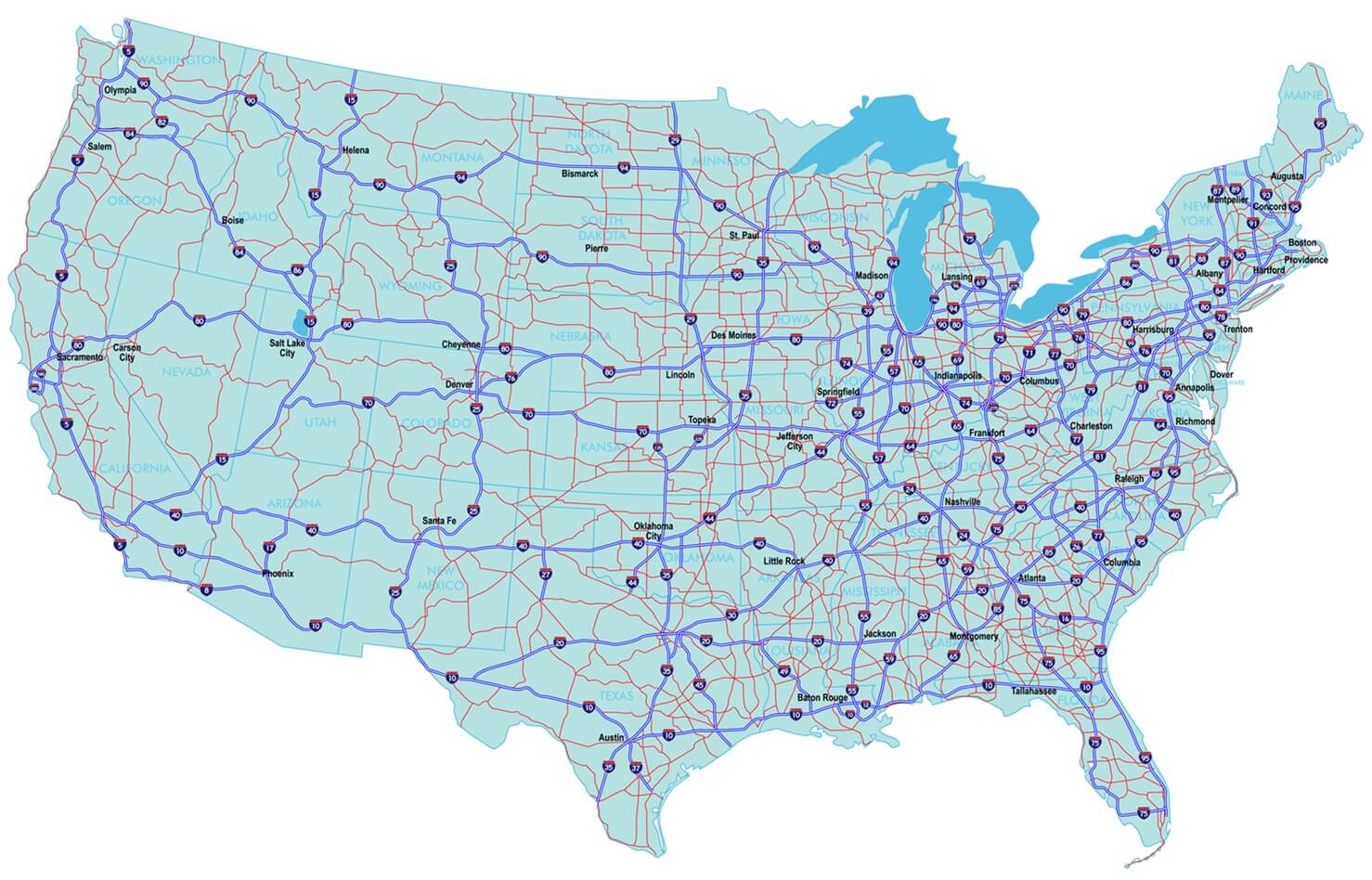
I-90 Trucking Corridor
Stretching across 13 states, I-90 is the longest interstate in the U.S. It connects Seattle, WA, to Boston, MA, passing through vital hubs like Chicago. Known for its accessibility, I-90 supports a diverse range of industries, including agriculture, manufacturing, and technology. Its ample rest areas and reliable truck stops make it a favorite for long-haul drivers.
With plenty of truck parking lots offering various amenities, you shouldn’t have any challenges finding a spot for your rig.
I-5 Trucking Corridor
Running along the West Coast, I-5 links California, Oregon, and Washington. It’s a crucial route for transporting goods between major ports like Los Angeles and Seattle. The corridor provides excellent infrastructure, with well-equipped truck stops and consistent fuel options, making it ideal for transporting fresh produce, electronics, and more.
I-44 Trucking Corridor
Connecting St. Louis, MO, to Wichita Falls, TX, I-44 is an essential artery for Midwest trucking. Known for its moderate traffic and well-maintained facilities, this route is particularly important for agricultural and industrial freight. Its central location makes it a key player in the national freight network.
I-15 Trucking Corridor
Spanning from San Diego, CA, to the Canadian border in Montana, I-15 is a critical link between the Southwest and the Pacific Northwest. It supports industries like tourism, agriculture, and manufacturing. Drivers appreciate the corridor for its scenic views, accessible parking, and reliable truck parking.
I-35 Trucking Corridor
The final trucking corridor that ranks nr 5 on the list of most popular routes is I-35. Running from Laredo, TX, on the Mexican border to Duluth, MN, I-35 is a vital North-South corridor. This route handles significant cross-border trade and serves as a backbone for industries like automotive and retail. Its numerous truck-friendly stops and streamlined logistics services make it indispensable for freight transportation.
How to Reserve a Truck Parking Spot on the Best Freight Corridors?
When driving
Chances are, your route will take you along one of the top 5 freight corridors in the U.S. to deliver your cargo. That’s why it’s essential to know how to book a parking spot for your rig before all the spaces fill up.
To ensure you always have a spot for yourself, benefit from Truck Parking Club, a platform that connects truck parking lots with truckers. Our selection of locations across the best corridors is vast and keeps expanding so that you can find a reliable and affordable place to park.
Register now for free and access all the parking lots added to our platform.
Wrapping Up
Driving America’s busiest freight lanes? The last thing you need is parking stress.
Join drivers who’ve completed over 60,000 reservations across 1,050+ verified locations nationwide – see real photos, amenities, and transparent pricing before you book. No surprises, no circling full lots, just reliable parking when and where you need it.
The information published herein is for general informational purposes only. Truck Parking Club does not make any representations or warranties about the completeness, reliability, legality, and accuracy of this information. Any reliance placed on such material is strictly at the user’s own risk. Truck Parking Club shall not be responsible for any losses or damages incurred in connection with the information published herein.
Truck drivers across the nation are facing a growing problem: finding safe and legal parking. The Electronic Logging Device (ELD) mandate, while aimed at improving road safety, has unexpectedly made this challenge even tougher.
ELDs are digital devices that automatically track a driver’s time on the road and hours of service. They’ve replaced the old paper logbooks, promising better compliance with safety rules. But there’s a catch – ELDs have also cranked up the pressure on an already strained system of truck parking.
With ELDs enforcing strict driving limits, truckers are now in a daily race against the clock to find parking before their hours run out. It’s not just about following rules anymore; it’s about basic safety and peace of mind. Many drivers find themselves choosing between breaking regulations or parking in risky spots.
The ripple effects of the ELD mandate on truck parking availability are significant, from increased stress for drivers to potential safety risks. The mandate impacts not just truck drivers but every corner of the trucking industry, including trucking companies, shippers, and the communities where trucks operate.
What Is the ELD Mandate?
The Electronic Logging Device (ELD) mandate is a federal regulation that requires most commercial motor vehicles to use electronic devices to track driver hours of service (HOS). These devices, known as ELDs, automatically record driving time and monitor engine hours, vehicle movement, miles driven, and location information.
The primary purpose of the ELD mandate is to create a safer work environment for drivers and make it easier and faster to accurately track, manage, and share records of duty status (RODS) data. It aims to improve road safety by ensuring drivers comply with hours-of-service regulations, which limit the number of hours they can drive without rest.
While well-intentioned, the mandate has backfired. The strict enforcement of driving limits, though meant to prevent fatigue, has created new pressures for drivers, particularly when it comes to finding safe and legal parking before their hours run out. This has led to situations where drivers may feel forced to choose between compliance and safety, sometimes parking in less-than-ideal locations or rushing to beat the clock.
How ELD Mandates Affect Truck Parking Availability
The ELD mandate has dramatically changed how truckers manage their time on the road, and this has had a knock-on effect on truck parking availability. Let’s break it down:
Impact of strict driving limits on drivers’ schedules
With ELDs enforcing hours-of-service rules to the minute, drivers have lost the flexibility they once had with paper logs. Now, when the ELD says time’s up, it’s up. This rigid schedule means more drivers are stopping at similar times, often in the same areas, creating a surge in demand for parking spaces.
Increased pressure to find parking when hours run out
As their driving time dwindles, truckers face mounting stress to find a spot. It’s not just about avoiding a violation anymore; it’s about basic safety. Drivers often find themselves in a race against the clock, sometimes forced to choose between parking in unsafe locations or risking an hours-of-service violation.
Statistics on parking shortages in high-demand areas
The numbers paint a stark picture of the parking crunch:
A 2019 survey by the American Transportation Research Institute found that 98% of drivers regularly experience difficulty finding safe parking.
The Federal Highway Administration estimates a shortage of over 40,000 truck parking spaces nationwide.
On average, there’s only one parking space for every 11 trucks on the road.
High-demand corridors, such as I-95 on the East Coast, often reach full capacity by early evening, leaving late-arriving drivers with few options.
The Reality of Finding Parking Spaces Under ELD Restrictions
Imagine driving for hours, your ELD ticking down the minutes, and every truck stop you pass is full. This scenario is all too common. Drivers often find themselves circling parking lots or driving miles out of their way in search of a spot. Some resort to parking on highway ramps or in retail lots, risking fines or being asked to move in the middle of their rest period. The problem is especially acute in urban areas and along major shipping routes, where demand far outstrips supply.
With the ELD’s inflexible countdown, drivers increasingly find themselves forced to make unplanned stops wherever they can. This might mean parking in poorly lit areas, on the sides of busy roads, or in neighborhoods not designed for large vehicles. This not only puts the driver at risk but can also endanger other road users and local residents.
The pressure to find parking while complying with ELD regulations is also taking a toll on drivers’ mental and physical health. Many report increased stress levels, sleep disturbances, and fatigue—ironically, the very issues the ELD mandate aimed to address.
Some drivers admit to speeding or skipping meals to make it to known parking locations before they fill up, compromising the very safety the ELD rule was meant to improve.
These challenges extend beyond individual drivers. Trucking companies face potential liability issues when their drivers park in unauthorized areas. Shippers may experience delays if drivers have to stop short of their destination due to hours running out. And communities along trucking routes are grappling with the influx of big rigs parking in areas not designed for them.
Solutions and Strategies for Drivers
As the parking challenge intensifies, drivers and the industry are having to find ways to cope.
Advanced Trip Planning and Parking Reservations
Platforms like ours – Truck Parking Club are changing the game for truckers. With over 800 locations and growing, drivers can now book daily, weekly, or monthly parking spots in advance and pay via an app. This eliminates the stress of last-minute searches and ensures a safe place to rest.
Adjusting Schedules to Off-peak Hours
When possible, some drivers are shifting their schedules to avoid peak parking times. This might mean starting routes earlier or later than usual to ensure parking availability at their planned stops.
Collaborating with Shippers and Receivers
More drivers are working with shippers and receivers to allow parking at delivery locations. This requires open communication and planning but can provide a reliable parking solution, especially in areas with limited truck stop options.
Truck Parking in the Post-ELD Era
The ELD mandate has undoubtedly intensified truck parking challenges, but it has also spurred the industry to devise solutions. From advanced booking platforms like Truck Parking Club to creative scheduling, drivers are finding ways to adapt.
The information published herein is for general informational purposes only. Truck Parking Club does not make any representations or warranties about the completeness, reliability, legality, and accuracy of this information. Any reliance placed on such material is strictly at the user’s own risk. Truck Parking Club shall not be responsible for any losses or damages incurred in connection with the information published herein.
The trucking industry is changing, and women are a big part of that change. Since 2010, we’ve seen a 68% jump in the number of women truck drivers. Now, they make up between 12.1% and 13.7% of all truck drivers in the US. Even more telling, about 20% of new truck drivers are women.
This is great news, but it also brings new challenges, especially when it comes to keeping these drivers on the job. One big issue? Safe places to park.
We’re going to discuss why safe truck parking matters so much for keeping women in trucking and how it could help make the whole industry better for everyone.
Current State of Truck Parking
Finding a safe place to park a truck isn’t easy. There just aren’t enough parking spots to go around. Drivers often find themselves circling truck stops or rest areas, hoping to snag a spot before their driving hours run out. When they can’t find a proper spot, some end up parking in less-than-ideal places like highway shoulders or empty lots. This isn’t just inconvenient – it’s dangerous.
Many existing parking areas aren’t exactly geared up for safety either. Poor lighting is a common problem, making drivers feel uneasy, especially at night. There’s often a lack of security personnel or cameras, which doesn’t help matters. For women truckers, these issues are even more worrying
The shortage of secure parking spots is more than just an annoyance – it’s a serious problem that’s pushing women truck drivers to reconsider their careers in trucking.
Unique Challenges for Women Truck Drivers
Being a truck driver isn’t easy for anyone, but women in the industry face some extra hurdles. Let’s break it down:
First off, there’s the safety issue. It’s not just about feeling uneasy – it’s a real problem. Nearly 25% of women have actually quit trucking because they didn’t feel safe. That’s one in four women leaving the job over safety concerns. It’s not hard to see why when you look at the numbers: 45% of women in trucking say they’ve been sexually harassed on the job.
We’re talking unwanted advances, verbal abuse, the works. It’s enough to make anyone think twice about their career choice.
Then there’s the practical stuff. About 37% of women drivers say they struggle with something as basic as finding a restroom. Truck stops and rest areas often don’t have great facilities for women.
All these issues come to a head when it’s time to park for the night. Women drivers aren’t just looking for any old spot to pull over. They need somewhere they can feel secure enough to actually get some rest. But with limited safe parking options, especially on long hauls, that’s easier said than done.
These aren’t just minor inconveniences. They’re big obstacles that can make or break a woman’s decision to stick with trucking as a career. And remember, we’re talking about a growing part of the workforce here. Women are entering the field in bigger numbers than ever before, but keeping them in the industry? That’s where the real challenge lies.
Impact of Unsafe Parking on Women Drivers
So, what happens when women truckers can’t find safe places to park? It’s not just about one bad night’s sleep. The effects can ripple through their whole lives and careers.
First, there’s the stress. Imagine driving for hours, tired to the bone, and not knowing if you’ll find a safe spot to rest. That kind of worry doesn’t just disappear when you park. It sticks with you night after night. Over time, that stress can really wear a person down.
Then there’s the health angle. When drivers can’t find proper rest areas, they might skip breaks they really need. Maybe they hold off on using the bathroom or grab junk food instead of a proper meal because they don’t want to stop in an iffy area. Do that often enough, and it’s bound to take a toll on your health.
Sleep is another big issue. When you’re parked somewhere, you don’t feel safe, and you’re not going to get good rest. You might sleep with one eye open, always on alert. Day after day of poor sleep? That’s a recipe for exhaustion, which isn’t just bad for the driver—it’s dangerous for everyone on the road.
All of this adds up to job dissatisfaction. When you’re stressed, unhealthy, and tired all the time, it’s hard to love what you do. For some women, it gets to be too much. Remember that stat about 25% of women leaving the industry over safety concerns? Lack of safe parking is a big part of that.
It’s a real shame, especially when you consider that women drivers tend to have a better safety record. They’re actually 20% less likely to get into accidents than male drivers. So when unsafe conditions push women out of trucking, the whole industry loses out.
The bottom line? Unsafe parking doesn’t just make the job harder for women truckers. It can drive good drivers out of the industry altogether. With the trucking industry already facing driver shortages, it’s an issue we can’t afford to ignore.
Solutions for Safe Truck Parking
Now that we’ve laid out the problems, let’s talk about solutions. There are several ways we can make truck parking safer and more accessible for women drivers:
More Secure Parking Facilities
We need more parking spots, plain and simple. But not just any spots – we’re talking about secure facilities designed with safety in mind. These could be at existing truck stops or purpose-built areas along major routes. The goal is to have enough spaces so drivers aren’t forced to park in unsafe locations.
Lighting and Surveillance Upgrades
Good lighting can make a world of difference. Well-lit parking areas feel safer and actually are safer. Add in some security cameras and maybe even on-site security personnel, and you’ve got a setup that can help women drivers feel a lot more comfortable during their rest periods.
Women-Centric Areas
Now, we’re not talking about completely separate “women-only” parking lots here. That might not be practical or even desirable for everyone. But what about designated areas within larger parking facilities that cater more to women’s needs? These spots could be closer to well-lit bathrooms or the main building, have better surveillance, or offer other features that women drivers have identified as important.
Parking Reservation Apps
These let drivers book a spot in advance, so they won’t be scrambling for parking at the end of a long day. Our platform at Truck Parking Club is one example; it provides truck drivers with access to a network of private parking spaces across the U.S. Our app and website allow drivers to locate and reserve secure, well-maintained private parking spots ahead of time
Better Facilities
Safe parking isn’t just about the parking spot itself. It’s about having access to clean, well-maintained restrooms, showers, and other facilities. Improving these amenities can make a big difference in how comfortable and secure drivers feel during their stops.
These solutions don’t just benefit women drivers. They make parking safer and more convenient for everyone on the road. It’s a win-win for the whole industry.
How Truck Parking Club Improves Safety for Women Drivers
Advance Parking Reservations
Truck Parking Club allows drivers to reserve spots in advance, by the day, week or month. This feature alleviates the anxiety and stress that comes with uncertain parking, a major concern for many women drivers.
Access to Private, Well-Maintained Parking
Unlike public rest stops, Truck Parking Club offers access to private, secure lots that are typically better-lit and monitored. This helps reduce the risk of harassment or theft, which are common concerns for women truck drivers.
Real-Time Availability
Our platform provides real-time updates on parking space availability, which means drivers can plan their routes and rest stops more efficiently. This reduces the likelihood of needing to park in unsafe areas, such as highway shoulders or abandoned lots.
Community-Driven Reviews
Truck Parking Club also features a community-based review system where users can rate and review parking locations. This feature is particularly valuable for women drivers, who can share information about which locations are safest and offer the best amenities.
The information published herein is for general informational purposes only. Truck Parking Club does not make any representations or warranties about the completeness, reliability, legality, and accuracy of this information. Any reliance placed on such material is strictly at the user’s own risk. Truck Parking Club shall not be responsible for any losses or damages incurred in connection with the information published herein.
The rumble of diesel engines and the hiss of air brakes have long been the soundtrack of American commerce. But today, a new sound is emerging: the frustrated sighs of truck drivers searching for a place to park.
As e-commerce reshapes retail and supply chains stretch to meet ever-growing demands, an unexpected challenge has rolled into view. It’s not about streamlining warehouses or optimizing delivery routes—it’s about finding a safe spot for an 18-wheeler to rest.
Across the nation, from busy urban centers to remote highways, the shortage of truck parking spaces has become a major issue. This isn’t merely a logistical hiccup; it’s a problem that touches on driver safety, industry efficiency, and the smooth flow of goods we all depend on.
The search for solutions is spurring innovation and forcing us to reconsider how we use our urban and roadside spaces. Let’s explore why truck parking has become such a pressing concern and how it’s driving change.
The Parking Predicament By the Numbers
To understand the scope of the truck parking challenge, we need to look at the hard data. Currently, approximately 313,000 truck parking spots are available across the United States. At first glance, this might seem like a substantial number. However, when we consider that about 3 million trucks traverse our highways, the imbalance becomes clear.
This disparity translates to a stark reality: there’s only one parking spot for every 11 trucks on the road. The situation becomes even more complex when we break down these spaces by type. Of the total spots, a mere 40,000 are located in public rest areas. The lion’s share—about 273,000 spaces—are found in private truck stops.
The Root of the Problem
Several factors have converged to create this parking crunch:
E-commerce Explosion
The meteoric rise of online shopping has dramatically increased the volume of freight on our roads. More goods in transit mean more trucks needing places to park for mandated rest periods.
Regulation Requirement
In recent years, driver rest periods have been stricter enforced. While these regulations are crucial for safety, they’ve intensified the need for accessible and legal parking options.
Infrastructure Inertia
Despite the growth in trucking activity, investments in highway infrastructure—including parking facilities—have not kept pace. This lag has left many areas woefully underequipped to handle current parking demands.
These factors have created a perfect storm, transforming truck parking from a minor inconvenience into a major industry challenge.
The Ripple Effects of Inadequate Parking
The shortage of truck parking spaces isn’t just an inconvenience—it’s a problem with far-reaching consequences:
Safety Concerns
When proper parking isn’t available, drivers may resort to unsafe alternatives. Parking on highway shoulders, exit ramps, or in unlit areas puts both drivers and other motorists at risk. Fatigue-related accidents become more likely as drivers push beyond their limits to find suitable rest spots.
Economic Impact
The time spent searching for parking is time not spent moving freight. This inefficiency translates to increased costs for trucking companies and, ultimately, higher prices for consumers. The American Transportation Research Institute estimates that drivers lose an average of 56 minutes of available drive time per day due to parking issues, equating to over $4,600 in lost annual compensation per driver.
Environmental Considerations
Trucks idling while waiting for parking spots or circling to find spaces contribute to unnecessary fuel consumption and emissions, contradicting efforts to make the logistics industry more environmentally friendly.
Solutions to the Parking Crunch
Technology-Driven Solutions
Real-Time Parking Information: Platforms like Truck Parking Club are simplifying how drivers find spots. With real-time updates on parking availability and drivers able to reserve spaces in advance, the stress and time wasted in searching for parking is greatly reduced.
Predictive Analytics: Advanced algorithms are being developed to forecast parking demand based on historical data, traffic patterns, and weather conditions. These systems can guide drivers to areas likely to have available spots, optimizing route planning and reducing unnecessary mileage.
IoT Sensors: Some parking facilities are implementing Internet of Things (IoT) sensors to monitor occupancy accurately. This data feeds into mobile apps, giving drivers up-to-the-minute information on space availability.
Repurposing Urban Spaces
Warehouse Conversions: In a clever twist of urban renewal, defunct warehouses and industrial sites are finding new life as secure truck parking facilities.
Retail Partnerships: Forward-thinking retailers are turning their vast parking lots into overnight havens for truckers. By allowing overnight parking during off-hours, these businesses are maximizing the use of their existing infrastructure while providing a valuable service to the trucking community.
Multi-Use Developments: Some urban planners are exploring the concept of mixed-use facilities that combine truck parking with other commercial or industrial uses, creating efficient hubs that serve multiple needs.
Government Initiatives
The Truck Parking Safety Improvement Act: This proposed legislation aims to dedicate $755 million over three years to expand truck parking facilities.
State-Level Programs: Several states are implementing their own initiatives, from expanding rest areas to creating truck-only parking zones.
Public-Private Partnerships: Collaborations between government agencies and private businesses are creating new models for funding and operating truck parking facilities.
The Road Ahead
The truck parking shortage isn’t going away overnight, but the industry is far from idling on this issue. The future of truck parking will likely involve a mix of smart infrastructure, data-driven planning, and flexible policies that can adapt to the logistics industry’s ever-changing requirements.
One standout solution to address rising demands is our platform, Truck Parking Club. We are tackling the parking crunch head-on. Drivers can find and secure parking spots across the country. With over 800 locations and counting, we are rapidly expanding our network to serve drivers nationwide.
We show real-time updates on availability, pricing, and amenities at each location. Drivers can book their spots directly through the app using a credit card, choosing from daily, weekly, or monthly options.
The information published herein is for general informational purposes only. Truck Parking Club does not make any representations or warranties about the completeness, reliability, legality, and accuracy of this information. Any reliance placed on such material is strictly at the user’s own risk. Truck Parking Club shall not be responsible for any losses or damages incurred in connection with the information published herein.
Truck drivers face a growing problem: finding a safe spot to park and rest after long hours on the road. Public rest areas and traditional truck stops are often full, leaving drivers stressed and scrambling. But there’s a solution gaining traction across the country – private parking lots designed specifically for truckers.
These specialized facilities are reshaping how drivers approach their mandatory breaks and overnight stays.
It’s a response to real industry challenges: stricter hours-of-service regulations, increased cargo theft, and a shortage of safe parking nationwide. For many drivers and fleet managers, these dedicated lots are becoming an essential part of trip planning and risk management.
Let’s examine the benefits that are drawing more rigs off the public roads and into private parking lots.
Safety and Security
Ask any trucker about their top concerns, and safety will be near the top of the list. It’s no secret that finding a secure place to park overnight can be a real issue.
Private lots tackle this problem head-on. They’re built with truckers’ safety in mind, plain and simple. No more worrying about sketchy rest stops or dimly lit back lots. These places are set up to keep drivers and their trucks safe.
What does this mean for truckers? For starters, it’s easier to get a good night’s sleep when you’re not constantly looking over your shoulder. Cargo theft has been a growing problem in the industry, but these lots make it a whole lot harder for thieves to operate.
Trucking companies are also catching on to the benefits. Fewer incidents mean lower insurance costs, and drivers are more likely to stick with a company that takes their safety seriously.
Amenities and Services
The last thing a driver needs is to hunt down basic necessities after a long haul. Private lots are stepping up, offering amenities that make a trucker’s life a whole lot easier.
Let’s talk about the basics – clean restrooms and hot showers. Public rest stops are often a gamble, with long lines during peak hours and facilities that have seen better days. Private lots flip this script, providing well-maintained facilities without the wait.
Then there’s the food situation. No more settling for vending machine snacks or spending time looking for a decent meal. Many private lots are partnering with food vendors or setting up their own options, from food trucks to on-site mini-markets.
For truckers, it’s one less thing to deal with on the road. Instead of worrying about where to grab a bite or freshen up, they can focus on what matters – getting rest and staying on schedule. It’s not just convenience; it’s about making the job a little more humane.
Guaranteed Availability
Finding a parking spot shouldn’t be a wild goose chase, but for many truckers, that’s exactly what it feels like at the end of a long haul. Private lots are tackling this problem head-on with smart reservation systems.
At Truck Parking Club, we are leading the charge, offering bookable spots across the USA from Arizona to Wyoming. It’s simple: drivers book their spot ahead of time, and it’s theirs when they arrive. No more crossing fingers or burning fuel looking for a place to park.
Planning ahead takes a huge weight off drivers’ shoulders. They can map out their routes, knowing exactly where they’ll stop, which makes sticking to schedules and regulations a whole lot easier. And for those times when plans change, real-time booking is an available option
This setup is a big deal for truck drivers. It’s making the job a lot less stressful and a lot more predictable in an industry where those things are often in short supply.
Compliance with Hours of Service Regulations
Truckers have a lot to juggle, and staying within Hours of Service rules is a big part of the job. Private parking lots make this balancing act a fair bit easier.
These lots give drivers a reliable place to clock out and rest. No more scrambling to find a spot when you’re running up against your hours limit. Drivers can plan their routes knowing exactly where they’ll stop, making it much simpler to time those mandatory breaks.
This setup is a win for everyone. Drivers don’t have to choose between bending the rules and parking somewhere sketchy. Trucking companies see fewer violations and fines, which keeps costs down and keeps them in good standing with regulators.
Technology Integration
The trucking world is going digital, and private parking lots are following suit. Smart tech is making life easier for drivers in ways that weren’t possible just a few years ago. Mobile apps are becoming a trucker’s best friend on the road. With a few taps, drivers can find nearby lots, check availability, and lock in a spot. Gone are the days of endless phone calls or driving in circles – now it’s all about instant access to the info you need.
These apps go beyond basic bookings. Many offer details on amenities, user feedback and more.
In some cases, your parking reservation can now communicate directly with your ELD, simplifying hour logging and compliance verification.
For drivers, this technology transforms parking from a frustrating task into a quick, efficient process they can handle before they even hit the road. Fleet managers benefit from gaining valuable data for route planning and vehicle tracking.
The Downsides of Public Rest Areas
Public rest areas aren’t cutting it for many truckers these days. What used to be reliable pit stops have become a bit of a gamble.
First, there’s the crowding issue. It’s not unusual to pull into a rest area only to find every spot taken, with rigs double-parked or lining the entrance ramp. During peak hours or bad weather, it can feel like a game of musical chairs—and nobody wants to be left without a spot when their hours are up.
Then there’s the bare-bones nature of these places. Many public rest areas have minimal facilities – maybe a bathroom and some vending machines if you’re lucky. Need a shower? Want to grab a hot meal? You’re often out of luck. It’s a far cry from what drivers need for a proper rest.
Safety is another big worry. Poorly lit areas, lack of security, and isolated locations can make public rest stops magnets for trouble. Many truckers have stories about theft, vandalism, or sketchy characters hanging around. It’s hard to get good rest when you’re sleeping with one eye open. It’s no wonder many are looking for better options.
The Road Ahead for Private Truck Parking
We’ve explored why private parking lots are becoming the go-to choice for truckers across the country. Here at Truck Parking Club, we’re proud to be at the forefront of this change.
We know what matters to you because it matters to us, too. That’s why every lot listing on our site shows you the essentials:
Exact location to make route planning easy
Available amenities so you know what to expect
Real-time space availability
Book daily, weekly, or monthly
Whether you’re hauling coast to coast or making regional runs, our network of secure parking spots has you covered.
It’s quick and easy, and you’ll have instant access to our entire network of parking spots.
The information published herein is for general informational purposes only. Truck Parking Club does not make any representations or warranties about the completeness, reliability, legality, and accuracy of this information. Any reliance placed on such material is strictly at the user’s own risk. Truck Parking Club shall not be responsible for any losses or damages incurred in connection with the information published herein.
Short-Haul Trucking Boom Highlights Growing Need for Flexible Parking Solutions
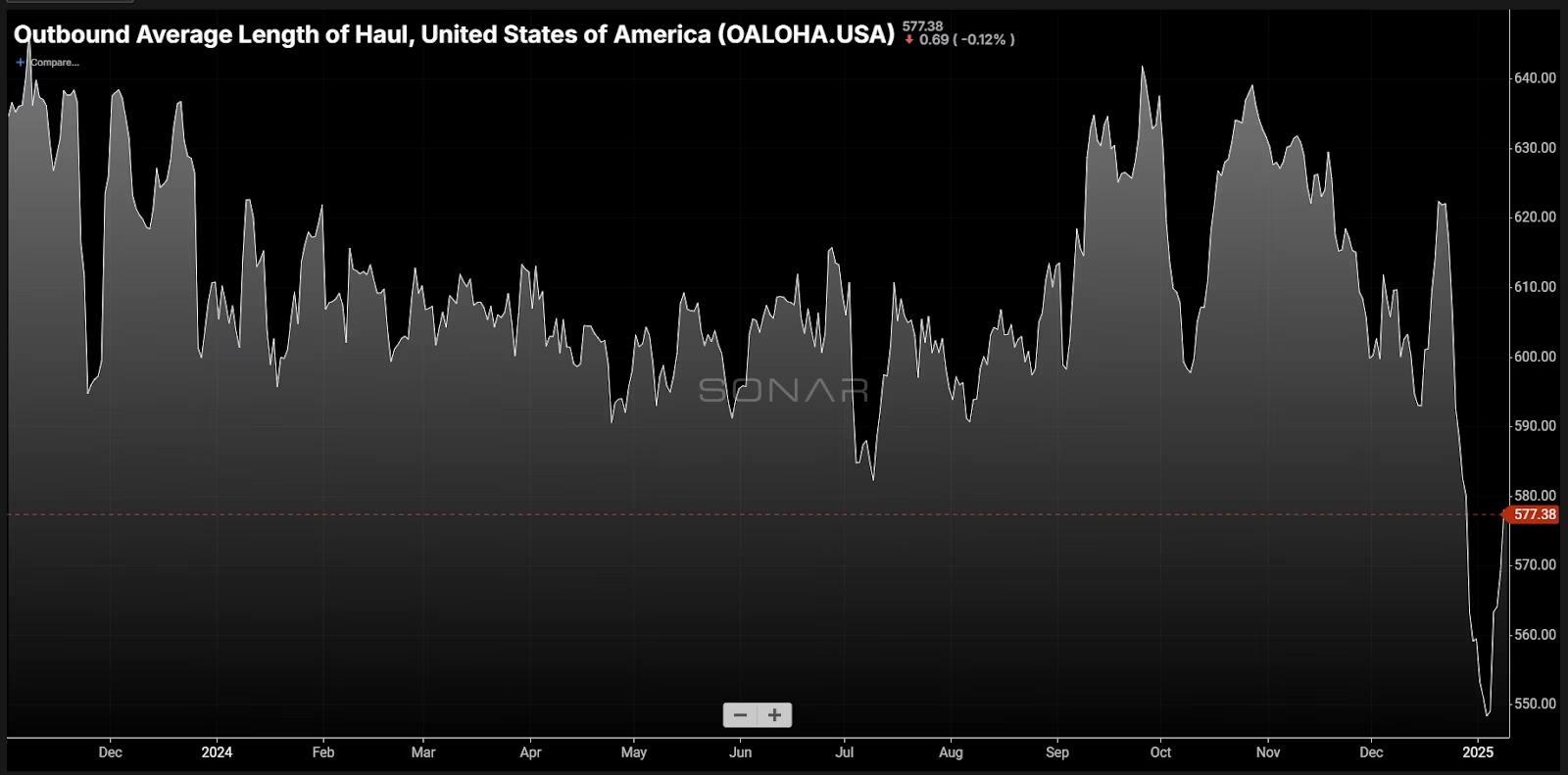
As FreightWaves reports, the trucking industry is undergoing a significant shift, with short-haul deliveries posting record-breaking growth. This rise in short-distance routes creates new challenges and opportunities—especially in urban and suburban areas where demand for flexible truck parking options has never been higher.
A Shift Toward Short-Haul Routes
Recent data shows:
A 13% year-over-year increase in short-haul truckload demand.
An 8% decrease in the average length of haul compared to early 2024.
These figures reflect changing supply chain strategies driven by booming e-commerce and evolving customer expectations.
E-Commerce Redefines Trucking Operations
The exponential growth of e-commerce is reshaping the logistics landscape. Companies are placing distribution centers closer to consumers, leading to:
Rising demand for local routes under 100 miles
More frequent urban and suburban deliveries
A greater need for short-term, flexible parking options near fulfillment centers
Why Parking Demand Is Surging
1. Urban Area Pressure
With more trucks moving around metropolitan areas, parking shortages and congestion are on the rise. Traditional truck stops along interstates may not meet the needs of short-haul drivers who operate primarily in or near cities.
2. Flexible Duration Requirements
Short-haul drivers have diverse parking needs:
Hourly parking for rapid drop-offs and pickups
Day-use parking for mid-shift stops
Secure overnight options for early morning routes
3. Strategic Location Matters
As distribution and fulfillment centers relocate to be closer to consumers, parking facilities near these hubs become crucial. Locations adjacent to major cities, e-commerce warehouses, and retail distribution centers are in particularly high demand.
Preparing for the Future
As the trucking industry continues to adapt to shorter hauls and more frequent deliveries, the demand for smart, tech-enabled parking solutions will continue to grow. Property owners with available space—especially in or near major metros—can capitalize on this trend by offering convenient, secure parking spots to short-haul drivers.
Market Opportunities
Urban parking facilities catering to local fleets
Flexible booking platforms for short-term needs
Secure, gated lots with enhanced technology features
Partnerships with retailers and e-commerce players to provide last-mile solutions
Industry Implications
While long-haul trucking faces growing intermodal competition, short-haul remains a bright spot. This upsurge creates a compelling opportunity for anyone positioned to offer suitable parking solutions. With e-commerce continuing to reshape delivery routes, providing easily accessible urban parking spots will become even more valuable.
Need Truck Parking in Metro Areas?
TruckParkingClub.com connects drivers and fleets to secure and convenient truck parking in cities and surrounding areas.
You might remember those ancient, dusty truck parking lots with nothing but a small greasy spoon and a payphone that is permanently out of service. Some of you might even remember with a degree of nostalgia.
But the truth is, truck parking lots have come a long way since the early days when parking lots were few in number, and most truckers had to rely on whatever random, wide-open space they could find.
Now, modern truck parking lots are an essential aspect of trucking – so much so that road freight would grind to a depressing halt without them. But where did truck parking begin, and how has it evolved into the gigantic industry we have today?
In this short blog post, we will cover the history of truck parking lots, starting with the first truck stop in America, before looking at the vast options currently available to truckers.
The First Truck Stop in America
In the very early days of trucking, there weren’t really any dedicated spots where truckers could safely rest. Long stretches of highways with only one or two gas stations left drivers with no option but to park wherever they could find room.
Then came the first ‘official’ truck stop in America – credited to the early 1940s – when a small fuel station in Grand Island, Nebraska, expanded to provide parking space and basic amenities for drivers to refuel both their rigs and themselves.
It’s hard to imagine now, but this first truck in America was considered revolutionary despite the rudimentary nature of the service.
Pioneering
Thanks to a certain Fred Bosselman – the owner and namesake of Bosselman and Eaton Truck Stop – freight drivers in the area now had convenient truck parking, affording much-needed rest for those who needed it.
With that, the floodgates opened, and more truck stops followed suit. What was once an unorganized, chaotic scramble for parking on abandoned private land or exit ramps evolved into a more structured system that identified the needs of long-haul drivers.
Expansion and Growing Demand
As the trucking industry grew in the decades following World War II, so did the demand for more dedicated parking lots. With the launch of the Federal Interstate Highway Act (and the subsequent 41,000 miles of highway that followed), truck stops suddenly started springing up everywhere.
These early truck stops started out as mere places to park but quickly evolved into mini-hubs with restaurants, repair services, and basic shower facilities. During the ’60s, larger and better-equipped truck stops began sprouting across the entire country.But even as more parking lots were built, the problem remained: demand always exceeded supply. Truck drivers were constantly searching for a safe place to rest, especially as regulations around driver rest periods became more stringent.
24-Hour Truck Stops
The 1970s saw a huge rise in 24-hour truck stops, with facilities that offered a wide range of services, including fast food, lodging, parking, and truck washes. You might describe this period as the golden era of truck parking facilities.
Truck stop parking in those days was usually free or incredibly cheap, premised on the idea that truckers would pay for services. As a result, truck stops were always launched with a wide range of additional services to draw truckers in.
Predictably, as the trucking industry continued to boom, so did the parking shortage. The balance between supply and demand remained completely uneven. Finding a spot to park became a relentlessly frustrating aspect of trucking (although not on the same dire levels as the current truck parking shortage).
The Modern Era
Skip forward to the present day, and technology has dramatically reshaped how truck parking lots function through the rise of truck parking apps and similar services.
No longer do truckers need to waste time endlessly circling parking lots, hoping for a spot to become available. With services like Truck Parking Club, the whole process has become far more efficient, organized, and stress-free.
Truck Parking Club allows property owners to list their unused spaces, affording a vast range of national parking options that truckers can book in advance. The service is nothing short of revolutionary, helping to put a significant dent in the current truck parking crisis gripping North America.
Convenience
Private parking spots like Truck Parking Club are a huge improvement from the old days, where finding a spot was essentially a massive gamble.
With tough Hours of Service regulations restricting the amount of time drivers can spend on the road, the traditional end-of-day hustle to find a parking space has turned into a last-minute scramble as drivers race against the clock, desperate to avoid penalties.
Now, truckers can simply whip out their phones, browse for nearby lots, and book a safe and secure parking space in seconds – completely eliminating that end-of-day scramble.
What started with the first truck stop in America all those years ago has grown into a system supported by cutting-edge technology that delivers more convenient options for today’s truckers.
The Future of Truck Parking
What makes Truck Parking Club so special is how effortlessly it connects property owners with truck drivers. The user-friendly app allows truckers to find available spaces near their location, book instantly, and avoid the frustration of driving in circles to find a place to rest.
With the parking shortage still a huge concern in most areas, Truck Parking Club is helping to relieve some of the pressure. More and more property owners are listing their spaces, providing truckers with more choices and greater peace of mind while on the road.
Bottom Line
Although we owe a lot to the first truck stop in America, the convenience truckers enjoy today is light years ahead of those early days. With the launch of convenient services like Truck Parking Club, finding a place to rest has never been so effortless, despite the ongoing truck parking fiasco.
Interested in using our service? Register with Truck Parking Club today, then simply browse for a space to reserve your spot in minutes. Our service is great value and utterly hassle-free.
Curious about becoming a property member? With Truck Parking Club, you can turn your vacant commercial land into a lucrative revenue stream with a steady flow of truckers – all of whom are in need of convenient parking. Find out how right here.
The information published herein is for general informational purposes only. Truck Parking Club does not make any representations or warranties about the completeness, reliability, legality, and accuracy of this information. Any reliance placed on such material is strictly at the user’s own risk. Truck Parking Club shall not be responsible for any losses or damages incurred in connection with the information published herein.