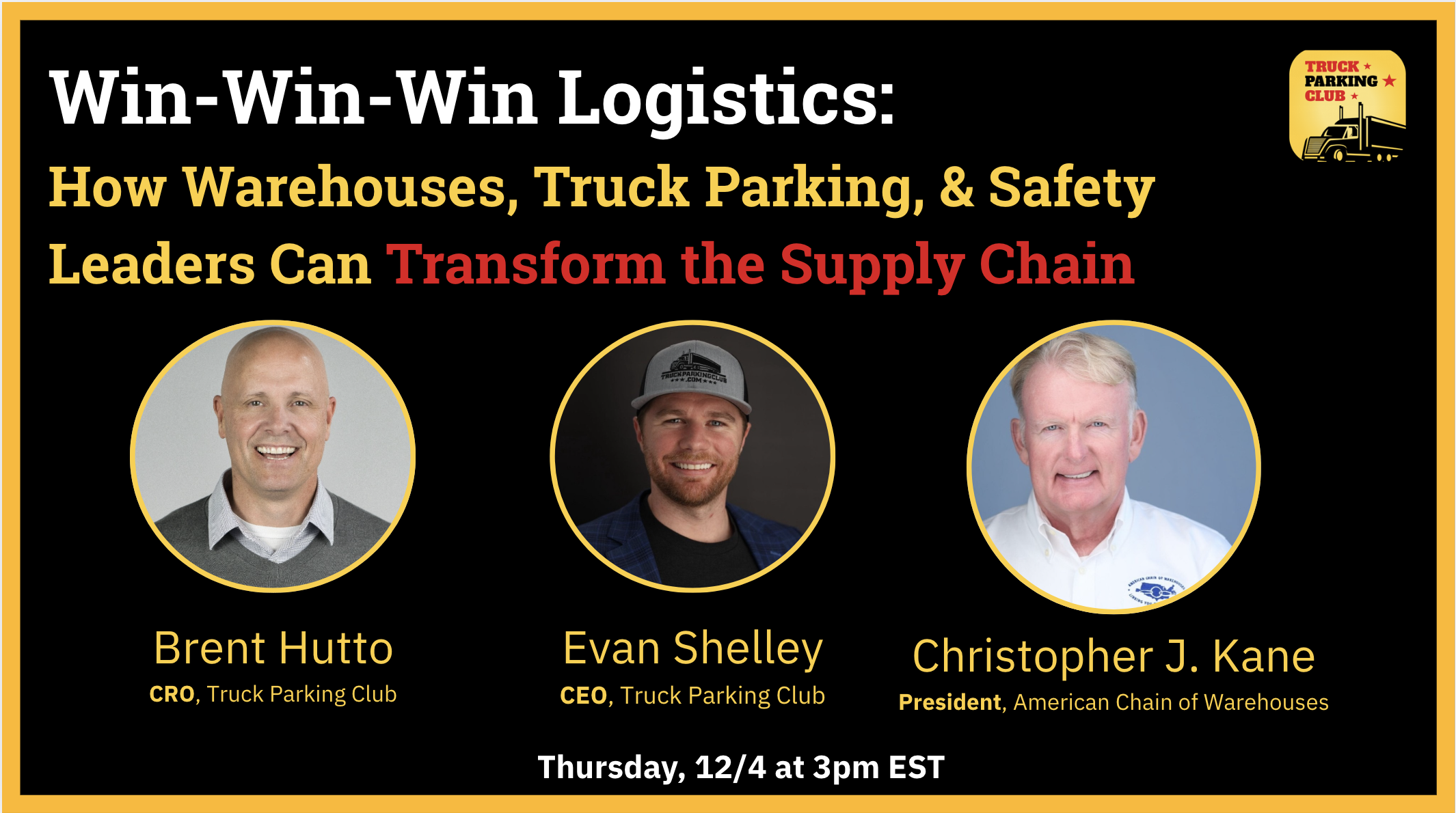
(Insights from Supply Chain Leaders, Truck Parking Club, & American Chain of Warehouses)
America is facing a truck parking crisis—one that affects every part of the supply chain, including warehouses, shippers, and recievers. Drivers lose nearly an hour every day searching for safe parking, costing the industry an estimated $125 billion per year in lost productivity, fuel, delays, and turnover.
But what most warehouse leaders don’t realize is this:
Warehouses collectively hold the key to solving the parking shortage—while generating meaningful passive income from underutilized yard space.
That was the takeaway from a recent industry webinar hosted by Truck Parking Club’s Chief Relationship Officer Brent Hutto, featuring CEO & Co-Founder Evan Shelley and Chris Kane, President of the American Chain of Warehouses (ACW).
This blog summarizes the biggest learnings, revenue opportunities, and operational benefits discussed in that session—so warehouse operators can fully understand why truck parking is emerging as one of the easiest new income streams available today.
The State of Truck Parking: A Growing Crisis
Truck parking has become one of the top 2 concerns for U.S. truck drivers according to ATRI. The causes are well known:
- 1.7 million additional truck parking spaces are needed nationwide.
- Municipal zoning often blocks new truck parking developments.
- Construction costs make dedicated parking financially unviable for many operators.
- Drivers burn 56 minutes a day searching for a spot—wasting fuel and HOS time.
- Two-thirds of drivers resort to illegal or unsafe parking on shoulders, ramps, and residential areas.
These inefficiencies ripple into your warehouse operations:
- No-shows rise due to drivers unable to find legal parking near the facility.
- Appointment windows tighten.
- Detention charges increase.
- Loads arrive late, stressed, or unexpectedly early.
As Chris Kane noted during the webinar:
“We used to see 20% no-show rates. A rested driver is a safe driver—and without parking, it’s nearly impossible for them to stay compliant.”
Why Warehouses Hold the Solution
U.S. warehouses and distribution centers collectively control millions of acres of industrial-zoned space—much of it underutilized or unused overnight.
Truck Parking Club’s research uncovered a striking insight:
Over 15 million potential truck parking spaces exist on shipper and warehouse lots. Yet only ~2% are currently accessible to drivers.
That unused concrete is a goldmine.
Warehouses already operate in industrial zones, where parking is usually permitted. They already have:
- Level ground
- Lighting
- Camera systems
- Controlled gates
- Staff onsite
- Dock space empty after hours
As Evan Shelley explained:
“If warehouses unlocked even 10% of their available capacity, the truck parking shortage would be drastically reduced.”
Read the full research report here: truckparkingclub.com/research
How Monetizing Your Truck Parking Works
Truck Parking Club operates a two-sided marketplace connecting warehouse owners with hundreds of thousands of drivers, dispatchers, brokers, and fleet managers.
The model is simple:
- List your available spaces (yard spots, dock doors, overflow areas).
- Drivers book them on-demand via app or website.
- You earn passive revenue with no operational burden.
What makes it especially appealing for warehouses is the flexibility:
- No leases
- No long-term commitments
- Adjust your available spaces anytime
- Turn the program on and off as operations shift
“Every day looks different for a warehouse,” Kane added. “The ability to update availability in real time is invaluable.”
The Revenue Opportunity for Warehouses
This is the question every warehouse leader asks:
How much money can we make from truck parking?
Across Truck Parking Club’s 206 warehouse partners:
- Spaces generate hundreds of dollars per month each.
- One top-performing warehouse earned over $12,000 in 30 days.
- Another operator, Logistics Plus, earned $13,000 in their first 60 days across nine locations.
And remember: These dollars come from assets currently making $0.
As Shelley put it:
“You’re earning net new revenue on space that’s sitting unused. This is pure margin.”
Operational Benefits for Warehouses
Paid parking isn’t just a revenue play. It also improves warehouse performance.
1. More On-Time Arrivals & Fewer No-Shows
Drivers can stage near your location, making morning appointments far more reliable.
2. Reduced Congestion & Unauthorized Parking
Instead of lining industrial parks or road shoulders, drivers have a legal, safe spot.
3. Fewer Detention Disputes
Drivers staged early aren’t rushing from across town to make a window.
4. Improved Safety & Lower Liability
Illegal parking around your facility often becomes your problem.
5. Protect Your Property
Truck Parking Club includes:
- 24/7 customer service from former drivers
- A two-way rating system for accountability
- Up to $25,000 in damage protection
Incidents are extremely rare—but the protection is there.
How Pricing Works
Warehouse partners set their own prices. The market naturally determines demand.
Typical rates:
- $10–$15/day in Midwest and low-density markets
- $20–$40/day in high-demand regions
- $150–$400/month for dedicated monthly spaces
- Premium rates for secure or gated yards
Truck Parking Club provides market guidance, but owners stay in control.
Case Study: Logistics Plus
A large 3PL with nationwide facilities, Logistics Plus approached Truck Parking Club with excess yard space.
Results within 60 days:
- 100+ bookings
- $13,000 earned
- Zero operational lift from staff
- Full visibility of who is parking and when
If a sophisticated national operator can easily deploy this model, so can any regional or local warehouse.
What About Safety, Trash, or Damage?
This is the most common concern among warehouse operators.
Truck Parking Club addresses it head-on:
- 24/7 staffed support line
- Marketplace reviews for drivers and property owners
- Rapid resolution of driver issues
- Up to $25,000 damage protection
- Detailed booking info: truck type, trailer type, hazmat, reefer, plate numbers
You stay fully in control of who parks on your property.
Zoning Requirements
Every municipality uses different industrial zoning designations (I-3, I-4, M-1, etc.). Warehouses are typically already zoned correctly.
Truck Parking Club helps owners understand local nuances and avoid compliance issues.
Why This Opportunity Is Growing Faster Every Month
The truck parking market is scaling rapidly as more fleets embrace strategic parking:
- Drivers are increasingly required to park legally.
- Fleets rely on staged parking near shipper locations.
- Carriers want safer options than overcrowded truck stops.
- Brokers use parking reservations to keep loads on schedule.
As Hutto explained:
“This marketplace is just beginning. What the revenue looks like today is a fraction of what it will be 12–36 months from now.”
Warehouses are entering the opportunity at the perfect time.
Key Takeaways for Warehouse Owners
✓ A national parking shortage is costing your partners billions—and hurting your operations.
✓ Warehouses control the real estate that can fix the problem.
✓ Monetizing unused yard or dock space generates passive income with zero friction.
✓ Truck Parking Club handles everything: bookings, payments, support, and protections.
✓ You maintain full control of capacity, pricing, and who can park.
✓ Early adopters are already earning thousands per month in new revenue.
As Chris Kane summarized:
“This is a win for safety, a win for warehouses, and a win for the trucking community. It’s rare to find an opportunity that benefits everyone.”
Want to Monetize Your Warehouse’s Parking?
It takes less than 10 minutes to determine if your location is a fit.
📌 Get started with Truck Parking Club:
truckparkingclub.com/warehouse
or email: [email protected]