Indiana is preparing for a significant upgrade to its highway rest areas, with a plan to pour more than $600 million into renovations and expansions over the next ten years. The much-needed, ambitious initiative aims to improve the travel experience across the state, with a particular focus on accommodating the growing need for convenient truck parking.
Expanding Indiana’s Welcome Centers and Rest Areas
The Indiana Department of Transportation (INDOT) has begun an ambitious project that includes the construction of two brand-new welcome centers. The welcome centers are an update to the news announced earlier this year reporting planned improvements to parking facilities across the state.
The Clear Creek Welcome Center, located near the Illinois border along I-70, and the Black River Welcome Center on I-64 eastbound mark the beginning of this extensive enhancement plan. Additionally, six more welcome centers are slated for construction during this period, significantly increasing the state’s capacity to serve travelers and truck drivers.
Improvements Aimed at Truck Drivers and Tourists
The enhancement package includes new and improved restrooms, water fountains, vending services for driving information, and picnic areas. This is in addition to the plan that promised over 1,100 new truck parking spots to accommodate semi-trailers. Some rest areas will also feature added amenities like showers, catering to the needs of drivers who are on the road for extended periods.
Future plans include integrating advanced technologies at rest areas to further address the needs of long-haul drivers. These technological enhancements aim to provide real-time parking availability updates and automated check-in systems, making it easier for drivers to plan their stops efficiently. Such innovations are part of Indiana’s broader strategy to expand physical infrastructure and modernize the interaction between technology and driver convenience.
Several older rest areas, including the Wolcott Rest Area on I-65 in western Indiana and the Nancy Hanks Rest Area near Evansville, will be phased out as part of the redevelopment. These closures are planned to streamline the state’s rest area services and focus resources on more strategically located facilities.
Bottom Line
Indiana’s substantial investment in its rest area facilities represents a proactive approach to supporting the trucking industry and improving road safety. By expanding these critical infrastructure elements, the state supports the logistics industry and boosts local tourism and the overall travel experience.
Truck drivers could be forgiven for adopting a more cynical opinion, possibly viewing the improvements as reactive rather than proactive measures. Many would argue that the developments are too delayed in effectively addressing the immediate challenges faced in truck parking.
With or without planned truck parking improvements across various states, Truck Parking Club continues to support truckers by providing an existing, established platform to easily browse for truck parking spaces, offering convenience with affordability to parking and amenities on affordable private lots.
Join Truck Parking Club today and discover stress-free parking solutions tailored to meet the demands of modern trucking.
The information published herein is for general informational purposes only. Truck Parking Club does not make any representations or warranties about the completeness, reliability, legality, and accuracy of this information. Any reliance placed on such material is strictly at the user’s own risk. Truck Parking Club shall not be responsible for any losses or damages incurred in connection with the information published herein.
Knowing how to sleep in a truck is essential to build a career as a truck driver. This doesn’t just mean knowing how to be comfortable sleeping in a truck; it also refers to the hygienic requirements of this kind of arrangement.
In this article, we’ll discuss some of the essential knowledge you need about how to sleep in a truck.
Why Getting Quality Sleep is Important
There are many benefits to getting sufficient quality sleep. One of the foremost is that a well-rested driver is more alert and can better handle sudden changes and the need to make snap judgments. According to AAA, approximately 17% of all fatal car crashes between 2017 and 2021 involved a drowsy driver. This is partially because insufficient rest can lead to compromised decision-making. Lack of sleep can significantly impact your ability to think clearly and coordinate. Being awake for 18 hours can impair you as much as having a blood alcohol content (BAC) of 0.05%.
Obstacles to Getting Quality Sleep
Knowing how to sleep in a truck consists partly of recognizing the obstacles you face and knowing how to deal with them. As a truck driver, you face many unique challenges that most people never have to consider. Some of these challenges may include the following:
The lack of a consistent sleep schedule: Because truck drivers often have to drive through the night and regularly change shifts, it can be difficult for them to establish a routine. As a result, their bodies often have little to no circadian rhythm, making sleep harder.
Insufficient access to basic hygiene and amenities: Many truckers find that truck stops and rest areas may not provide the necessary amenities. Fortunately, it depends greatly on your chosen truck stop or rest area. Some facilities have amenities like showers and other requirements.
The nature of truck stops and rest areas: Truck stops and rest areas for truckers tend to be loud and busy. From the sound of engines running to people talking and the coming and going of truck headlights, it can be really difficult to sleep well in this environment.
Anxiety and stress: The trucking industry can be really stressful, thanks to tight deadlines, the stress of the road, and dealing with traffic. These things can make it hard for a truck driver to unwind at the end of the day.
You can do some things to help mediate some of these obstacles. For instance, you can buy sunscreens to help you block out the intruding headlights. You can also sleep with noise-canceling headphones.
The trick to amenities is to choose the right facility. For example, many of the facilities available on the Truck Parking Club App offer a wide range of amenities.
Tips for Establishing Good Sleeping Habits
There isn’t much to knowing how to sleep in a truck. The real trick lies in establishing healthy sleep habits that help you sleep even when conditions aren’t perfect.
Try to Sleep on a Schedule
One of the most important things is to try to establish a sleeping routine. Whether it’s a holiday, weekday, or weekend, it’s important to establish a routine that you can live with.
Try to wake up and go to sleep at the same time every day. Of course, if your shifts change regularly, this might not be easy. However, having some kind of circadian rhythm is better than having none.
It’s also important to establish how much sleep you need. Aim for seven to nine hours, and keep track of the results. When you find several hours that work for you, stick to it.
If you get an option about which shipments you’re driving and which schedule you prefer, try to consistently pick roughly the same time slots. Doing so will allow your body to establish a basic circadian rhythm.
Avoid Drinking Caffeine and Other Stimulants Before Bed
One mistake that people often make is that they overload on stimulants in the time leading up to bedtime. This can make it difficult for their minds and bodies to come to rest when they settle down for the night.
If you want a good night’s sleep, try to avoid any stimulants, including caffeine, in the hours before bed.
How to Sleep in a Truck
Here’s a full list of instructions for how to sleep in a truck.
Choose the right place to sleep: Sleeping becomes much easier when you pick an appropriate place, especially when the facility offers useful amenities.
Upgrade your mattress: You’ll be surprised just how much difference a soft mattress can make to your sleep schedule.
Buy appropriate bedding: You’ll likely never make your sleeper truck truly comfortable. But by customizing your space with decent bedding, like weighted comforters, you can easily make sleeping more comfortable.
Install sunshades: Investing in window shades to block out sunlight and headlights (depending on your driving shift) can make sleeping easier.
Block out the noise: Try using noise-canceling headphones, foam earplugs, or a white noise generator to help block out intruding noises.
Silence your phone completely: Don’t just turn your phone on vibrate; silence it completely. This will help ensure that your sleep is uninterrupted.
Stay away from technology before bed: Technology can lead to hyperactivity in your mind. Avoid using your phone, tablet, and other technology before bed.
Have a bedtime routine: Even if you’re unable to sleep at the same time every day, establishing a routine that you practice every day before bed will help signal your body that it’s time to sleep.
Get a Good Night’s Rest with Truck Parking Club
We realize that knowing how to sleep in a truck means very little if you don’t have a good place to park your truck. With the Truck Parking Club website and app, this doesn’t have to be a problem.
Whether you’re looking for a parking area with amenities or just a place to park, Truck Parking Club can help. Register today and get access to many truck parking opportunities that aren’t listed elsewhere.
The information published herein is for general informational purposes only. Truck Parking Club does not make any representations or warranties about the completeness, reliability, legality, and accuracy of this information. Any reliance placed on such material is strictly at the user’s own risk. Truck Parking Club shall not be responsible for any losses or damages incurred in connection with the information published herein.
On the road and looking for a daily truck parking space? Find the closest daily parking spot in a matter of seconds.
A closer look at how heavy electric trucks are gaining a foothold in the US transportation industry—and how we got here
As cities worldwide implement zero-emission zones for freight, transportation businesses and local authorities have increasingly looked for ways to electrify heavy-duty vehicles.
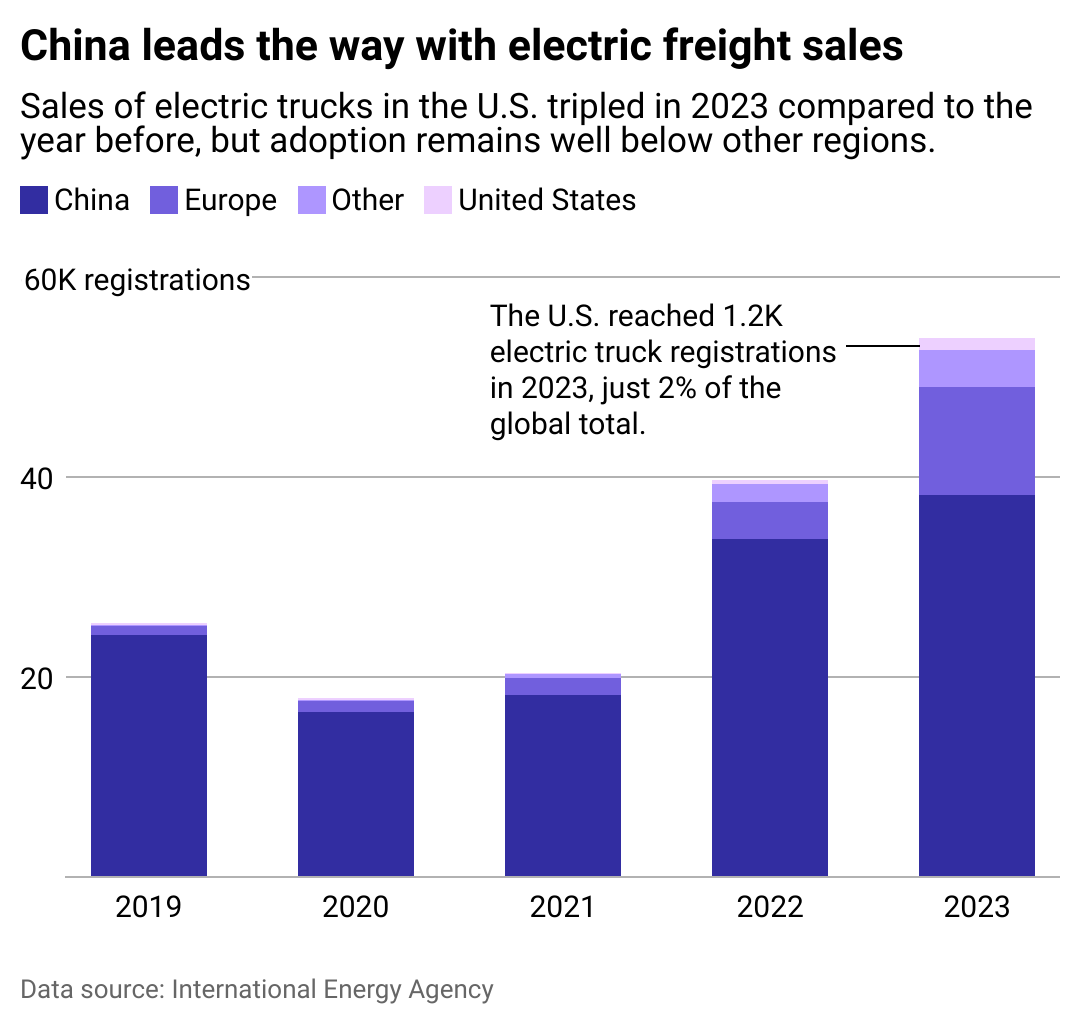
Global sales of heavy-duty electric trucks between 2022-2023 climbed by more than one-third, according to the International Energy Agency. The United States occupied just 0.1% of the 54,000 total reported global sales in 2022. Truck Parking Club looked at the growing adoption of heavy electric trucks in the U.S. and compared that growth with other countries embracing medium- and heavy-duty electric freight trucks. Historical data comes from the International Energy Agency.
Heavy-electric truck adoption in the U.S. is growing, albeit slowly. Charging infrastructure rollout is lagging, truck-model recalls slowed market launches, and two battery makers—Romeo Power and Proterra—liquidated assets and entered Chapter 11 bankruptcy, respectively.
China leads the electric truck market, comprising 70% of 2023 sales worldwide, according to the IEA, marking a sharp decrease from the 85% it occupied in 2022. European Union countries saw a significant increase in electric truck purchases, tripling sales in just a year. Growth was similar in the United States, although total sales lagged behind at 1,200.
In the U.S., the electric trucking industry didn’t begin to really catch on until 2019, when German-based manufacturer Daimler shipped its electric Freightliner semi-truck. In 2022, smaller delivery trucks manufactured by EV startup Rivian began hitting the pavement as part of Amazon’s fleet.
That same year, Tesla launched the first electric Class 8 semi-truck outside of its warehouse in Sparks, Nevada, giving the U.S. a stake in the global market. The futuristic Tesla Semi promised a longer range, safer braking, and a better driving experience. By 2023, other manufacturers followed suit with their own hulking Class 8 electric semis, including Volvo’s VNR Electric.
Electric trucks are still relatively uncommon on the road. As of January 2024, of a fleet of 12.2 million trucks, just 13,000 were electric, according to the Environmental Defense Fund analysis. That analysis defined these trucks as Class 2B to Class 8 vehicles, ranging from step-up vans to tractor-trailers.
Tesla and Daimler will remain industry leaders in 2024 as electric trucks continue to gain momentum, notably because of their cost-effectiveness compared to diesel trucks. The lower cost of electricity compared to fossil fuels, stable electricity rates, and simpler drivetrains or transmission systems all contribute to the price difference. Additionally, electric trucks designed with batteries and motors at the bottom provide a lower center of gravity, enhancing stability and reducing rollover risk, according to EESI.
Electric trucks are not without their disadvantages, however. High initial costs and uneven charging infrastructure raise significant questions about the long-term payoff of the investment.
Even as battery technology for electric trucks continues to evolve, manufacturers will face formidable challenges on the path to widespread adoption.
Despite the potential to increase the range of electric trucks by 30%, the large size and hefty weight of Daimler Trucks’ lithium iron phosphate batteries—plus their lower energy density and poor performance in extreme temperatures—make them less than ideal for cross-country treks in varied conditions. Nissan projects exclusive use of lighter-density solid-state batteries by 2028; but drawbacks remain, including the high price of lithium, a lack of viable recycling options, and the risks of lithium electrodes shorting out as batteries age.
The push for greener freight remains strong despite obstacles. Organizations in the U.S.—notably the North American Council for Freight Efficiency and the Rocky Mountain Institute—are working to identify elements of the trucking industry that could be electrified by conducting trials. So far, they’ve deployed nearly 300 electric trucks of different sizes to collect data on their performance and challenges in the market.
Proponents of the technology argue that electric HDVs emit significantly lower greenhouse gases than their conventional counterparts, making them a powerful tool in the fight against climate change. The potential public health benefits would be worth hundreds of billions of dollars, according to the Environmental and Energy Study Institute.
PARK YOUR TRAILER WITH NO HASSLE
Store your trailer in a safe place with a state-of-the-art platform that locates trailer parking near me.
How the rest of the world is investing in EV technology
As a manufacturer of goods exported worldwide, China dominates the electric truck market in part due to its large customer base and high demand for such vehicles.
This is particularly the case in light of recent Chinese government policymaking, which zeroes in on commercial vehicles like freight trucks as part of the country’s overall electrification strategy, according to the International Council on Clean Transportation.
China has aimed to incentivize greater electric truck use by supporting battery-swapping technology. At charging stations, drivers can replace their battery with a fully charged one in minutes rather than waiting up to several hours to charge their vehicle.
Roughly half of electric trucks in China had swappable batteries in 2020, according to the council. Technologies such as battery-swapping significantly alleviate range anxiety—a barrier to electrifying—by delivering an experience similar to fueling at a gas station.
European regulators have also attempted to nudge the HDV industry toward electrification through strict regulations. In April 2024, the European Parliament overwhelmingly voted to require CO2 emissions from large trucks and buses to be slashed incrementally from 2030, reaching a 90% reduction in emissions by 2040. Europe is home to many electric vehicle manufacturers, and these regulations could bring similar changes to other jurisdictions where European-built HDVs are sold.
KENA BETANCUR/AFP // Getty Images
How the US is investing in electric freight adoption
HDVs aren’t the only mode of transportation undergoing electrification. Under the Biden administration, the U.S. is promoting EV freight adoption through the National Zero-Emission Freight Corridor Strategy. This long-term plan aims to broaden the zero-emission vehicle charging and hydrogen fueling infrastructure along approximately 12,000 miles of major freight routes nationwide.
At the state level, at least 17 states and Washington D.C. agreed to an action plan to work toward 100% electric medium and heavy-duty vehicle sales by 2050. The Joint Office of Energy and Transportation and the Department of Energy developed the strategy with the Department of Transportation and the Environmental Protection Agency.
Disparities in charging infrastructure in rural areas remain a significant barrier to electrification. Another common concern in the passenger vehicle market is charging time, which could impact truckers operating on tight schedules. This, however, can be mitigated by improving charging technology and exploring the use of China’s battery swap technology in the American market.
PREVIOUSLY INACCESSIBLE TRUCK PARKING
Take care of your truck and trailer parking needs with new locations added daily.
Story editing and additional writing by Alizah Salario. Copy editing by Kristen Wegrzyn.
While they often make it look incredibly easy, reversing a truck can be one of the most challenging tasks for truck drivers, especially in tight parking lots. While most people learn to reverse a standard vehicle effortlessly, learning how to reverse park a truck weighing 100,000 pounds is a different matter entirely.
Understanding how to reverse park a truck and using effective truck backing-up techniques is one of the first things you are taught as a new truck driver. Reversing is a seriously important aspect of trucking in terms of safety and damage avoidance, especially when parking at night with poor visibility.
Knowing that many of our trucker members are quite new to the job, we figured a little refresher might help. So, this short blog post will provide a few reminder tips for how to reverse park a truck, starting with one of the most important truck backing-up techniques – the dreaded blind spot.
How to Reverse Park a Truck | Blind Spots
Obviously, trucks have much larger blind spots compared to regular vehicles. These areas can hide entire cars or obstacles, making it risky to reverse without proper awareness. Before attempting to back up, you need to identify and understand these blind spots.
Walk around your truck to inspect the area where you plan to park. This fundamental aspect of truck backing-up techniques is something you should do every time, without fail, to help you identify any potential obstructions.
While reversing, make frequent stops to get out of the truck and reassess the surroundings. This habit might seem time-consuming to many people, but it is extremely important for safety. Constantly checking your blind spots reduces the risk of collisions and helps you maneuver more confidently.
Making the most of your mirrors effectively and maintaining a vigilant lookout for pedestrians or other vehicles is another essential aspect of parking your truck.
How to Reverse Park a Truck | Positioning
Proper positioning before reversing is fundamental to making the task easier. Start by pulling a few feet ahead of your intended parking spot. This forward movement allows you to create a better angle for reversing. The more space you have between your truck and other vehicles, the easier it will be to line up your truck correctly.
Avoid making sharp turns that complicate the maneuver when positioning your truck. Instead, aim for a wide, sweeping motion that gives you more control over the truck’s rear end. This technique helps you straighten your vehicle more effectively and reduces the likelihood of scraping against other parked cars. Always remember that taking a few extra seconds to position your truck correctly can save you from potential damage and stressful situations!
How to Reverse Park a Truck | Patience
When reversing a truck, patience is key. Moving slowly allows you to maintain control and reduce the risk of accidents. Keep your window down to better hear any potential warnings or obstacles, and use your mirrors frequently to monitor your surroundings and make minor adjustments as needed. By taking your time and not rushing, you ensure a far safer and smoother parking experience.
How to Reverse Park a Truck | Swinging the Cab
To successfully reverse into a tight spot, you need to swing the cab out wide. Turn the wheel in the direction of the parking spot, allowing the front end of the cab to move outward.
This maneuver helps align the truck’s rear end with the parking space. Once the rear end is positioned correctly, turn the wheel slightly away from the spot to straighten the cab. If the angle isn’t perfect, don’t hesitate to pull forward and try again.
How to Reverse Park a Truck | Practice Makes Perfect
Learning how to reverse park a truck requires practice to become truly proficient. Find a safe and open area to practice your truck backing-up techniques, not a dangerous truck parking spot. With consistent practice and given enough time, you will become familiar with the truck’s movements and improve your confidence.
With dedication to the cause, you will easily develop the skills needed to reverse park a truck. Patience and persistence are your main allies in mastering this essential driving skill!
Bottom Line
Learning how to reverse park a truck, especially in tight parking lots, can be challenging at times, but with the right techniques, it becomes second nature. By identifying blind spots, positioning your truck correctly, moving slowly, and practicing regularly, you can master how to reverse park a truck safely. These truck backing-up techniques are essential for any driver who wants to improve their skills and avoid accidents.
It certainly helps if you have more room to work with! Remember, traditional truck stops and rest areas often have tight parking spaces because they are often rammed full. Selecting a Truck Parking Club space at one of our private and affordable parking lots often means finding less crowded options.
To make your parking experience even smoother, you can browse for truck parking spots in real time on our user-friendly platform. If you are looking for a convenient and stress-free solution to truck parking, you have it right here at Truck Parking Club.
The information published herein is for general informational purposes only. Truck Parking Club does not make any representations or warranties about the completeness, reliability, legality, and accuracy of this information. Any reliance placed on such material is strictly at the user’s own risk. Truck Parking Club shall not be responsible for any losses or damages incurred in connection with the information published herein.
In what many may view as an unsympathetic move, the Texas city of College Station has passed a local ordinance prohibiting all commercial truck parking throughout the city. Following a majority vote held by College Station City Council members, the action is expected to take effect in September 2024.
Currently, truck parking is restricted on designated city streets during specific hours. The new rules will restrict all areas of the city, forcing truck drivers to park outside the city limits to meet driver hours of service regulations.
The sweeping action addresses ongoing road safety concerns, although many will see the new regulations as unnecessary and inhibiting for truck drivers, most of whom are already severely hindered by a nationwide truck parking crisis. Those with a more cynical view might assume they are a sudden, thinly veiled attempt at improving city aesthetics at the expense of truckers’ livelihoods.
New Ordinance
Under the law, any vehicle used mainly for transporting goods or passengers that also meets a specific, governed weight threshold will be prohibited from parking within College Station city limits.
For clarity, this includes vehicles with a gross combination weight or rating over 26,001 pounds and towed units exceeding 10,000 pounds. Considering most trucks fall outside this criteria, one could argue the law affects the vast majority of heavy transport vehicles.
Implications
Officials have previously argued that the city’s streets, like Ponderosa Drive and Birmingham Road, have seen apparent problems with unattended trucks and trailers. The ordinance aims to clear up the issue, improving the aesthetics and safety of the community.
The actual severity of these issues may be open to interpretation, however, with no obvious evidence suggesting the city experienced prior unacceptable levels of unattended parking.
The regulation also extends to banning unattached trailers (a practice already prohibited in residential zones) and introduces a requirement that commercial vehicles must not park within 30 feet of driveways.
City officials hope that the blanket ban will simplify enforcement and prevent the inconsistent application of rules, which had previously allowed some areas to become inadvertent parking havens.
Public Response
Acknowledging the serious impact it could have on local businesses and truck operators, the city council has proposed a transition period of grace, intended to last between six and twelve months. In a glaring display of optimism, councilors believe those affected should have enough time to find alternative truck parking solutions and adjust to the new regulations.
With rest areas and truck stops at a premium in the local area, how well truckers will adjust remains to be seen. Unless new facilities are provided this year – a prospect that seems extremely unlikely, if not impossible – drivers will have very few options available to them.
Many locals suggest the move is necessary to reduce the number of trucks within the city, while others take a more empathetic view, mindful of the essential role that commercial vehicles fill. Those who support the legislation may form a different opinion if and when retail deliveries are affected further down the line.
With a vast number of truckers unable to meet tight schedules owing to new driver regulations introduced a few years ago – in addition to the aforementioned HOS regulations and existing truck parking issues – you would be forgiven for assuming the new ordinance could be a nail in the coffin for transport efficiency, locally.
Moving Forward
As College Station prepares to implement this ordinance, city leaders are considering establishing designated parking areas where truckers could pay to park overnight. This solution aims to negate some of the challenges presented by the ban and support the needs of the trucking industry in an era plagued with severe truck parking issues.
While this measure meets with broader trends in urban areas to regulate large vehicle parking, it also raises questions about the balance between city development and the necessities of commerce and transportation that rely heavily on these vehicles. There certainly seems to be a striking disparity between the two currently.
Private Sector Alternatives
The transport industry will hope other cities do not follow a similar trend, though signs are not too encouraging at present. Various state council authorities are rumored to be working towards more regulated environments. As they do, the availability of good truck parking facilities will become even more pressing.
In the meantime, drivers and logistics managers looking for reliable parking solutions will find much needed alternative options in the form of Truck Parking Club, specializing in convenient private truck parking through a vast national network.
Becoming a Trucker Member
Truck Parking Club enables drivers to schedule parking spots either in advance or at the last minute by browsing real-time truck parking listings for available spaces in any area of their choosing. Good parking spots can be secured for an affordable nightly rate, with many locations providing useful driver facilities. If any of these issues sound familiar, become a trucker member today for affordable, convenient, stress-free parking solutions.
The information published herein is for general informational purposes only. Truck Parking Club does not make any representations or warranties about the completeness, reliability, legality, and accuracy of this information. Any reliance placed on such material is strictly at the user’s own risk. Truck Parking Club shall not be responsible for any losses or damages incurred in connection with the information published herein.
The Federal Highway Administration (FHWA) has initiated steps to conduct its third nationwide survey under Jason’s Law, focusing on truck parking issues across the United States. The move is being seen as a continued effort to address the critical shortages in truck parking, which have been a longstanding concern for truck drivers and fleet operators.
The upcoming survey aims to gather detailed information from various stakeholders who play essential roles in providing and managing truck parking facilities. These stakeholders include state transportation and enforcement officials, port authorities, private facility owners, and truckers themselves.
The goal is to create a comprehensive picture of the current parking infrastructure and identify pressing needs and gaps that could be targeted for future improvements.
Survey Objectives
You would be forgiven for assuming this is a routine check, but it is actually a mandated requirement under the MAP-21 transportation funding enactment, first passed in 2012. The law requires periodic assessments of truck parking facilities nationwide to ensure that there are enough safe, accessible parking spots to meet the industry’s demands.
The FHWA plans to explore the frequency and location of parking shortages, drivers’ perceptions of future truck parking needs, and the availability of parking capacity information. The survey will also examine drivers’ challenges in accessing these facilities and their broader implications for their safety and transportation efficiency.
State Responses
Since the enactment of Jason’s Law, named after Jason Rivenburg – a trucker who tragically lost his life due to inadequate parking – the FHWA has been tasked with shedding further light on the critical issue of truck parking. The initial survey results, released in 2015 before a subsequent report was created in 2020, have both highlighted the relentless problem of inadequate truck parking, which hasn’t seen measurable improvement over the years.
Several states have responded to the earlier findings by taking steps to improve their truck parking facilities, although many in the logistics industry would dismiss the efforts as box-ticking, designed to appease the community.
That said, some states have demonstrated progress. New Jersey and Indiana, for example, are actively working to expand the number of available parking spots, while Georgia has recently passed legislation aimed at developing a long-term freight and logistics plan, which includes increasing truck parking capacity.
Future Directions
Public participation is a crucial component of this survey process, an assertion that is reflected by the FHWA opening a public comment period and inviting all interested parties’ feedback. This feedback will hopefully play an important role in shaping the final survey and ensuring that it accurately reflects the current state of truck parking.
The deadline for comments is set for June 27, 2024.
With the deadline looming, Truck Parking Club encourages drivers and transport managers to share their experiences and insights. Your input is valuable and will not only contribute to the final report but also guide future policy and funding decisions aimed at alleviating the truck parking crisis.
Bottom Line
The outcomes of this survey could lead to significant changes in how truck parking is managed across the nation, potentially easing the burden on truckers and improving the overall flow of goods and services.
Jason’s passing is profoundly tragic, yet it compels us to act. By providing feedback before the June 27th deadline, we can contribute to meaningful changes that can improve truck parking safety in this country.
While the public sector works to evaluate truck parking facilities, the private sector offers immediate solutions in the form of Truck Parking Club.
Truck Parking Club specializes in providing convenient and secure truck parking through a vast national network, helping drivers find and reserve truck parking spaces in real time. For truckers facing the ongoing challenge of finding reliable parking, joining Truck Parking Club could be the key to simpler and stress-free travel.
The information published herein is for general informational purposes only. Truck Parking Club does not make any representations or warranties about the completeness, reliability, legality, and accuracy of this information. Any reliance placed on such material is strictly at the user’s own risk. Truck Parking Club shall not be responsible for any losses or damages incurred in connection with the information published herein.
Truck parking has become a critical issue across the United States, with New Jersey being no exception.
To address this, the New Jersey Department of Transportation (NJDOT) is actively seeking feedback from both short-haul and long-haul truck drivers through two comprehensive surveys. These surveys are designed to gather valuable insights into truck drivers’ parking needs and help develop effective solutions.
What Are the Surveys About?
The New Jersey DOT has launched two separate surveys aimed at understanding the specific parking challenges faced by short-haul and long-haul truck drivers.
The goal is to provide the department with crucial data on the current state of truck parking in New Jersey and highlight the areas that require immediate attention.
The surveys delve into various aspects of truck parking, including:
Parking Needs: Drivers are asked to detail their specific parking requirements.
Search Patterns: Insights into how drivers search for parking spots.
Time to Park: Data on how long it typically takes for drivers to find a parking spot.
The surveys are open to all truck drivers and industry stakeholders until June 16, 2024. So, if you want to have your say on the matter, we suggest doing so fast.
Addressing New Jersey’s Freight Bottleneck
New Jersey is home to the nation’s top freight bottleneck in Fort Lee.
The NJDOT aims to collaborate with industry stakeholders to identify and implement effective solutions. The survey is expected to help them decide on the effectiveness of various potential solutions, such as:
Adding more parking spaces to existing facilities.
Utilizing technology to improve parking efficiency.
Allowing more on-street parking options.
Exploring the feasibility of paid parking options.
Modifying delivery hours to alleviate parking congestion.
Truckers are asked to rate these solutions, which, in theory at least, should help New Jersey officials decide which ones to pursue.
Wrap Up
As the truck parking shortage continues to wreak havoc in the industry, more and more states are showing proactive steps toward addressing this crisis. The NJDOT’s survey is a perfect example of that.
By gathering data and feedback from truck drivers, the department aims to develop targeted solutions that will benefit the entire trucking community.
If you are a truck driver or industry stakeholder, make sure to participate in the surveys before the June 16 deadline to have your voice heard and contribute to improving truck parking in New Jersey.
And for now, whenever you find yourself searching for available truck parking spots in New Jersey, be sure to use Truck Parking Club.
The information published herein is for general informational purposes only. Truck Parking Club does not make any representations or warranties about the completeness, reliability, legality, and accuracy of this information. Any reliance placed on such material is strictly at the user’s own risk. Truck Parking Club shall not be responsible for any losses or damages incurred in connection with the information published herein.
Two truckers from Palm Beach County, Florida, have filed a lawsuit against the county, challenging a recent ordinance prohibiting them from parking their trucks at their homes.
The Florida truckers see This new regulation as an unfair and targeted campaign to push out blue-collar residents in favor of wealthy newcomers.
Truck Parking in The Acreage
For nearly two decades, truck drivers Jorge Alfaro and Clare Dougal have parked their commercial trucks at their homes in The Acreage, a rural section of Palm Beach County.
This practice was permissible due to specific exemptions in the county’s Unified Land Development Code, which excluded agricultural residential zones from parking ordinances that applied to residential districts.
The Turning Point
In recent years, changes to the Unified Land Development Code have stripped The Acreage of its exemptions.
Starting in 2019, the county amended the code, removing the exclusion that allowed truck parking in agricultural residential zones. This change led to a surge in enforcement actions against truckers like Alfaro and Dougal, who began receiving fines for illegal parking.
The Lawsuit
The lawsuit, filed in the 15th Judicial Circuit Court of Florida, alleges that the new truck parking ban violates their rights as property owners.
Jorge and Clare argue that the ordinance changes are part of a “targeted campaign of rural gentrification” aimed at displacing blue-collar residents to attract white-collar residents.
They claim that the ordinance constitutes a “regulatory taking” of their property.
By prohibiting them from parking their trucks at their homes, the county has effectively taken away the primary use of their property without providing compensation. This, they argue, is a violation of their rights.
The lawsuit also highlights the broader impact of the parking ban.
Truckers in The Acreage face a severe shortage of available truck parking spaces. There are only two dedicated lots in the area, and these lots are often full, forcing truckers to wait for hours or pay high fees for dedicated spots.
As a result, Alfaro and Dougal claim that the new regulations have devalued their property and jeopardized their livelihoods.
County’s Position and Reactions
In February 2024, the Palm Beach County Board of Commissioners clarified truck parking rules, denying a request to allow two 80,000-pound trucks per lot in The Acreage.
Instead, the county amended the code to permit two 16,000-pound vehicles at any home-based business in the area, a rule set to take effect on July 1.
As the lawsuit progresses, it underscores a growing tension between rural and suburban development in Palm Beach County. The outcome of this case could have significant implications for property rights and residential zoning laws in the region and beyond.
Final Thoughts
The lawsuit filed by Jorge Alfaro and Clare Dougal against Palm Beach County highlights the challenges faced by truckers in rural communities amid changing zoning laws.
As they seek justice and the right to park their trucks at their homes, this case brings to light the broader issues of regulatory overreach and the impact of gentrification on long-standing residents.
This case also highlights the nationwide truck parking problem and the federal and state government’s inability to resolve it.
Fortunately, private solutions like our very own Truck Parking Club help truckers find available parking spots across the US, whether in Florida or any other state.
However, until government officials start doing more to resolve the truck parking crisis, more truckers will likely follow Jorge and Clare’s example and try to fight for their right to park their trucks close to their homes.
The information published herein is for general informational purposes only. Truck Parking Club does not make any representations or warranties about the completeness, reliability, legality, and accuracy of this information. Any reliance placed on such material is strictly at the user’s own risk. Truck Parking Club shall not be responsible for any losses or damages incurred in connection with the information published herein.
As with almost every other physical asset in the business world, maintenance is essential to owning a truck parking lot. Not only does it help to keep your parking lot in good shape, but it also helps to reduce the potential for costly problems and accidents.
Below, we’ll discuss some of the most essential aspects of maintaining a truck parking lot and the costs, time, and benefits involved.
Truck Parking Lot Maintenance Checklist
We’ll discuss parking lot maintenance in detail in a moment. First, let’s look at a short checklist of regular tasks that you need to do to ensure that your parking lot is in good working order.
General Maintenance Tasks
Keeping your truck parking lot clean Frequency: Weekly
Checking for and repairing cracks Frequency: Monthly
Summer Maintenance Tasks
Sealing the parking lot Frequency: Every two years
Repainting stripes and on-road signage Frequency: Yearly
Fall Maintenance Tasks
Remove leaves and other debris from the lot Frequency: Daily
Ensure you have everything for maintenance during the winter period Frequency: Yearly
Winter Maintenance Tasks
Apply a liquid deicing agent before the first snowfall Frequency: Yearly
Remove snow from the parking lot as quickly as possible Frequency: Daily, or twice a day, if there is snow
Apply sand, salt, or other deicers to prevent ice buildup Frequency: Daily, during times of snow
Spring Maintenance Tasks
Check for and remove unwanted vegetation and weeds Frequency: Bi-weekly
Ensure that all drainage systems are in working order Frequency: Bi-monthly
Truck Parking Lot Maintenance: a Detailed Overview
On average, an asphalt parking lot has a predicted lifespan ranging from 20 to 40 years. However, good parking lot maintenance practices can help extend the lifespan by as much as 30 years. Below, we’ll highlight some of the most common and essential maintenance requirements.
General Surface Care
Because truck parking lots are constantly exposed to harsh weather conditions, caring for their surfaces is an ongoing process. Wind, rain, sunlight, and the trucks themselves all contribute to wear and tear.
A range of different types of maintenance should be implemented to keep the parking lot in excellent condition.
Keeping the Truck Parking Lot Clean
An often overlooked part of parking lot maintenance, keeping the surface clear of dirt and debris is essential.
First of all, certain types of debris may be hazardous to the parking lot or the trucks themselves. Nails, tins, cans, and even rocks may pose a risk of damage to truck tires.
Second, when the parking lot has a layer of debris over it, the slightest mist, rain, or snow may make the surface slick, making it unsafe to drive on.
Keeping the lot clear of debris is especially important in fall when leaves are abundant. The leaves of many trees exude chemicals that may eat away at the tarmac, causing larger problems later on.
This maintenance should be done at least twice a week during most of the year, but preferably daily during the Fall. It can be relatively inexpensive since it only takes an hour or so each day. You could probably get unskilled labor assistance for under $250 a month (during peak season) and less than $100 a month the rest of the time.
Finding and Repairing Cracks
One of the easiest ways to avoid major parking lot repairs is to watch for cracks that form from weather exposure. You need to repair these or have them repaired as soon as possible. Try to check for cracks at least once a month and repair them immediately.
You can expect to pay between $0.50 and $3.00 per linear foot for crack repair. If you catch cracks early, the cost will be less than it typically would.
General Maintenance (Usually Done in Summer)
Summer is the best time to perform certain maintenance tasks since you don’t have to deal with overwhelming weather conditions or an influx of debris.
Striping
Stripes and painted-on road signs are essential to your truck parking lot. Consequently, you need to ensure that they remain easily visible and don’t get the opportunity to wear off. This is known as striping and should be done yearly or biyearly.
Depending on the size of the lot, the cost for this type of parking lot maintenance may be as low as $100 or as high as $1,000.
Resealing the Tarmac
Since truck parking lots are constantly exposed to wear and weather conditions, it’s vital to reseal them regularly. This prevents moisture from seeping into the tarmac, where freezing and other events can cause significant damage.
It’s best to have the tarmac resealed every two years, though you may wish to do it yearly in particularly trying climate conditions.
You can expect to pay between $0.10 and $0.50 per square foot for this process.
General Maintenance (Usually Done in Spring)
During the spring season, you may have to deal with some issues that aren’t a problem the rest of the year.
Removing Unwanted Vegetation
In spring, you may encounter vegetation growing on your tarmac. Certain types of weeds are highly resilient and will easily grow in even the smallest spaces.
However, as their roots expand, the plants may begin to crack or even lift the tarmac. For this reason, removing or killing any unwanted vegetation before it takes hold is essential.
One of the easiest ways to do this is to apply a herbicide to the affected areas. In that case, you can probably pay less than $100. If your entire lot requires treatment, this value can go up into the thousands.
Ensure That All Drainage Systems are Working
After winter, it’s essential to ensure that all drainage systems are clear and working properly. This helps to ensure that there’s no standing water in the lot. You might have to do this about once a week for the first month of spring and once a month after that.
It won’t cost you anything if you’re willing to do this yourself. If you pay someone to do it, you can expect to pay up to $100 for the process (assuming there are no major blockages).
Winter Tasks
During Winter, there are certain tasks that aren’t necessary for the rest of the year. This part of truck parking lot maintenance is specifically for regions with snow and ice.
There are three main tasks to consider and perform:
Treating the lot with a liquid deicing agent before the first snow or ice. This will cost between $4 and $12 per gallon on average and prevents the ice from bonding with the tarmac.
Keeping the lot clear of snow. This should be a daily task when it is snowing, and you can probably hire someone to do it for as little as $150-$300 a month (depending on how long the process takes every day).
Treating the tarmac with a deicer. After the snow has been removed, it’s essential to apply a deicing agent. This prevents the ice from bonding with the tarmac and making it slippery. Expect a cost of $2-$3 per 1,000 square feet when using something like salt.
Truck Parking Lot Maintenance Tips
When you’re dealing with the administration and day-to-day of a business, taking the time to invest in truck parking lot repairs and maintenance can seem daunting. These are some of our top tips for successfully maintaining your lot.
1 – Consider Contracting Out Maintenance, Especially in Winter
There are many companies out there specializing in parking lot repairs, maintenance, and installation. Often, they perform these services at reasonable rates, meaning it won’t take a large percentage of your profits.
Leaving the maintenance and repair work to a company like this, especially in the harsh winter conditions, will give you peace of mind and free up your time.
2 – Sign Recurring Contracts with Trustworthy Contractors
Some tasks will need to happen yearly or bi-yearly. In these cases, when you find a contractor who does the job well and that you know you can trust, consider asking them for a recurring contract. This will take the effort out of arranging for the same service every year. Instead, they will come at the same time each year, and you simply have to pay the bill.
3 – For Low-Income Lots, Consider DIY
In certain circumstances, your lot may be in an out-of-the-way location or a town that doesn’t see much truck traffic. In these cases, you may feel that the price spent on contractors is simply too high. This is a good time to consider DIY options, as they can cost you as little as a third of the price.
Final Thoughts
It may be tempting to neglect maintenance until there are visible signs of its necessity, but this can be a fatal mistake. Truck parking lot repairs almost always cost significantly more than maintenance would.
It’s best to maintain a regular maintenance schedule rather than have to deal with the inconvenience of repairing or even replacing your lot’s surface. With the information listed above, you should be able to perform truck parking lot maintenance with ease.
Are you ready to make more income from your well-maintained parking lot? Become a property member with Truck Parking Club today!
The information published herein is for general informational purposes only. Truck Parking Club does not make any representations or warranties about the completeness, reliability, legality, and accuracy of this information. Any reliance placed on such material is strictly at the user’s own risk. Truck Parking Club shall not be responsible for any losses or damages incurred in connection with the information published herein.
The national truck parking shortage has led to an array of different challenges and intuitive solutions. Many changes have been implemented in Florida to help mitigate the effects. Below, we’ll take a closer look at some specific actions that have been implemented.
The Truck Parking Availability System (TPAS)
The Truck Parking Availability System, or TPAS, is a significant new implementation along certain interstates in Florida. The Florida Department of Transport, or FDoT, is spearheading this initiative in an effort to help truck drivers have up-to-date information regarding parking availability.
Significant improvement has been made in states like Texas, where this system has already been implemented. But what is TPAS, and how does it work?
TPAS is an as-it-happens update system that tracks available truck parking and transmits this information to truck drivers and other interested parties. This makes it considerably easier for drivers to keep track of available parking spaces.
The system uses sensors placed in parking spaces at parking lots and rest stops to accurately determine the number of spaces available. As a result, truckers across the nation can safely and easily navigate routes and easily access rest stops when they need them.
According to the Florida Department of Transport, the implementation of the TPAS system will be a three-part process.
They’ll be implementing the technology at state-owned facilities, which will then give them the data they need to accurately assess truck parking availability (and share it with truck drivers and other stakeholders). They’ll also use this information to accurately predict and analyze future parking availability.
900+ New Parking Spaces
Florida government has also promised to produce at least 900 new parking spaces along Central Florida’s Interstate 4. This will go a long way toward reducing pressure on the already overburdened transportation industry in the state.
EV Charging
Many of the new truck parking facilities will also incorporate electric vehicle charging ports. This will help to lighten the environmental impact of the trucking industry in the state while simultaneously helping to ease pressure on the petroleum industry.
Bipartisan Infrastructure Law
Another relevant aspect of the attempt to add at least 900 additional truck parking spaces is the influx of funds from the bipartisan infrastructure law. This law is funnelling an additional $180,000,000 towards the problem of truck parking shortages in Florida.
This shows how resolved the government is to tackle Florida’s parking issues. The $180 million is just a portion of nearly $5 billion earmarked for transportation projects.
Incorporating Private Parking Locations
Florida’s government has seen the need for significant parking expansion in the state, and therefore aims to incorporate more private parking locations. Doing so can have a significant impact on the amount of parking available.
Tools like Truck Parking Club are one way to keep track of how many parkings are available at these new private locations. Get easy and immediate access to a list of parking spots available in your area.
Significance of these Developments
The truck parking shortage has been an ongoing problem throughout much of the United States. At the same time, however, truck drivers need to adhere to Hours of Service regulations.
This means that they often have to stop in places that were not designed as truck rest areas. Some drivers may even park illegally on road shoulders in order to adhere to their Hours of Service requirements.
This new system of management TPAS will allow drivers to know in advance where there’s space available for them to park at a designated resting area. By cutting down on the number of truck drivers parking on road shoulders and in other illegal areas, these developments will make roads safer.
Easier access to information about where truck parking is available will also help to ensure that truck drivers can move through their routes faster. This will help improve delivery times for just-in-time deliveries, among other things.
By incorporating this new technology, there will be one other significant change. Instead of having some truck parking stops filled to overflow while others are underutilized, drivers will know exactly where there’s space for them. This should mean that all parking stops are used equally, easing pressure on overburdened stops and cutting down on wait times.
Final Thoughts
Whether you consider the addition of the Truck Parking Availability System, the addition of over 900 new truck parking spaces, or the large investment made by the Bipartisan Infrastructure Law, truck parking in Florida is moving in the right direction.
That doesn’t mean you can’t help improve your chances even more, though. As a truck driver, you can quickly and easily register with Truck Parking Club.
As a property owner, you can register your land and make it available as a truck parking area. This can help alleviate the strain on an already strained truck parking system.
The information published herein is for general informational purposes only. Truck Parking Club does not make any representations or warranties about the completeness, reliability, legality, and accuracy of this information. Any reliance placed on such material is strictly at the user’s own risk. Truck Parking Club shall not be responsible for any losses or damages incurred in connection with the information published herein.