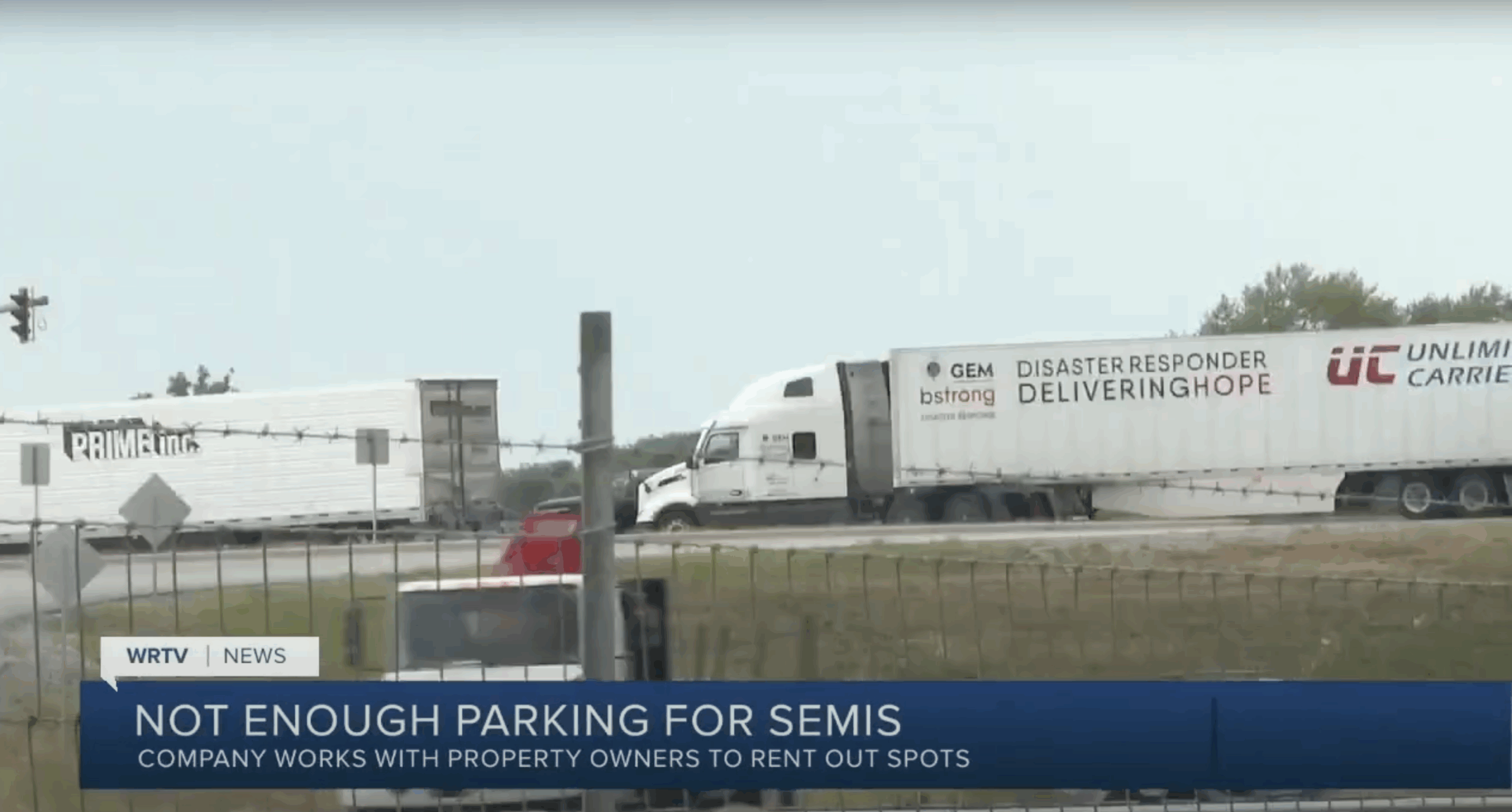
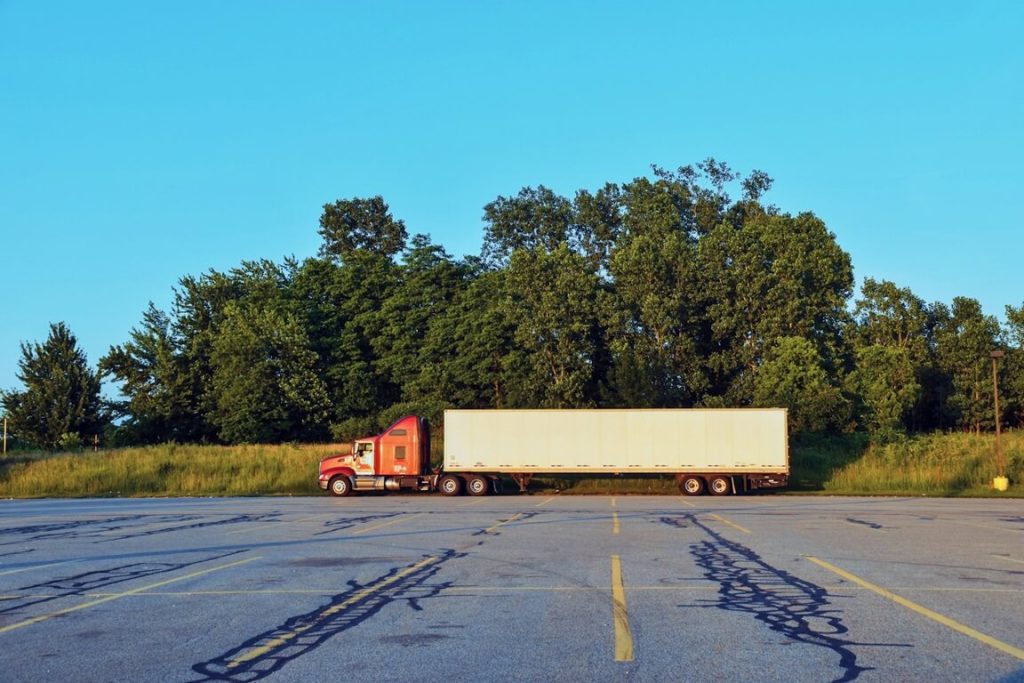
We’re excited to share that Truck Parking Club was recently featured in a major news story by WRTV6 in Indianapolis, highlighting the critical truck parking shortage affecting drivers across Indiana and the nation.
The Story Behind the Coverage
The WRTV story, reported by Meredith Hackler, focused on the growing crisis of semi-trucks being forced to park along interstate ramps as drivers search for legal places to stop. The report cited our data showing that for every 11 semis on the road, there is only one parking spot available.
What We Shared
Our CEO Evan Shelley was interviewed about how Truck Parking Club is working to fill this critical gap by partnering with local property owners across the country, including in Indiana. We currently manage about 100 truck parking spots in the state alone.
Drivers looking for parking in Indiana can find available spaces across our 100+ locations with over 2,300 parking spaces at truckparkingclub.com/truck-parking/indiana.
Evan explained our unique approach: “That can be a trucking company with extra space in the yard, a tow truck company, a truck repair shop, a warehouse, a self-storage facility. Any space that is suitable for truck parking, we can get them in the business of truck parking the same day.”
The Bigger Picture
The story also highlighted that the Indiana Department of Transportation (INDOT) is expanding capacity, with plans to add 1,200 new truck parking spaces across their rest areas and welcome centers. This expansion is crucial as freight flow in Indiana is expected to increase by about 60% by 2040.
Why This Matters
This media coverage helps raise awareness about a problem that affects not just truck drivers, but everyone who relies on goods being transported across the country. When drivers can’t find safe, legal places to park and rest, it impacts delivery schedules, driver safety, and ultimately, the cost of goods for consumers.
Residents in a Manteca, California neighborhood are raising concerns over big rig trucks parked along their residential streets, saying they’re fed up and want the city to step in. The situation highlights a growing nationwide problem where truck drivers, facing a critical parking shortage, are forced to use residential areas as makeshift truck stops.
The Problem: Semi-Trucks in Residential Neighborhoods
Homeowners on Villa Ticino Drive say the sight of multiple semi-trucks lined up outside their homes isn’t what they expected when moving in. One resident, Darrin DeSilva, recently moved to Manteca from Tracy and was shocked by the frequent presence of large trucks on his street.
“It’s been a couple of months of this,” said DeSilva. “Me and my wife just married last year. We came here to start a new life, and when I pictured the community I wanted to live in, it didn’t involve seeing huge semi-trucks outside my front door.”
According to the City of Manteca’s municipal code, daytime parking of oversized vehicles is prohibited in residential areas unless the vehicle has a valid permit specifying the date and time.
Community Response and City Action
DeSilva shared a video of the trucks on social media to raise awareness and called for action. Manteca Mayor Gary Singh responded to his post, stating: “This is not ok. Call Manteca Police or DM me the address.”
The Root Cause: A Critical Truck Parking Shortage
A local truck driving instructor based in nearby Lathrop told reporters they advise students not to park in residential neighborhoods, citing noise from diesel engines and safety concerns. However, the reality is that many drivers have few alternatives.
According to research conducted by Truck Parking Club, there is a 1.7 million space shortage on a daily basis across the US. In California, this shortage is particularly acute due to high freight volume through major ports and distribution centers.
Community Solutions
Not all residents see the trucks as a problem. Some neighbors say as long as no one is being harmed, they don’t mind the rigs being there. This division reflects the complex nature of the issue—while residents want quiet, safe neighborhoods, they also recognize that truck drivers are essential to the local economy.
“The more Manteca grows, the more we’re going to have issues like this,” said DeSilva. “Maybe we can have some sort of designated hub where drivers can pay to park their trucks.”
How Truck Parking Club Provides Solutions
Private solutions like Truck Parking Club can help bridge the gap between immediate community needs and long-term infrastructure development. By connecting property owners with available space to truck drivers who need parking, we can reduce illegal parking in residential areas while providing safe, legal alternatives for drivers.
As Manteca continues to grow and develop, finding solutions to the truck parking challenge will become increasingly important. The city’s response to this issue could serve as a model for other California communities facing similar problems.
The key to success will be balancing the needs of residents with the economic importance of the trucking industry, while developing practical solutions that work for everyone involved.
Howard County, Maryland is taking a hard stance against illegal truck parking that has been plaguing residential neighborhoods. Starting September 7, 2025, the county will implement a dramatic increase in fines for illegally parked commercial vehicles, jumping from the previous $33 penalty to a tiered system that could cost truckers up to $1,000 per violation.
The Problem: $33 Fines Were Too Cheap
Until recently, Howard County had the lowest truck parking fines of any jurisdiction in Maryland at just $33. This created a perverse incentive where truckers found it cheaper to park illegally and pay the fine than to use legitimate parking facilities.
Dan Medinger, a business owner on Twin Knolls Road in Columbia, explained the situation: “The truckers found out the tickets were cheaper than going to park pay to park someplace, so they came back and said, you want a ticket me? Go ahead.”
The result was a pattern of overnight and weekend truck parking that turned residential areas into what Medinger described as “industrial parking lots.”
Community Concerns Beyond Just Parking
The illegal truck parking created multiple problems for Howard County residents:
Traffic issues from large commercial vehicles in residential areas
Environmental concerns including trash left behind from trucker cookouts
Safety concerns including potential human trafficking activities
Quality of life impacts as neighborhoods were transformed by industrial vehicles
“Some of these truckers have turned our neighborhoods and side streets into industrial parking lots, and it’s just not right,” Medinger said.
The Solution: A Tiered Fine System
District 2 Councilor Opel Jones successfully passed legislation creating a new tiered fine structure:
First offense: $250 minimum
Second and subsequent offenses: Up to $1,000 maximum
This represents a 658% increase from the previous $33 fine, making illegal parking significantly more expensive than legitimate parking options.
Implementation Timeline
Howard County police will begin a 30-day educational period starting next Thursday, during which they’ll issue warnings to illegally parked trucks. The new law takes full effect on September 7, 2025.
The Impact on Truck Drivers
While the new fines address community concerns, they also highlight the broader truck parking shortage facing drivers. A trucker interviewed by WMAR-2 News expressed concern that once the law takes effect, finding legal parking will become a real challenge.
Councilor Jones acknowledged this concern but emphasized the need to balance driver needs with community safety: “Honestly, if it’s not zoned for that and there’s residential neighborhoods, you don’t want to pass by 2, 5, 10 tractor trailers going into your neighborhood. It is unfortunate if the driver has to make other arrangements, but that’s up to the company to ensure that these drivers are safe, and if they have to park somewhat of a distance away from where they’re working, they need to set that up.”
A Broader Trend in Local Government
Howard County’s approach reflects a growing trend among local governments to address truck parking issues through stricter enforcement rather than infrastructure investment. While fines can deter illegal parking, they don’t create additional parking capacity for drivers who need to rest or wait for their next load.
How Truck Parking Club Provides Solutions
The situation in Howard County highlights the importance of having accessible, legal parking options for truck drivers. Private solutions like Truck Parking Club can help bridge the gap between enforcement and infrastructure needs.
Howard County’s new enforcement approach should significantly reduce illegal truck parking in residential areas. However, the success of this initiative will depend on:
Consistent enforcement by local police
Awareness among trucking companies about the new penalties
Availability of alternative parking options for drivers
Ongoing community feedback to ensure the solution addresses all concerns
A Model for Other Communities
Other jurisdictions facing similar truck parking issues may look to Howard County’s approach as a model. The combination of:
Substantial fine increases to change behavior
Educational period to ensure awareness
Clear enforcement timeline for implementation
Shows how local governments can take decisive action to protect residential communities while maintaining the flow of commercial traffic.
Looking Ahead
As September 7 approaches, Howard County residents should begin to see improvements in their neighborhoods. The key to long-term success will be:
Effective enforcement of the new fine structure
Partnerships between law enforcement, trucking companies, and local communities
Continued development of legitimate parking options for commercial vehicles
Balanced approach that addresses both community concerns and driver needs
This initiative represents more than just increased fines—it’s a commitment to maintaining the quality of life in Howard County neighborhoods while ensuring that commercial trucking operations can continue safely and legally.
The Port Authority of New York and New Jersey has taken a significant step toward resolving a long-standing issue affecting Queens residents. On Tuesday, August 6, 2025, the agency broke ground on a major expansion of truck parking facilities at John F. Kennedy International Airport, a project designed to keep cargo trucks off residential streets after years of complaints from southeast Queens communities.
The Scope of the Problem
For years, residents in neighborhoods surrounding JFK Airport—including Springfield Gardens, Rochdale, Brookville, and Rosedale—have endured the consequences of inadequate truck parking infrastructure. The situation has been particularly challenging as JFK Airport has experienced substantial growth in cargo operations:
1.67 million tons of cargo handled in 2024
5% increase from the previous year
25% growth since 2019
8th busiest cargo airport in the United States
The existing Airport Truck Plaza, with space for only 50 trucks, has been woefully inadequate to meet the demand, forcing drivers to park illegally on residential streets.
The Expansion Project Details
The new initiative represents a comprehensive solution to the parking shortage:
Triple the Parking Capacity
The expansion will triple the number of truck parking spaces at the airport, providing much-needed relief for both drivers and residents.
Modern Amenities
The expanded facility will include:
Updated restrooms for driver comfort and compliance with hours-of-service regulations
Food concessions to support drivers during their rest periods
Electric vehicle chargers to accommodate the growing fleet of electric trucks
Strategic Location
The expanded truck plaza will replace a currently vacant food preparation building and complement the existing Airport Truck Plaza, maximizing the use of available airport property.
Community Impact and Relief
The project has been met with enthusiasm from local community leaders who have long advocated for a solution to the overnight truck parking problem.
Bryan Block, chair of Queens Community Board 13, expressed relief: “Today, we can finally look forward to the potential solution of a problem our communities have suffered through for many years… overnight truck parking.”
The expansion is expected to significantly reduce the burden on nearby neighborhoods by providing designated parking areas that keep large commercial vehicles off residential streets.
Economic and Operational Benefits
Rick Cotton, Port Authority executive director, emphasized the broader benefits: “Breaking ground for the expansion of truck parking facilities at JFK Airport is a win for the airport, a win for the community and a win for the drivers who support our cargo operations and help to keep our region moving.”
The project is part of the Port Authority’s broader investment strategy at JFK Airport, reflecting the agency’s commitment to supporting both airport operations and surrounding communities.
Timeline and Implementation
Groundbreaking: August 6, 2025
Expected completion: Fall 2026
Project scope: Part of broader JFK Airport investment program
The Broader Context: Nationwide Truck Parking Shortage
The situation at JFK Airport reflects a larger nationwide challenge. According to the American Trucking Associations, there is currently one truck parking space for every 11 trucks on the road nationwide. This shortage forces drivers into difficult situations, including illegal parking in residential areas.
How Truck Parking Club Provides Additional Solutions
While the Port Authority’s expansion addresses the immediate need at JFK Airport, private solutions like Truck Parking Club continue to play a vital role in addressing the broader parking shortage:
The JFK Airport expansion demonstrates how airports can work with their surrounding communities to address truck parking challenges. The combination of:
Strategic location planning
Modern amenities for drivers
Community input and feedback
Partnerships between government and industry
Shows that even complex urban problems like airport-adjacent truck parking can be addressed effectively.
Looking Ahead
As construction progresses toward the fall 2026 completion date, Queens residents should begin to see improvements in their neighborhoods. The key to success will be:
Effective utilization of the expanded parking facilities
Ongoing community feedback and program adjustments
Partnerships between the Port Authority, trucking companies, and local communities
Continued investment in airport infrastructure to support growing cargo operations
This expansion represents more than just additional parking spaces—it’s an investment in community relations, airport efficiency, and the well-being of the truck drivers who keep America’s cargo moving.
Queens residents may finally see relief from a persistent problem that has plagued their neighborhoods for years: illegal truck parking by large commercial vehicles on residential streets. On Thursday, July 30, 2025, three City Council bills will go into effect, marking a significant step toward addressing this quality-of-life issue that has particularly affected areas surrounding John F. Kennedy Airport.
The Scope of the Problem
The illegal parking of tractor trailers and other large commercial vehicles has been especially problematic in Southeast Queens, where streets surrounding JFK Airport—one of the world’s busiest commercial hubs—have become de facto truck parking lots. The consequences have been far-reaching:
Congestion on residential streets
Reduced parking availability for local residents
Interference with street cleaning operations
Safety concerns for pedestrians and other motorists
Property value impacts in affected neighborhoods
The Legislative Solution
The three bills, including one sponsored by Southeast Queens Councilmember Nantasha Williams, establish a comprehensive approach to the problem:
1. Overnight Parking Areas for Commercial Vehicles
The Williams-sponsored bill requires the Department of Transportation (DOT) to establish designated overnight parking areas for commercial vehicles in business zones. These areas will:
Be available exclusively for commercial vehicles
Operate for at least 10 consecutive overnight hours
Be strategically located in industrial business zones rather than residential areas
2. Enhanced Sanitation Department Authority
The other two bills grant the city’s Sanitation Department increased authority to identify and remove derelict vehicles, providing additional enforcement capabilities.
Bipartisan Support and Community Impact
The legislation received overwhelming support, passing unanimously with 37 co-sponsors. Council Speaker Adrienne Adams emphasized the broader impact: “Illegal commercial truck parking remains a persistent issue in Southeast Queens and communities across the city, impacting the health and safety of New Yorkers.”
The new law builds on previous Council actions, including:
Redesigning the city’s truck route network
Creating off-site parking for tractor trailers
Establishing the “Safer Truck Parking for Safer Streets” pilot program
The Pilot Program and Implementation Challenges
The DOT has been piloting the “Safer Truck Parking for Safer Streets” program, which introduces metered parking options in select industrial business zones. However, the initial pilot locations—Flatlands in Brooklyn, Hunt’s Point in the Bronx, and Maspeth—excluded the JFK area, drawing criticism from Southeast Queens leaders.
Councilmember Williams expressed confusion about the exclusion: “I’m actually quite confused as to why my community was not included in this pilot. I know tons of communities deal with truck parking related issues, but I will endeavor to say that the Southeast Queens community…have been dealing with this issue for far longer than I’ve been in the Council.”
Implementation Timeline and Challenges
According to Councilmember Selvena Brooks-Powers, the pilot program is still in its early stages. The DOT has been using this time to identify suitable sites and prepare for the legislation’s implementation. Brooks-Powers recently toured a potential site in Springfield Gardens but noted the challenges of finding ideal locations.
“We are a community that nestles right next to one of the busiest airports in the nation, that has one of the highest traffic for cargo, and so it becomes challenging,” she said. “It’s not going to be an easy task to identify the most ideal location, because all of these things are things that have to be taken into account.”
The Role of Enforcement
James Johnson, executive director of the GatewayJFK Business Improvement District, emphasized that the success of the legislation depends heavily on enforcement: “The bill will not work if there’s no enforcement. We need enforcement, and if enforcement is happening, then this bill can work magically.”
A Model for Other Communities
Queens’ approach to addressing illegal truck parking could serve as a model for other communities facing similar issues. The combination of:
Designated overnight parking areas
Enhanced enforcement capabilities
Community input and feedback
Strategic location planning
Demonstrates a comprehensive approach to solving a complex urban problem.
The Broader Context: Nationwide Truck Parking Shortage
The situation in Queens reflects a larger nationwide issue. According to the American Trucking Associations, there is currently one truck parking space for every 11 trucks on the road nationwide. This shortage forces drivers into difficult situations, including illegal parking in residential areas.
How Truck Parking Club Provides Solutions
While government initiatives like Queens’ new legislation are crucial, private solutions like Truck Parking Club continue to play a vital role in addressing the parking shortage:
The implementation of these bills represents a significant step forward in addressing the illegal truck parking crisis in Queens. As the DOT continues to identify suitable sites and the pilot program expands, residents should begin to see improvements in their neighborhoods.
The key to success will be:
Effective enforcement of the new regulations
Adequate capacity in the designated parking areas
Ongoing community feedback and program adjustments
Partnerships between government, property owners, and the trucking industry
This legislation demonstrates that with proper planning, community input, and enforcement, even complex urban problems like illegal truck parking can be addressed effectively.
Ohio Governor Mike DeWine has taken a bold step to address one of the most critical issues facing the trucking industry today. On July 29, 2025, Governor DeWine and Ohio Department of Transportation (ODOT) Director Pamela Boratyn announced a comprehensive plan to add at least 1,400 new truck parking spaces across the state, more than doubling Ohio’s current truck parking capacity on state-owned property.
A Strategic Response to Growing Demand
Ohio’s position as a critical freight corridor makes this expansion particularly significant. The state is perfectly situated within a day’s drive of 60% of the U.S. and Canadian population, making it one of America’s most important transportation hubs.
The numbers tell the story:
27.5 million miles logged by trucks on Ohio roads in 2023 alone
26% increase in freight volume projected by 2045
33 new truck parking areas across 19 counties
$150 million in funding from the current transportation budget
The Human Cost of Parking Shortages
The announcement comes at a critical time. According to the American Trucking Associations, there is currently one truck parking space for every 11 trucks on the road nationwide. This shortage forces drivers into dangerous situations:
Driving while drowsy when they can’t find parking
Parking in unsafe areas like highway shoulders and exit ramps
689 crashes caused by drowsy semi-truck drivers in Ohio since 2015
345 injuries and 2 fatalities resulting from these crashes
Strategic Site Selection
The 33 new truck parking areas will be strategically located across 19 counties, organized by region to maximize coverage and accessibility:
Northwest Region (8 locations)
Allen County: US 30 Rest Areas (Westbound & Eastbound)
Henry County: US 6 and County Road 424 Infields (Eastbound)
Medina County: IR 71 Rest Areas (Northbound & Southbound), IR 76 Rest Areas (Eastbound – Existing, Westbound – Vacant)
Wyandot County: US 30 Rest Areas (Westbound & Eastbound)
Northeast Region (8 locations)
Ashtabula County: IR 90 Vacant Rest Areas (Westbound & Eastbound)
Summit County: IR 271 Rest Areas (Northbound & Southbound), IR 77 Vacant Rest Area
Belmont County: IR 70 Weigh Station (Eastbound)
Lake County: IR 90 Vacant Rest Areas (Westbound & Eastbound)
Mahoning County: SR 11 Vacant Rest Areas (Northbound)
Southwest Region (7 locations)
Auglaize County: US 33/Willipie Infields (Eastbound), US 33 Rest Areas (Westbound & Eastbound)
Clermont County: IR 275 Rest Areas (TP Northbound & Southbound)
Warren County: IR 71 Rest Areas (Northbound & Southbound)
Southeast Region (10 locations)
Guernsey County: IR 70 Rest Areas (Westbound & Eastbound)
Franklin County: IR 71/US 62 Infields (Eastbound)
Ross County: US 35/US50 Interchange, US 23/SR159 Interchange
Gallia County: US 35 Rest Areas (Westbound & Eastbound)
Fayette County: US 35/US62/US22 Infields (East)
Once complete, the American Transportation Research Institute projects that Ohio will lead the nation in the total number of long-term truck parking spaces available on state-owned property.
A Comprehensive Approach to Safety
Each new parking site will include:
Lighting for enhanced security and visibility
Restroom facilities to support driver comfort and compliance with hours-of-service regulations
Safe, accessible locations away from dangerous highway shoulders
Building on Previous Success
This expansion is part of Ohio’s ongoing commitment to supporting freight mobility and highway safety. Recent initiatives include:
2019: Launch of Truck Parking Information Management System (TPIMS) with Midwest states for real-time parking availability 2022: Conversion of more than a dozen unused weigh stations into truck parking areas (144 new spaces) 2023: Statewide initiative to modernize 36 rest areas (401 new truck parking spots) 2024: Transformation of two abandoned rest areas in Preble and Trumbull counties (138 additional spaces)
The Economic Impact
Governor DeWine emphasized the broader economic benefits: “As Ohio’s economy continues to grow, so do the number of trucks traveling on Ohio’s network of interstates and state routes. By expanding safe, accessible places for drivers to rest, we’re supporting the people who keep our economy moving and making it safer for everyone on our roads.”
Timeline and Implementation
Construction begins: 2026
Expected completion: End of 2027
Total current parking spaces statewide: Approximately 14,200 (mostly at privately owned truck stops and businesses)
How Truck Parking Club Complements State Initiatives
While Ohio’s public investment is crucial, private solutions like Truck Parking Club continue to play a vital role in addressing the parking shortage. Our platform helps property owners monetize underutilized space while providing drivers with safe, reliable parking options.
Ohio’s comprehensive approach—combining public investment with private partnerships—could serve as a model for other states facing similar truck parking shortages. The combination of strategic site selection, safety-focused design, and substantial funding demonstrates what’s possible when state leadership prioritizes this critical infrastructure need.
Looking Ahead
As construction begins in 2026, Ohio will be setting a new standard for truck parking infrastructure. The state’s commitment to doubling its truck parking capacity shows that with proper planning and investment, the truck parking crisis can be addressed effectively.
This initiative represents more than just additional parking spaces—it’s an investment in highway safety, economic growth, and the well-being of the truck drivers who keep America’s economy moving.
Stanislaus County is taking decisive action to address a growing crisis: the proliferation of illegal truck parking facilities that have been causing conflicts between trucking businesses, property owners, and agricultural operations.
According to a recent Modesto Bee report, the county Planning and Community Development Department is holding a public meeting this week to discuss proposed new regulations for truck parking facilities. The meeting comes after months of study by a county-appointed committee that has been examining the complex issues surrounding truck parking in agricultural zones.
The Problem: Demand Far Exceeds Legal Options
The situation in Stanislaus County mirrors a nationwide trend. As the Modesto Bee reported, “The demand for truck parking has far outstripped the number of legal parking facilities, and public complaints about illegally parked trucks have intensified.”
Trucking businesses that haul regular freight (not agricultural products) have increasingly been parking trucks and trailers on rural parcels throughout the county. This has created tension with farming advocates who complain about interference with farm operations, ground pollution, increased truck traffic and noise, and road wear and tear.
Proposed Solutions and Their Impact
The county is considering several key changes to address these issues:
Limiting home-occupation permits in agricultural zones to one tractor-trailer rig instead of three
Prohibiting oil changes and truck washing at parking facilities
Defining “concentration” limits – no more than two truck parking facilities within one mile of a state highway or interstate
These regulations aim to balance the needs of trucking businesses with the concerns of agricultural operations and residents.
The Bigger Picture: Why This Matters
Stanislaus County’s situation highlights a critical nationwide issue: the truck parking shortage affects everyone in the supply chain. When truckers can’t find legal parking, they’re forced to park illegally, creating safety hazards and community conflicts.
The county’s approach of studying the issue thoroughly before implementing regulations is commendable. However, while these regulatory changes work their way through the approval process (expected to reach the Board of Supervisors in November), truckers still need parking solutions today.
Immediate Solutions Available
For Truckers: Legal, safe parking is available right now in the Stanislaus County area. Instead of risking citations and safety concerns with illegal parking, drivers can book confirmed truck parking spots online with instant reservations.
For Property Owners: If you have unused space in Stanislaus County – whether you’re a trucking company, storage facility, or agricultural property owner – you can monetize that space while helping solve this community problem. The county’s new regulations will likely create more opportunities for properly permitted facilities.
Looking Ahead
Stanislaus County’s proactive approach to addressing truck parking issues could serve as a model for other communities facing similar challenges. By creating clear regulations that balance the needs of all stakeholders, they’re working toward a sustainable solution.
The key is ensuring that as regulations are implemented, there are enough legal parking options available to meet the demand. This requires collaboration between government, property owners, and the trucking industry.
In an op-ed published in the Chicago Tribune on July 22, 2025, Chris Spear, President and CEO of the American Trucking Associations (ATA), sounded the alarm on one of the most critical issues facing the trucking industry today: the severe shortage of safe truck parking spaces across America.
The Stark Reality: 11 Drivers for Every Parking Space
Spear’s article opens with a sobering statistic: For every 11 truck drivers on the road, there is only one truck parking space available. This imbalance creates a cascade of problems that affect not just truck drivers, but the entire economy and public safety.
The consequences are dire:
Drivers spend up to an hour daily searching for parking (unpaid time)
Average annual lost compensation: $6,800 per driver
Forced parking in unsafe locations like highway shoulders and exit ramps
Increased delivery delays and costs for businesses and consumers
Thousands of accidents and dozens of fatalities annually
A Tragic Reminder of the Human Cost
Spear references a devastating 2023 accident on Interstate 70 in Illinois, where a Greyhound bus struck three semitrailers parked on a rest area ramp shoulder, resulting in three fatalities. National Transportation Safety Board Chairman Jennifer Homendy’s recent report directly attributed this tragedy to the “critical shortage of safe truck parking.”
Federal Action and the Path Forward
The op-ed highlights recent federal initiatives, including:
$275 million in grant funding for truck parking expansion
$180 million specifically for the Interstate 4 corridor in Florida (adding 917 parking spots)
The bipartisan Truck Parking Safety Improvement Act (sponsored by Illinois Rep. Mike Bost)
$755 million in dedicated funding over four years proposed in the bill
How Truck Parking Club is Part of the Solution
While Spear emphasizes the need for public-private partnerships, Truck Parking Club has been actively working to address this crisis through innovative solutions:
1. Expanding Private Parking Networks
Through partnerships with storage operators, property owners, and existing truck stops, we’re rapidly expanding the available parking inventory without waiting for federal funding cycles.
2. Real-Time Parking Information
Our platform provides drivers with real-time parking availability, reducing the time spent searching for safe parking spots and helping them comply with hours-of-service regulations.
3. Safety-First Approach
Every location in our network is vetted for safety and security, providing drivers with the peace of mind they deserve after long hours on the road.
4. Economic Benefits for Property Owners
By helping storage operators and property owners monetize underutilized space, we’re creating a sustainable model that benefits both drivers and property owners.
The Call to Action
Spear’s message is clear: “Truckers don’t ask for much. They don’t expect luxury accommodations or special treatment. What they do expect — and deserve — is a safe place to stop after moving America’s economy day and night.”
At Truck Parking Club, we’re answering that call every day. Our growing network of safe, accessible parking locations is helping to bridge the gap while federal and state initiatives work their way through the system.
Join the Movement
The truck parking crisis affects everyone who relies on the goods transported by truck drivers. Whether you’re a property owner with available space or a driver in need of safe parking, Truck Parking Club offers solutions that work.
For Property Owners
Are you a property owner interested in listing your location for truck parking?
A major win for truckers and communities: U.S. Senator Shelley Moore Capito (R-W.Va.), Chairman of the Senate Environment and Public Works (EPW) Committee, has announced a $24,837,048 grant for the West Virginia Department of Transportation (WVDOT) through the U.S. Department of Transportation (DOT) BUILD program. [Source]
This funding, made possible by the Infrastructure Investment and Jobs Act, will be used to expand truck parking capacity at three existing West Virginia Division of Highways (WVDOH) facilities along I-81, I-64, and I-79 in Berkeley, Cabell, and Monongalia Counties. Senator Capito personally supported the project, highlighting its importance for safety, economic growth, and the efficient movement of goods across the state and nation.
“Efforts to upgrade facilities along West Virginia portions of major interstates will enhance the safety of our drivers, support the regional and national movement of goods, and encourage economic investments across our state. As Chairman of the EPW Committee, I made this investment a priority and I’m thankful DOT recognized its importance. This support will help WVDOT and WVDOH continue their mission of safe and efficient transportation in West Virginia,” Chairman Capito said.
Why This Matters
Truck parking shortages are a nationwide issue, impacting driver safety, supply chain reliability, and local communities. West Virginia’s investment is a model for how federal, state, and local leaders can work together to address this critical need. Expanding parking along major freight corridors not only helps truckers comply with rest regulations but also reduces illegal or unsafe parking in residential and commercial areas.
The Bigger Picture
While large-scale infrastructure projects like this are essential, there’s still a pressing need for more truck parking options—especially in areas not served by public facilities. That’s where private property owners come in.
Are you a property owner in West Virginia with unused space? You can help solve the parking crisis and generate new revenue by listing your location for truck parking.
A recent WDSU story highlighted a growing problem in New Orleans East: big rigs are turning residential neighborhoods into makeshift truck stops, creating frustration for residents and safety concerns for everyone involved.
The situation perfectly illustrates the nationwide truck parking shortage. As Commelita McKee, Chairman of the New Orleans East Task Force, told WDSU: “I don’t want that on my street, and I don’t want that on your street.” Meanwhile, truck driver Dejon Smith explained the harsh reality drivers face: “I was running out of time. I was going to have to park on the side of the road.”
The Real Problem: Not Enough Legal Options
Smith, who has been driving for five years, pointed out that New Orleans doesn’t have as many truck stops as other cities. Federal regulations require truckers to rest after 11 hours of driving, often leaving them with no choice but to park illegally in residential areas when legal options aren’t available.
Both residents and truckers agree this creates safety hazards and isn’t sustainable. As McKee noted, “We want them to be able to do their business, but until the laws are changed we cannot allow you to park or drop a trailer anywhere.”
There Is a Solution
While waiting for new truck stop construction (which can take years and cost $100,000-$200,000 per space), existing properties can be converted to truck parking in days, not years.
For Truckers: Legal, safe parking is available right now in the New Orleans area. Instead of risking fines and safety concerns in residential neighborhoods, drivers can book confirmed truck parking spots online with instant reservations.
For Property Owners: If you have unused space in the New Orleans area – whether you’re a trucking company, storage facility, repair shop, or warehouse – you can monetize that space with no upfront costs while helping solve this community problem.
The story shows both sides want the same thing: safe, legal places for truckers to park that don’t disrupt residential neighborhoods. By bringing more properties online quickly, we can create that “happy medium” both residents and truckers are hoping for.